



You have multiple alternatives when you need to quickly sell your house. The conventional method requires working with a real estate agent but many people choose cash house buying companies because they want a fast and simple selling process. These investors buy your property with their own money so you don’t have to deal with banks or mortgage approvals or waiting for financing. The guide provides you with all available options so you understand cash buyer operations and choose the most suitable option for your situation.
How Cash House Buying Companies Really Work

Selling your home to a cash buyer represents one option among various home selling methods. The process resembles trading your vehicle at a car dealership. You can achieve higher prices by selling your vehicle through private market channels yet the dealership provides an instant sale without any complications. The main disadvantage is that. The system functions as an automated platform which enables sellers to set firm selling dates without requiring property repairs.
The business model of these companies involves buying homes at below-market prices from distressed or outdated properties. They fix up the houses before selling them to make a profit. The model provides sellers who face difficult situations with a helpful option to choose from.
The Core Business Model
The cash-for-homes process eliminates all the paperwork that comes with a traditional home sale. The process removes the need for you to deal with listings and open houses and negotiations and the lengthy process of waiting for buyer loan approval. Your house sale will proceed through direct contact with the entity which purchases properties.
The direct approach provides several fundamental advantages to the table:
- Speed: A cash sale can close in as little as 7 to 21 days. Compare that to the typical 45-60 days (or longer) it takes on the traditional market.
- Certainty: The buyer faces no risk of financing problems ending the deal because they will use their own funds. That’s a huge relief.
- Convenience: The process allows you to sell your home without making any changes to the property. Your home will be purchased by them in its present condition. There’s no need to fix the roof leak or renovate the kitchen or remove all your belongings.
These companies need to acquire a continuous flow of properties to maintain their business operations. Real estate lead generation happens in a competitive market where investors depend on established methods to locate homeowners who require their services.
The direct-to-seller method provides a simplified process which makes convenience the main benefit for customers. The seller obtains a guaranteed sale at their own pace while the buyer gains access to a property with potential value.
The convenience of cash offers comes with a trade-off because you will receive less money than you would by selling through traditional market channels. The main question is whether that trade-off is worth it for your specific situation. Our guide on how “we buy houses for cash” companies operate provides additional information if you want to learn more. The organization works with buyers across the country and local investors to build straightforward solutions for individuals who require assistance.
iBuyers vs. Investors: Knowing Your Options
Not all companies that buy houses for cash are created equal. Your situation requires an understanding of essential differences to find an appropriate match. The best doctor for a broken leg would be a specialist in orthopedics rather than a heart surgeon. Cash buyers operate with distinct specialists who handle various property types and seller categories.
The three primary buyer categories include tech-savvy iBuyers and local investors who work on the ground and nationwide buyers who combine elements of both. Each operates with a different playbook, so let’s dig into what that means for you.
The High-Tech iBuyer Model
First up are the iBuyers (which stands for “instant buyers”), like giants Opendoor and Offerpad. These are massive, tech-driven companies that use powerful algorithms to generate fast, data-based offers on homes. Their whole system is built around a slick, almost entirely online experience.
Their sweet spot? Homes in pretty good shape, located in major metro areas where there’s a ton of recent sales data to feed their algorithms. Because they lean so heavily on data, they tend to steer clear of houses needing major repairs or properties in rural areas.
- Offer Structure: Their offers come close to market value but they charge service fees about 5% which works like traditional agent commissions.
- Best For: The service is designed for homeowners who want to sell their property quickly without any major repairs.
The iBuyer route is polished and fast, but it’s not very flexible. If your house doesn’t check all their boxes, they’ll probably just pass on it.
The Traditional Local Investor
Then you have the classic local investors. The “We Buy Ugly Houses” signs you have probably seen belong to house flippers who operate in your neighborhood. These are typically independent businesses that possess deep experience about particular neighborhoods and towns. The business model of these companies depends on finding properties which need complete restoration work.
These experts possess the ability to detect valuable gems in unpolished materials. They enter a house with a leaking roof and an outdated kitchen from the 1970s and foundation cracks yet they recognize its potential. A local investor will come out to your property, walk through it with you, and calculate an offer based on what it could be worth after all the work is done.
Local investors offer a genuine solution to people who own homes that become extremely difficult to sell through regular market channels. They discover value in locations which people normally consider worthless.
Because they stick to a small geographic area, they know the local market inside and out. The trade-off is that their smaller size means they can only take on so many projects at one time.
The Flexible Nationwide Buyer
Finally, there are nationwide cash buyers. These companies successfully combine iBuyer scale with local investor hands-on operational flexibility. The company has the financial resources and operational systems to purchase homes across the entire United States in all conditions.
This model is built to be an all-around problem solver. The company provides services for homes in any condition from perfect to complete demolition. For a more detailed breakdown, our guide on cash buyers versus iBuyers puts these models head-to-head.
The adaptability of these solutions makes them suitable for homeowners who need immediate assistance during urgent situations. Eagle Cash Buyers and other companies in this market provide fast property purchases along with convenient transactions and the capability to buy homes that other buyers reject.
Weighing the Real Pros and Cons of a Cash Sale

When you consider selling to a cash-buying company, you’re making a specific trade-off. You need to evaluate your current situation with total honesty. The deal goes beyond standard real estate transactions because it involves trading maximum profit potential for quick and certain and simple deals. Understanding that core exchange is the first step to making a decision you won’t regret.
The main attraction of this process is the fast pace of its execution. A property sale through traditional methods may take 45-60 days or more because buyers need to complete mortgage approvals and property inspections. A cash sale? We’re often talking one to three weeks from offer to closing. The program provides instant financial support to people who qualify for it.
The speed of the process creates a more powerful advantage which leads to greater certainty. The number one reason traditional home sales fall apart is buyer financing. The risk of a cash sale disappears completely. The buyer is using their own money, so you can sleep at night without worrying about a last-minute loan denial wrecking your plans.
The Clear Advantages of a Cash Sale
The practical advantages of this approach become evident when considering both the timeline and security benefits. Working with companies that buy houses for cash brings a level of convenience the open market just can’t offer.
Here are the main upsides:
- You Sell ‘As-Is’: The “As-Is” sales condition represents the most significant factor in this case. You don’t have to do any work or spend money on repairs or renovations or deep cleaning. The buyer assumes responsibility for the leaky roof and the outdated 70s kitchen and the foundation problems. The buyer becomes responsible for all these issues which used to be your responsibility.
- No Commissions or Fees: When you sell with an agent, you’re typically handing over 5-6% of your home’s price. A direct cash buyer eliminates the need for any costs in the transaction process. Reputable companies also handle all the standard closing costs, meaning the number on the offer is the number on the check.
- A Simple, Private Process: You can sell your home through a private process which eliminates the need for staging and showing and weekend open houses. A cash sale typically involves just one quick walkthrough. The whole thing is private and low-stress.
The Unavoidable Trade-Offs
Okay, let’s talk about the other side of the coin. The primary downside to a cash sale is simple: the offer will be less than what your home might fetch on the open market. This isn’t a secret or a “catch”—it’s the business model.
The cash buyer will deduct the present value of upcoming repair expenses and property maintenance costs and tax and insurance payments and market risks that come with purchasing a property in its current state. The company makes money through their labor which transforms the house into its market-ready value.
That lower offer is the direct exchange for the speed, convenience, and certainty you get. The model has proven its success through its expanding adoption rates. In the first half of 2025, cash deals made up 32.8% of all home purchases, a noticeable jump from the pre-pandemic average of 28.6%. You can dig into this trend toward all-cash home sales for more context. For a deeper dive into how all this applies to you, our guide on the pros and cons of selling your house for cash breaks it down even further.
Your current preferences will determine what matters most to you. Are you willing to wait for several months to get the maximum value from your home equity? Your present situation dictates whether you need a fast guaranteed sale or a hassle-free sale. Your best path forward becomes clear once you answer this question.
How Cash Buyers Calculate Your Offer
Ever wondered how a cash home buyer actually lands on a specific number for your house? The valuation process needs more than simple math to produce accurate results. Most reputable companies that buy houses for cash start their calculations with the After Repair Value (ARV).
Think of the ARV as the future market value of your home—what it would be worth on the open market after it’s been fully updated and all repairs are done. The buyer can calculate their offer by subtracting these elements after they have determined the property’s value.
The Standard Calculation Formula
The ARV is the ceiling, the absolute top value your property could reach. An investor determines their maximum purchase price by subtracting all anticipated expenses and desired profit from the property’s after-repair value. The business model allows them to finance complete flooring projects and closing expenses while maintaining financial stability.
The formula is pretty straightforward:
- (After Repair Value) – (Repair Costs) – (Holding & Selling Costs) – (Profit Margin) = Your Cash Offer
Let’s pull back the curtain on each of these components so you can see exactly how the numbers shake out.
Deconstructing the Offer Components
Each piece of that formula is critical. Understanding them helps take the mystery out of the offer you receive and lets you see the deal from the buyer’s side of the table.
1. After Repair Value (ARV): This is the bedrock of the entire calculation. The process of determining ARV involves studying recent sales of completely renovated homes in your local area. The first step requires learning about ARV because it serves as the most important factor for property valuation.
2. Repair Costs: This is exactly what it sounds like: the estimated cost for all the materials and labor needed to get your property up to its full ARV. The renovation work could range from complete kitchen and roof replacement to basic painting and light fixture replacement.
3. Holding & Selling Costs: An investor starts racking up bills the moment they buy your house. The costs consist of property taxes and insurance fees and utility expenses which you will need to pay during your ownership period (holding costs). The homeowners will need to pay agent commissions and closing costs (selling costs) when they put their property up for sale. The total expenses reach about 10% of the property sale price.
4. Profit Margin: This is the investor’s paycheck for taking on the risk, managing the renovation, and putting up the cash. The profit margin is the key component that keeps their business operations going while basing its calculation on a percentage of the ARV.
A lot of seasoned investors use a rule of thumb to see if a deal makes sense. They aim to make an offer that’s roughly 70% of the After Repair Value, minus the estimated repair costs.
This guideline is often called the “70% Rule,” and it’s a quick way for them to factor in their costs and profit. You can get the full scoop on this industry benchmark in our guide explaining what the 70% Rule is in house flipping. The rule serves as a common baseline for buyers although some may not follow it strictly. A trustworthy buyer will reveal their calculation method to you through a transparent process which enables you to make an informed choice.
Your Step-By-Step Guide to a Cash Sale
What does the process of selling a house to a cash buyer actually involve? The system provides an easy-to-use interface which delivers complete transparency about every step of the process. The stressful process of a regular home sale becomes manageable through a series of simple steps.
It all starts when you reach out. You’ll find a buyer’s website, punch in a few details about your property on a short form, and click “submit.” That’s it. This first move costs you nothing and doesn’t lock you into anything.
From Initial Contact to Final Offer
The process speeds up immediately after you enter your information. You should expect to see a preliminary cash offer land in your inbox or get a phone call within about 24 hours. The first number emerges from public documents and your description of your home’s current state.
If that initial figure feels like it’s in the right ballpark for you, the next step is a quick property walkthrough. The company will send a representative to your home for an inspection to verify its condition and determine necessary repairs. The inspection is not a frightening formal process which seeks to detect all possible imperfections. The purpose of this step is to create a final version of their calculations.
After the walkthrough, you’ll get a firm, final cash offer. The buyer will give you this offer without any pressure or manipulation tactics. They will let you decide if the offer works for you without any obligations.
The infographic demonstrates how an investor determines the final cash value of your home from its market value.
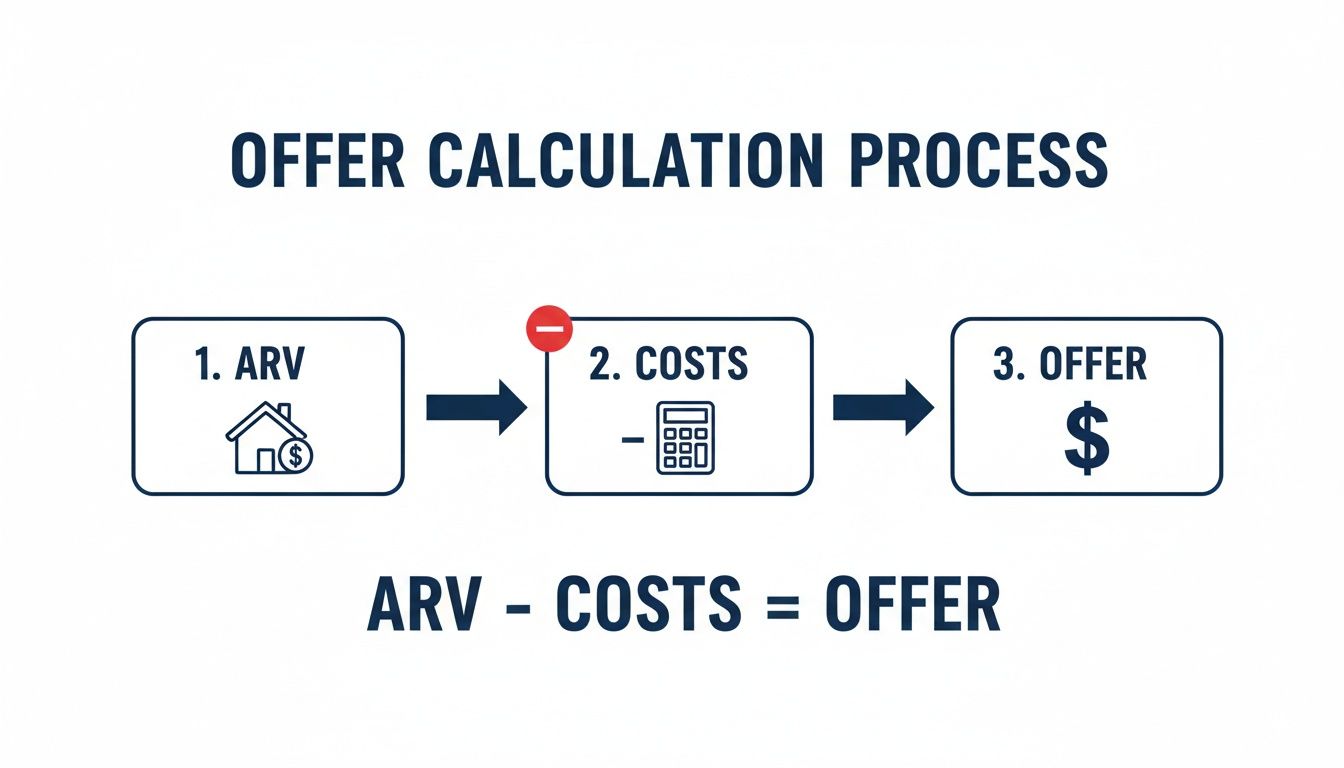
The final number results from a basic equation which starts with the home’s After Repair Value (ARV) and then subtracts all necessary expenses to achieve that value.
Navigating the Closing Process
Once you say “yes” to the final offer, you’re on the home stretch. You’ll sign a straightforward purchase agreement to get the ball rolling. One of the best parts about this process is the flexibility—you usually get to pick the closing date. Need to be out in seven days? No problem. Need a couple of months? That can often work, too.
The last step is the closing itself. The process requires a neutral third party such as a local title company or real estate attorney to oversee the transaction for proper documentation and secure fund transfer.
Let’s boil it down to the essential stages:
- Submit Your Info: You share basic details about your house online or over the phone.
- Get a Preliminary Offer: An initial, no-obligation offer arrives in about a day.
- Schedule a Quick Visit: The buyer pops by for a brief walkthrough to verify the property’s condition.
- Receive a Firm, Final Offer: You get a solid, take-it-or-leave-it cash offer.
- Pick Your Closing Date: If you accept, you set a closing timeline that works for you.
- Close & Get Paid: You sign the paperwork at a title company and walk away with your cash.
Homeowners tend to value the certainty of this process above all else. The top home buyers follow a transparent step-by-step process when working with both local flippers and big companies. The program provides an easy path to home selling which removes all the difficulties and uncertainties of traditional market selling.
How to Spot Scams and Find a Reputable Buyer

Most companies that buy houses for cash operate legitimately but the increasing number of such businesses has led to a few dishonest operators entering the market. Your best defense is knowing how to tell a trustworthy partner from a potential scammer before you get too far down the road.
The market has evolved beyond its status as a specialized segment. All-cash transactions have reached record levels because they now represent 26% of all real estate transactions during the past twelve months. The percentage of all-cash sales has jumped to 26% during the past year which represents a major increase from the pre-2010 average of under 10%. The large amount of money passing through this system demands that you keep your guard up. You can learn more about this market shift in NAR’s 2025 housing report.
Critical Red Flags to Watch For
A scammer uses urgent timelines and confusing information to make people rush into making poor purchasing decisions. The time has come to slow down if you notice any of these methods.
- Upfront Fees: This is the biggest red flag of all. A legitimate cash buyer will never ask you for money. Any request for payment related to “application fees” or “inspection fees” or other upfront costs should be considered fraudulent. The conversation should be ended.
- High-Pressure Tactics: Be wary of anyone pushing you to sign a contract on the spot. A professional buyer will respect your need for time to review their offer and consult with family or an attorney.
- Vague or Confusing Contracts: The purchase agreement should be straightforward. The presence of complicated legal terms together with missing essential information indicates that the party might have something to hide.
Hallmarks of a Trustworthy Cash Buyer
On the flip side, reputable companies operate with transparency. The company provides simple methods to verify their identity which helps users develop trust in them.
A trustworthy buyer’s goal is to provide a clear, fair solution. The company understands your challenging circumstances so they will help you make informed decisions through respectful guidance instead of pressuring you.
Look for these positive indicators:
- A Professional Online Presence: A credible company has a well-maintained website with clear contact information, real testimonials, and a detailed breakdown of their process.
- Strong Third-Party Reviews: Check the Better Business Bureau (BBB) ratings and read authentic Google reviews to see what other sellers have experienced. A consistent track record of positive feedback speaks volumes.
- Use of a Title Company: Reputable buyers always close through a neutral, third-party title company or real estate attorney. The process requires this step to protect both parties while ensuring legal compliance and secure financial transactions.
- Clear Communication: They should answer your questions directly and patiently. If you’re not sure what to ask, our guide on important questions to ask a cash home buyer is a great place to start.
Ultimately, finding the right partner comes down to doing your homework. A reliable company will always encourage you to do your research and feel completely comfortable before moving forward.
Common Questions About Selling Your House for Cash
Even after you get the hang of how cash sales work, it’s completely normal to have a few questions rattling around. Selling your home is a huge deal, and you absolutely need straight answers before you make a move. Let’s tackle some of the most common things homeowners ask when they’re thinking about selling to a cash buyer.
The goal here is to provide clear, practical information so you can feel confident in whatever decision you make.
Will I Really Pay Zero Fees or Commissions?
Yes, that’s one of the biggest draws. With a legitimate cash buyer, the number on the offer sheet is what you should walk away with. In a typical real estate deal, you’d see 5-6% of your sale price go straight to the agents. A direct sale to a cash buyer wipes that cost off the table entirely.
On top of that, most established cash buyers also pick up the tab for all the standard closing costs. This is a core part of their business model—making the process simple and transparent. Just be sure to double-check that this is spelled out clearly in your purchase agreement so there are no last-minute curveballs.
What if My House Is in Really Bad Shape?
This is exactly why cash buyers exist. They specialize in buying properties “as-is,” which means you don’t have to touch a thing. Forget about fixing that leaky roof, patching drywall, or even hauling away junk you don’t want anymore. They buy it, problems and all.
These companies have the experience to accurately estimate the cost of repairs and renovations, and they simply bake those numbers into their offer. They take on all the projects after they own the property, which saves you a ton of time, money, and headaches.
The whole point of an “as-is” sale is to take a property that feels like a huge burden and turn it into a simple, clean transaction. The buyer takes on the problems so you don’t have to.
How Fast Can I Realistically Close and Get My Money?
The speed is no joke. While every company is a little different, most cash sales can close in as little as 7 to 21 days from the moment you sign the contract. Compare that to the 45-60 days (or even longer) it takes for a traditional sale to navigate mortgage approvals and underwriting, and you can see the appeal.
Most buyers are also flexible. If you need a bit more time to pack or figure out your next move, you can usually negotiate a closing date that fits your schedule. You’re in the driver’s seat.
Am I Locked In if I Get a Cash Offer?
Not at all. Any reputable cash home buyer will give you a free offer with absolutely no strings attached. This is a non-negotiable part of a legitimate process. It allows you to see the real numbers and decide if the deal makes sense for you and your family without any pressure.
You should always feel free to get multiple offers, weigh your options, and make the best choice for your situation. A trustworthy buyer will respect your decision, whether you take their offer or walk away.
Every homeowner’s story is different. For some, the traditional market is the right path. For others, a faster, more certain solution is exactly what they need. If you’re facing a tight deadline, dealing with a difficult property, or just want to avoid the hassles of a typical sale, exploring a no-obligation cash offer is a great way to understand all your options.
If you decide this path is a potential fit, companies like Eagle Cash Buyers have built their process around being fair, fast, and reliable. You can get a free cash offer from Eagle Cash Buyers to find out if it’s the right choice for you.