



You experience a shocking discovery when you find out that someone has started living in your property without your authorization. To handle squatters effectively you need to begin by calling law enforcement for a trespassing report instead of treating it as a tenant matter. You should avoid direct confrontation with them and stay away from any lock modifications or utility disconnections because these actions might lead to legal difficulties for you. The police will direct you to follow the standard legal eviction procedure which requires you to serve a notice to quit and file an unlawful detainer lawsuit when they classify the situation as a civil matter.
The situation can get out of control fast but the first day of your response will decide how everything turns out. The way they handle the situation determines if it will reach a quick solution or transform into an extended legal battle that lasts for many months.
Your first gut reaction might be anger and a desire to storm in and confront them. Fight that urge. Your safety stands as the top priority which means you should avoid any type of face-to-face encounter.
Your Immediate First Steps When You Discover Squatters
The initial correct approach establishes the direction which will guide all future activities. The goal is to handle this as a criminal trespassing issue, not a civil tenancy problem.
Don’t try to be the hero. The practice of changing locks or water shutoff or property removal from tenants constitutes illegal self-help eviction which most states consider unlawful. The situation will escalate because you need to get rid of the squatter but the law will provide them with protection against your efforts to remove them from their unauthorized residence.
The Critical First Phone Call
You need to find a protected space away from your property before you should call law enforcement for immediate assistance. You must decide how to present this situation during your call and when you speak with the officers who respond to your call.
You should report an unknown person who has entered your property without authorization. Use phrases like “intruder” or “trespasser.” You need to show your proof of ownership which includes your deed and property tax statement through your phone display.
The key is to present this as a criminal trespassing matter from the outset. Officers must leave the situation when they identify it as a civil dispute between landlords and tenants because they need to follow the proper eviction process.
What to Say to Law Enforcement
You need to stay composed while delivering clear information when police officers arrive at the scene. You need to demonstrate your ownership of the home because it was scheduled for vacancy and you never authorized this individual to enter your property. The term “squatter” should stay away from your initial report because law enforcement might think the matter belongs to civil court which they cannot handle.
The following list contains essential points you need to focus on:
- Your Ownership: “I am the legal owner of this property.”
- No Permission: “This individual does not have my consent to be here. I’ve never had any agreement with them.”
- Your Safety: “I am concerned for the safety of my property and myself.”
The distinction between trespassing and squatting becomes difficult to determine. Our detailed FAQ on property issues provides answers to common questions which you can find by exploring the resource. You need to talk with police officers right away because this conversation represents your best chance to get the person removed immediately without having to go through court proceedings.
To keep it simple, here’s a quick guide on what to do and what to avoid in those first critical moments.
Immediate Do’s and Don’ts For Dealing With Squatters
| What You Should Do Immediately | What You Must Avoid Doing |
|---|---|
| Call the police from a safe location. | Do not confront the squatters directly. |
| Report an “intruder” or “trespasser.” | Do not change the locks or shut off utilities. |
| Have proof of ownership ready. | Avoid using the word “tenant” or “rent.” |
| Stay calm and cooperate with officers. | Do not physically remove them or their things. |
The following instructions will help you maintain your safety while protecting your legal rights from the beginning of the situation.
Distinguishing Between a Trespasser and a Squatter
All future legal actions which follow will depend on your ability to prove if the person who entered your property is a trespasser or a squatter who has taken residence there. The choice between these two terms goes beyond simple language because it determines if police will solve the case quickly or if it will become a lengthy civil eviction procedure which takes months to complete.
A trespasser is exactly what it sounds like: someone who enters your property without permission. The offense stands as a basic criminal offense which requires no further explanation. A squatter occupies your property without authorization but they create a false appearance of tenancy which grants them specific legal rights.
The Shift From Criminal to Civil
The criminal behavior of a trespasser develops into a complicated civil dispute through a process which turns their simple trespassing offense into an elaborate legal case. The process requires you to develop a fake tenant appearance which will prove your case. The legal system becomes your opponent because they use unclear laws to force you into court battles which create delays for you.
The following tactics represent the most common methods they use to establish their presence:
- Waving a Fake Lease: Even a poorly forged rental agreement can be enough to make police officers back off, telling you it’s now a civil matter.
- Getting Mail Delivered: Having letters, bills, or packages sent to your address in their name is a classic move to prove they live there.
- Connecting Utilities: If a squatter gets an electric or water bill in their name, they’ve created a powerful piece of “evidence” that they’re a resident, not an intruder.
The moment a squatter shows an officer any of this so-called “proof,” the police will likely wash their hands of it. The situation will be treated as a landlord-tenant conflict which they will direct you to resolve through the court system while the squatter remains inside your home.
The decision tree demonstrates the initial decision point which appears when you discover someone without authorization on your property.
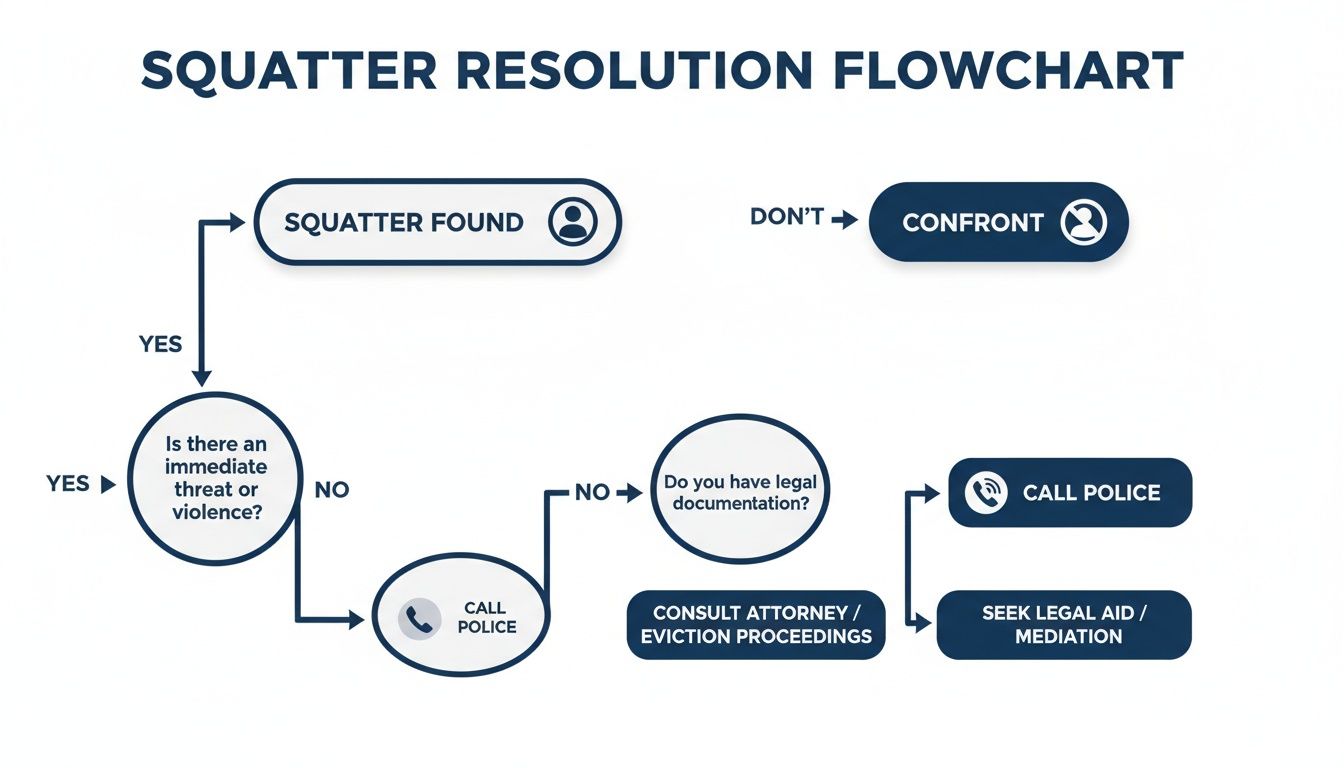
The path requires you to start by calling the authorities but you need to remember the most essential rule which states you should never try to handle the situation by yourself.
Real-World Scenarios and Legal Complexities
The situation has become so chaotic that it only requires a small amount of research to prove this fact. Property owners across the nation face mounting expenses when they try to recover their properties through various legal proceedings. A 2023 law review article estimated that ‘tens of thousands of homeowners’ have been ensnared by squatters using fake documents and legal loopholes.
The 2023 Texas case revealed a homeowner who lost access to their home because a squatter used a fake lease to lock them out while the individual had already been removed from three other properties because of similar fraudulent activities. These situations exist as more than isolated events because they represent an increasing trend.
Key Takeaway: The moment a person can produce any document connecting them to your address—even a fraudulent one—your problem likely shifts from a simple trespass call to a complex civil eviction case.
The process needs documented evidence to operate effectively. The rental agreement template provides future tenants with an unambiguous contract which prevents any confusion from occurring. You should understand the property transfer process when you inherit real estate to protect your legal rights.
The legal system operates at a slow pace which makes people feel frustrated. The original purpose of squatters’ rights was to put unused properties into use but today people manipulate these rights in ways that go beyond their intended use. The first essential step to defend your investment requires you to understand these different aspects.
Navigating the Formal Eviction Process
The situation transforms into a civil matter once the police establish that you need to take action. The law prevents you from using trespassing as a reason to have the squatter removed. You need to shift your focus now because you must begin the official eviction procedure which operates as a distinct legal system to recover your property.
I understand the strong urge to just replace the locks and cut off the utilities. The solution seems to be the fastest way to resolve the issue. But trust me, these “self-help” evictions are illegal and will backfire spectacularly. The situation will become more complicated because you need to handle legal actions which will result in expensive penalties that make your case weaker.

The process of removing a squatter who has obtained legal rights requires the same level of effort as removing a tenant who refuses to pay rent. You must follow every step of the law through a patient and organized method.
The First Step: Serving a Formal Notice
The first step of the eviction process requires you to serve a legal notice to the squatter. You need to write a formal document which serves as your initial step before you can begin the legal process of filing a lawsuit. The most common form is a Notice to Quit, which legally informs the person they have a certain number of days to vacate the property, as determined by your state’s laws.
You need to follow all required steps to deliver this notice. A simple tape attachment to the front door will not suffice as an appropriate solution. To make sure it’s legally valid, you’ll likely need to hire a professional process server or have the local sheriff’s department deliver it. This step is absolutely crucial—it creates the official paper trail you’ll need to present in court.
Filing the Unlawful Detainer Lawsuit
The squatter will stay in your property after the deadline has passed even though you issued the Notice to Quit? Your next move is to file an unlawful detainer lawsuit with the court. The legal process requires you to file a formal eviction lawsuit which will result in a judge issuing an order to remove the individual.
The process requires you to fill out specific court forms while paying a filing fee. Most property owners choose to hire an attorney at this stage. The paperwork system functions like a dangerous minefield because any small error in your documents will lead to a complete case dismissal which forces you to start the entire process from the beginning.
Crucial Tip: Meticulous documentation is your best friend in an eviction lawsuit. Every single piece of paper strengthens your case and proves to the judge that you are the rightful owner and the occupant has no legal right to be there.
Preparing Your Evidence for Court
The success of your court case depends on your ability to organize the evidence which you plan to present in court. You need to establish an unbreakable case which leaves no chance for any doubts to exist. You need to collect all available documents before your court date. The legal process to remove squatters follows the same steps which apply to tenants once they establish rights. The legal tenant eviction process guide serves as an excellent reference for understanding these procedures in depth.
Bring these items with you when you head to court:
- Proof of Ownership: Your property deed is best, but mortgage statements or recent property tax bills also work.
- Photographic Evidence: Dated photos and videos of your property, both before the squatter arrived and its condition now.
- Communication Records: Any copies of emails, texts, or letters you’ve exchanged, including a copy of the formal notice you served.
- Official Reports: The police report you filed when you first discovered the situation.
- Witness Statements: If you have neighbors or anyone else who can confirm when the unauthorized occupancy began.
It’s always better to show up with too much evidence than not enough. The judge will review everything you provide to make their ruling.
Securing the Writ of Possession
The court will award you victory when the judge decides in your benefit. The court will issue a writ of possession or a writ of restitution through their court order. This document represents the official document which you have been working to obtain. The document grants law enforcement officers including local sheriffs and marshals the power to remove squatters from your property through physical force.
The order requires you to follow it but you lack the authority to enforce its provisions. The final step is to take the writ to the sheriff’s department. They will set up an appointment to visit the property for legal squat removal which will result in home possession being returned to you. The process to retrieve your property follows a legal path which will take time and create frustration but it remains the only authorized method to regain your ownership.
Practical Alternatives to a Lengthy Eviction
The eviction process which follows official procedures represents a difficult and time-consuming process. You will face a lengthy process which will cost you money and time even when you have complete legal authority. You will need to endure multiple months of waiting while paying thousands of dollars in legal expenses because you will not know what condition your property will be when you receive it.
Most people who own homes want to retrieve their property without facing any legal battles.
You have several alternatives which let you avoid spending years in court for your case. The methods help you save time and money while avoiding major problems because they offer a direct approach to retrieve your property. These choices enable you to resolve your problems without court rulings although they represent the most effective solutions for practical decision-making.
Option 1: The “Cash for Keys” Negotiation
The most common and successful method to solve this problem involves creating a “cash for keys” agreement. The practice of paying squatters to leave your property might seem strange but it effectively resolves the situation. The process of contested eviction will cost you between $3,000 and $5,000 or more without including the expenses for lost rent and property repairs. The offer of $500 to $2,000 for a guaranteed fast exit seems like an excellent deal. The agreement provides you with a practical solution which enables you to obtain your property right away.
If you choose this approach you need to document every detail in writing. A complete “cash for keys” agreement needs to specify the exact date and time for move-out and the total payment amount and the property condition requirements (broom-swept with no new damage) and the recipient must sign a document which removes their right to claim the property.
Pro Tip: Never pay upfront. Structure the deal so you hand over the cash only after they have completely moved out and you’ve walked through the property. Meet them there with the keys in one hand and the cash in the other. This ensures they follow through.
Option 2: Selling Your House As-Is to a Cash Home Buyer
Sometimes, the squatter is just the tip of the iceberg. Maybe you inherited the property, it’s in rough shape, or you live out of state. The thought of managing an eviction, even a simple one, is just too overwhelming. In these situations, your most powerful move might be to sell the property as-is—squatter and all.
This is nearly impossible on the regular market, as typical homebuyers can’t get a mortgage for a house with an illegal occupant. However, professional home buyers specialize in these complicated situations. Companies that buy houses for cash are equipped to purchase your property with the squatter still inside, handling the entire eviction process themselves after the sale closes.
This path offers you a clean, immediate break from the entire problem.
- You Don’t Have to Evict Anyone: The buyer takes on the full legal and financial burden of removing the occupants.
- You Get Cash Fast: These sales often close in just a few weeks.
- No Repairs Necessary: They buy properties in any condition.
- A Guaranteed Exit: You get a fair cash offer and a firm closing date, avoiding the uncertainty of the court system.
Selling to a cash buyer like Eagle Cash Buyers lets you walk away from the stress and the financial drain for good. We can give you a fair cash offer for your property and take over the squatter situation ourselves after we close, allowing you to turn a major liability into cash and move on.
How to Prevent Squatters in a Vacant Property
After you’ve been through the wringer evicting an unauthorized occupant, the absolute last thing you want is a repeat performance. Honestly, the best way to handle squatters is to make sure they never see your property as an easy target to begin with. Being proactive is always cheaper and far less of a headache than dealing with the aftermath.
This really comes down to shifting your focus from reaction to prevention. A vacant property, especially one that looks forgotten, is basically a flashing neon sign for trouble. Your best defense is making your property look occupied and obviously secure.

Fortify Your Physical Security
Your first job is to make the property physically tough to get into. Opportunistic squatters are almost always looking for the path of least resistance, so you want to turn your home into a hard target.
Start with the obvious, but don’t skimp on quality. Make sure all your doors are solid-core, not hollow, and fit them with high-quality deadbolts. Think about reinforcing ground-floor windows with security film or adding new locks. And don’t forget the less obvious entry points—basement windows, pet doors, and that rickety garage side door are all vulnerabilities. A small investment in good hardware can deter the vast majority of would-be intruders.
A property that’s visibly secured with cameras, strong locks, and well-maintained entry points sends a clear message: this place is monitored, and trying to occupy it will bring immediate consequences.
Create the Illusion of Occupancy
A house that looks lived-in is a house most squatters will walk right past. You don’t need someone there 24/7; you just need to create a convincing illusion of activity that makes your property a poor choice for them. This is all about simple, low-cost “soft security” tactics.
Here are a few strategies I’ve seen work time and again:
- Use Light Timers: This is one of the easiest tricks in the book. Set lights in different rooms to switch on and off at various times in the evening. It instantly signals someone might be home.
- Manage Mail and Flyers: Nothing screams “empty house” like an overflowing mailbox or a pile of soggy flyers on the porch. Ask a trusted neighbor or friend to swing by and clear the doorstep regularly.
- Maintain the Landscaping: An overgrown lawn and untrimmed bushes are a dead giveaway. Keeping the yard looking neat suggests an attentive owner who is likely to notice any funny business right away.
These small, consistent actions create a powerful deterrent when used together. If you’re managing a distressed or inherited property and ongoing upkeep isn’t practical, remember that you can often sell a house as-is to avoid these headaches entirely.
Regular Visits Are Non-Negotiable
There is absolutely no substitute for putting your own eyes on your vacant property. If you live close by, make it a habit to drive past at different times of day and do a full walk-through at least once a week.
For out-of-state owners, this is critical: hire a property manager or pay a trusted local to perform these checks. It’s an investment in peace of mind.
These visits allow you to spot signs of forced entry, vandalism, or unauthorized occupation immediately. The faster you catch a problem, the better your chances of handling it as a simple trespassing issue before any complex tenancy rights can be established. This preventative mindset is more important than ever. UN-referenced estimates suggest roughly 10% of the world’s population lives in informal housing, underscoring the global scale of this issue. You can discover more insights about squatting statistics on lethub.co to get a clearer picture of why proactive security is so vital for property owners today.
Your Top Questions About Squatters Answered
When you discover someone is living in your property without permission, your head starts spinning with questions. It’s a stressful, confusing situation, and the legal system can feel like a maze. A wrong turn can cost you dearly in both time and money.
Let’s cut through the noise and get you clear, practical answers to the most pressing concerns homeowners have when facing a squatter.
Can I Just Turn Off the Utilities to Get Them to Leave?
This is usually the first thought that crosses a frustrated owner’s mind, but the answer is a hard no. It might seem like a simple solution, but it’s a move that can backfire spectacularly.
Once someone has occupied your property for a certain period, they often gain legal protections as a tenant-at-will, even without a lease. Shutting off essential services like water, electricity, or heat is seen by the courts as a “self-help” eviction, which is illegal. Taking this route can land you in legal hot water, facing fines and even a lawsuit from the squatter. The only legitimate path forward is the formal eviction process through the courts.
What’s the Real Cost of Legally Evicting a Squatter?
There’s no single price tag for an eviction, as costs can swing wildly depending on where you live and how hard the squatter decides to fight. But even a straightforward case will set you back hundreds of dollars.
Here’s a realistic look at where your money will go:
- Court Filing Fees: You have to pay the court just to start the unlawful detainer lawsuit.
- Process Server Costs: A professional has to be paid to legally serve the eviction notice. You can’t just do it yourself.
- Attorney Fees: This is the big one. If the squatter contests the eviction, your legal bills can quickly climb into the thousands.
- Sheriff’s Fees: After you get a judgment, you’ll pay a fee for a law enforcement officer to physically remove the person from your property.
A relatively simple, uncontested eviction might run you under $1,000. However, if it becomes a drawn-out battle, it’s not uncommon for the total cost to balloon to $5,000 to $10,000 or more.
The longer a squatter stays, the more you bleed money—not just in legal bills, but in lost rent, mounting property damage, and the sheer emotional toll. In these situations, time is your most expensive asset.
What Is a “Cash for Keys” Agreement?
Sometimes the fastest, cheapest way out is to pay the squatter to leave. A “cash for keys” agreement is exactly what it sounds like: you offer the occupant a sum of money, and in return, they agree to vacate the property by a set date, leaving it in reasonable condition.
It can feel deeply unfair to pay someone who has no right to be there, but think of it as a strategic business decision. You are essentially buying your property back without the time, cost, and uncertainty of a court battle.
If you go this route, get everything in writing. The agreement should clearly state the move-out date, the payment amount, and the condition that they leave the property undamaged. It’s a good idea to have an attorney draft a simple agreement to make sure you’re protected.
Can I Sell a House with a Squatter Still in It?
The traditional real estate market does not support this practice but you can definitely do it. The approval of mortgage loans requires typical homebuyers to get bank approval because no bank will approve a loan for a property which contains an unauthorized occupant. The situation has become an instant deal-breaker.
The sale of your property to a cash home-buying company represents an effective solution for this situation. These investors specialize in dealing with problem properties which include properties that have active squatter problems.
How This Works for You:
- You receive a cash offer for the house in its current “as-is” condition.
- The company buys the property with the squatter still inside.
- They take on the entire legal and financial burden of the eviction after you’ve been paid and have moved on.
The process allows you to avoid all eviction-related complications. The process enables you to receive fast cash while you avoid all eviction-related problems because professional teams will handle the complicated removal operation. You can achieve a complete separation from your distress situation when you use this method.
You have several options available to you if you want to avoid the lengthy court process and achieve complete ownership of the property. You can solve the problem fast by selling your home to a cash buyer. Eagle Cash Buyers operates as a cash buyer to purchase homes which include squatter-occupied properties. You can obtain a fair cash offer without any obligation and choose your closing date to move forward without facing eviction-related stress and costs. Find out how we can help you today.