



Selling your house “as is” means selling it in its current condition, without making any repairs or improvements for the buyer. The process requires you to set a price for your house based on its condition while disclosing all known defects and selecting a sales approach which matches your desired speed and profit and convenience levels.
What Selling a House As Is Really Means
The process of selling your house “as is” feels overwhelming yet it happens more frequently than people realize. The condition of the property that you show to buyers will remain unchanged throughout the entire transaction. Your actions show that you will not fix the leaking faucet or replace the carpet or fix the roof before the closing day.
For many homeowners, this is a huge relief. It completely removes the stress and financial weight of pre-sale renovations. You can start the sale process immediately by choosing this option instead of spending months on projects which cost thousands of dollars.
Why This Strategy Works So Well Today
The current housing market experiences extended durations for standard home sales. An “as is” sale cuts through the noise and provides a very practical solution. The program directly connects with two specific buyer groups who want to purchase homes with cash: investors and home buying companies.
These aren’t your typical homebuyers. In fact, cash buyers snapped up 28% of U.S. homes in 2023, according to Trading Economics. They’re actively searching for properties they can add value to, turning what you see as a problem into their next big opportunity.
Selling “as is” isn’t about giving your house away for a lowball price. The choice between repairs and fast closing represents a strategic trade-off because you exchange the effort and expense of repairs for a more rapid and guaranteed closing. Think of it as an efficient exit strategy when speed and convenience are your top priorities.
The path lets you take back control. You can avoid the never-ending negotiation process about repairs which typically blocks conventional home sales.
The benefits are clear:
- No Repair Costs: You avoid spending potentially thousands of dollars on renovations and fixes before you even list the property.
- Faster Closing Times: Cash transactions can often close in just a few weeks, a stark contrast to the 45-60 days it typically takes to close with a financed buyer.
- A Lot Less Stress: Forget the headache of finding and managing contractors, dealing with inspection reports, and haggling over buyer demands.
If you want a deeper dive, check out our guide on the benefits of selling a house as is. Understanding these advantages can help you decide if this is the right move for your situation.
Comparing Your Best As-Is Selling Options
Deciding to sell your house “as-is” isn’t the end of the decision-making process—it’s the beginning. The property selling process has multiple options now available to you which provide different timelines and risk factors and potential benefits. The only path to select the right option depends on your understanding of these routes which match your requirements for speed or profit or simplicity.
The flowchart shows you the main decision point between fixing the house or selling it in its current state.
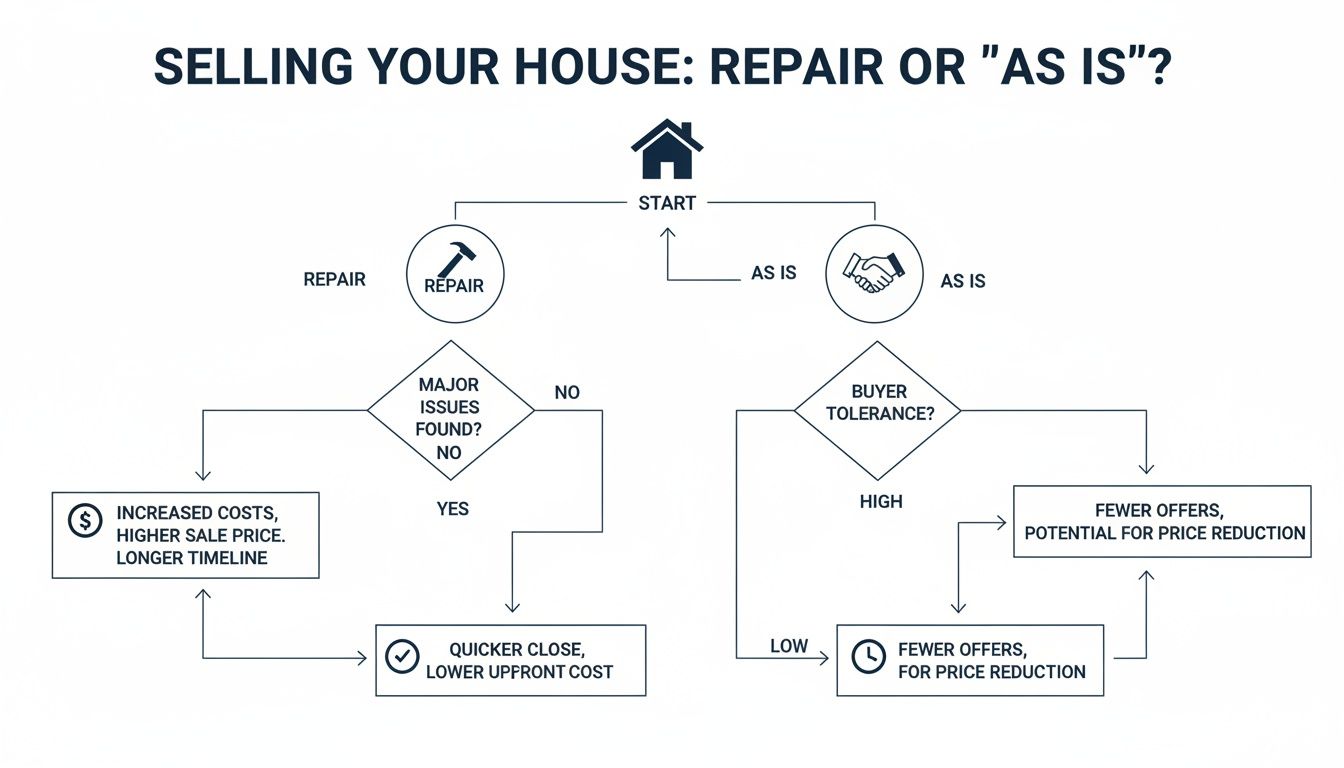
When you decide to sell without making repairs your options become limited to particular buyers who are willing to buy as-is.
Listing with a Real Estate Agent
A real estate agent can list an “as-is” home for sale on the open market. The trick is to partner with an agent who has a proven track record with these kinds of properties. The ideal candidate for this position understands how to price homes that need repairs while connecting with investors and renovators who want to buy such properties.
A good real estate agent will show all the defects that a property has. They will show the property truthfully through professional images and detailed descriptions which will draw in the appropriate audience. The strategy puts your home on the Multiple Listing Service (MLS) for maximum exposure to potential buyers. The only disadvantage is that you need to pay the standard agent commission which usually amounts to 5-6% of the final sale amount.
Just be prepared. The process of selling a house as-is requires you to show the property to buyers and allow them to conduct inspections. A financed offer has the potential to fall through when an underwriter decides the property condition presents an excessive risk to the bank.
Selling Directly to a Cash Home Buyer
For a truly no-fuss, fast-track sale, nothing really beats a direct sale to a cash home buyer. These buyers typically consist of local investors and specialized companies who purchase homes directly from sellers by using their own cash to eliminate the need for middlemen.
Going this route sidesteps all the usual headaches of a traditional sale. The process becomes more straightforward because you do not need to wait for bank mortgage approvals or deal with the risk of a buyer’s loan falling through at the last minute. The appraisal process creates no difficulties because experienced cash buyers can evaluate property values and repair expenses all by themselves.
This is a perfect fit if you’re:
- Facing a tight deadline from a job relocation, looming foreclosure, or other financial pressure.
- Dealing with a property that has seen better days and needs significant work.
- More interested in a guaranteed, stress-free closing than squeezing every last penny out of the sale.
Imagine you’ve inherited a house across the country that’s cluttered and needs updating. A cash buyer will present an offer and accept the property with all its current condition including clutter while you can complete the paperwork from your residence. It’s a problem-solver.
Trying the For Sale By Owner (FSBO) Route
Going FSBO means you’re the captain of the ship. You’ll be the one pricing the home, taking the photos, writing the marketing copy, scheduling every showing, negotiating with buyers, and wrangling all the legal paperwork. The amount of work is substantial.
The primary benefit is that you save money because you do not have to pay a seller’s agent commission. The entire process demands a big time investment and requires you to understand your local real estate market. The biggest pitfall for FSBO sellers is pricing. Price it too high, and your phone will never ring. Price it too low, and you’ve just given away your hard-earned equity.
A Word of Caution: FSBO sellers often find it tough to connect with the most likely buyers for an as-is home. Your marketing efforts will rely on two primary channels because you do not have an agent’s network or MLS access: a yard sign and a Zillow listing which might not attract dedicated investors who actively seek these deals.
Using an iBuyer Service
iBuyers, or “instant buyers,” are large, tech-first companies that use algorithms to generate a fast, all-cash offer on your home, often within 24 hours. The whole process is designed for maximum convenience, starting with a simple online form.
The service functions similarly to a cash home buyer but it has some important distinctions. The selection process of iBuyers includes rejecting properties which contain major foundation problems and roof defects and other major construction issues. The service charges fees which can reach or surpass the amount of a traditional real estate agent’s commission. The initial offer will almost certainly get reduced after they perform a comprehensive property evaluation.
Taking Your Home to Auction
The fixed timeline of a real estate auction allows you to sell your “as-is” property. The auction format creates a competitive buzz that can drive the price up as bidders compete. The auction sale becomes final when the winning bidder places their non-refundable deposit on auction day.
The sale date is fixed with a quick closing process that normally takes about 30 days. The downside? There’s no guarantee on the final price, and it’s possible you’ll sell for less than you’d hoped. The auction process requires you to factor in both the auctioneer’s commission and the marketing expenses which help attract potential buyers to the event.
Making Your Choice
The different options provide distinct combinations of speed and cost and required effort.
- An agent provides maximum market exposure.
- Cash buyers deliver speed and certainty.
- FSBO saves you the commission if you’re willing to do the work.
- iBuyers offer a convenient, tech-based process.
- Auctions create urgency and a definite sale date.
The process of selling your home quickly without complications requires you to explore this option further. Understanding when selling your house for cash is the best choice can bring a lot of clarity. Homeowners who want a quick simple sale should choose Eagle Quick For Cash because it provides the easiest way to sell without repairs or fees or commissions.
How to Price Your As Is Home Realistically
The process of pricing an “as is” home requires objective calculations instead of relying on intuition. Get it right, and you’ll attract serious offers almost immediately. The market will ignore your property if you set emotional value-based pricing because it creates an unsold situation that wastes your money.
To understand the property from a buyer’s perspective you must remove your homeowner perspective and view it as a potential buyer who only sees defects and their monetary value.

Your entire pricing strategy hinges on one crucial number: the After Repair Value (ARV). Your house would sell for this amount when it reaches its fully renovated state with complete move-in readiness.
Start with the After Repair Value
To determine your ARV you must study comparable sales known as “comps.” These are recently sold homes in your immediate area that are a lot like yours in size and style but have all the modern updates.
You’re looking for properties sold within the last three to six months that are a close match on:
- Square footage
- Number of bedrooms and bathrooms
- Lot size and general layout
- Age and architectural style
By seeing what these turnkey homes actually sold for, you establish a realistic, market-backed ceiling for your home’s potential value. Think of this number as your starting point, your anchor.
Subtract the Cost of Repairs
With a solid ARV in hand, the next step is to get brutally honest about what it would cost to bring your house up to that pristine level. This is where you have to be tough and objective. Make a detailed list of every single flaw, from the biggest to the smallest.
Put yourself in the shoes of a home inspector. Note the obvious stuff, like a 20-year-old roof or a kitchen straight out of the 90s, but don’t forget the hidden issues like old plumbing or questionable wiring. When you’re trying to price realistically, it’s crucial to factor in things buyers will find during an inspection; for example, understanding the potential cost of significant repairs like termite treatment can give you a better idea of how a buyer will discount their offer.
Once you have your list, add a 15-20% contingency buffer to the total estimate. Home renovation projects tend to reveal unexpected costs which usually exceed initial budget estimates according to my experience.
Subtract your total estimated repair costs (including that contingency buffer) from the ARV. The number you’re left with is a strong, data-driven starting point for your “as is” list price.
Consider Your Target Buyer
The final piece of this pricing puzzle is knowing your audience. Who are you selling to?The purchasing goals of different buyers lead them to establish various price limits.
-
Real Estate Investors: An investor is running a business, and they need to see a clear path to profit. They’ll likely use a formula such as the 70% Rule to determine their highest bid by calculating all repair expenses and holding costs before making a profit from the flip. To get inside their head, you can learn more about what the 70% Rule is in house flipping.
-
DIY Homeowners: A buyer who plans to live in the house and tackle the repairs themselves might be willing to pay a little more. They aren’t looking for a profit margin, but you can bet they’re still heavily discounting their offer to account for all the weekends and “sweat equity” they’ll be pouring into the place.
Setting a realistic price from day one is the single most important thing you can do for a successful “as is” sale. A cash home-buying company like Eagle Quick For Cash provides a fast cash offer without any obligation for those who want to establish a baseline price. The tool shows you a specific price which lets you evaluate different choices without feeling obligated or restricted.
Handling Disclosures and Legal Requirements
Many sellers believe that “as-is” provides them with complete protection against any potential defects in their property. That’s one of the biggest myths out there.
Selling “as-is” only means that the seller will not perform any repairs. It absolutely does not mean you can hide known issues. Honesty isn’t just good policy here; it’s a legal requirement that protects you from lawsuits down the road.
What Is a “Material Defect”?
You need to disclose all defects that you know about according to the law. Think things like an old roof leak you patched, some settling cracks in the foundation, or past water issues in the basement. The law requires you to disclose defects but it also helps you avoid expensive legal battles.
Will I Get a Lowball Offer?
The offer you make will match the costs of repairs that need to be done but this does not mean it qualifies as a “lowball” offer. You need to evaluate the entire situation to understand the present condition.
Think about what you’re saving: thousands on renovations, 5-6% in realtor commissions, and months of holding costs (mortgage, insurance, taxes). When you subtract all those expenses from a traditional sale, a cash offer often comes out surprisingly strong.
Your actual profit from the sale is what counts more than the final sale price. The cash offer seems lower at first glance but it proves to be more profitable because buyers avoid repair expenses and agent fees and get a quick deal which ultimately brings in more cash than a traditional sale with multiple fees.
Should I Even Bother Cleaning the Place?
You can definitely skip the deep clean and major staging, but a basic tidy-up goes a long way. The impact of the matter is extremely important.
Your main focus should be on removing garbage and personal items along with any significant clutter. A quick sweep or vacuum helps buyers see the actual space and structure—the “bones” of the house—without getting distracted by messes. A clean, accessible property almost always results in a better offer.
When Selling Your House ‘As-Is’ Just Makes Sense
Sometimes, selling a house “as-is” isn’t about laziness or cutting corners. It’s a smart, strategic move driven by life’s realities. It’s the perfect solution when time, money, or emotional energy are in short supply and you just need to move forward.
Let’s step away from the abstract and look at some real-world situations where an as-is sale is the clear winner. You might just see your own story reflected here.
The Inherited Property
You’ve inherited a house from a relative, but it’s three states away. On top of dealing with your grief, you’re now in charge of a property you barely know. It’s packed with a lifetime of belongings, the roof is questionable, and the kitchen is a time capsule from the 1980s.
Trying to manage a massive clean-out, hire contractors, and vet real estate agents from a distance is more than a headache—it’s a logistical nightmare. For most people in this situation, the priority isn’t squeezing every last dollar out of the sale. It’s about settling the estate without adding a mountain of stress. Selling as-is is the fastest way to honor your loved one’s legacy and move on.
The Sudden Relocation
Congratulations, you landed that dream job! The only catch? It starts in another city in three weeks. The clock is ticking, and you don’t have the bandwidth—or the spare cash—to prep your current home for a traditional market debut.
Your energy should be focused on the exciting stuff: packing your life, finding a new home, and getting ready for your new career. Juggling painters and staging a home for weekend open houses just isn’t in the cards. An as-is sale gives you a firm closing date, puts cash in your hand, and lets you make a clean start without your old house holding you back.
The Worn-Out Landlord
Being a landlord has its moments, but it can also grind you down. Maybe you’ve been dealing with a problem property for years—one with difficult tenants, deferred maintenance, and a growing list of expensive repairs from leaky faucets to beat-up floors.
You’re just… done. You’re tired of the late-night calls and the constant drain on your bank account. Instead of sinking thousands more into a property you’ve lost all passion for, an as-is sale lets you cut the cord. You can offload the asset quickly and finally wash your hands of the responsibility.
In these moments, selling a home as-is isn’t just a transaction. It’s a tool for getting your time, your sanity, and your life back. It’s less about the state of the house and more about the state of your circumstances.
The Financial Squeeze
When money gets tight, a house can feel less like a home and more like an anchor. A sudden job loss or a mountain of medical bills can put you on the brink of foreclosure, with mortgage payments piling up and stress levels going through the roof.
Here, every single day counts. The long, uncertain timeline of a traditional sale is a gamble you can’t afford to take. Selling your house as-is, especially to a cash buyer, is a lifeline. It provides a guaranteed sale on a quick timeline, allowing you to pay off your lender, protect your credit from the damage of foreclosure, and hopefully walk away with some money to make a fresh start.
If these stories hit close to home, a direct sale might be the most practical path for you. Companies like Eagle Quick For Cash are built to handle these exact situations. We offer a simple, transparent process with no repairs, no agent commissions, and no waiting around. You get a fair cash offer and the power to close on your schedule, turning a complicated property problem into a straightforward solution.
Common Mistakes to Avoid in an As Is Sale
Selling a house “as is” is a fantastic way to move quickly, but I’ve seen a few common missteps trip sellers up, costing them time and money. If you know what to look out for, you can steer clear of these pitfalls and have a much smoother sale.

The single biggest mistake? Letting emotion dictate the price. It’s completely understandable to be attached to your home and the memories in it. But an “as is” buyer, especially a professional investor, is looking at the deal purely from a numbers perspective. Overprice it out of the gate, and you’ll hear crickets. Serious buyers won’t even bother looking at a property that doesn’t pencil out.
Another huge error is trying to hide known problems. Look, “as is” means you don’t have to fix anything, but it doesn’t mean you can conceal a material defect you’re aware of. Failing to disclose a leaky roof or a cracked foundation can land you in legal hot water long after closing. Honesty is always the best policy—it builds trust and keeps the transaction clean.
The Small Things Still Matter
Even when you’re selling a property that needs work, don’t underestimate the power of a first impression. A little bit of effort can go a surprisingly long way.
You don’t need to start a renovation, but you should absolutely:
- Declutter everything: Get rid of junk, extra furniture, and personal belongings. An empty-feeling room looks bigger and helps a buyer see the potential, not your clutter.
- Do a quick clean: A simple sweep and wipe-down can make a world of difference. It shows you haven’t completely neglected the property and prevents buyers from being grossed out by surface-level grime.
- Tidy up the yard: Just mowing the lawn and trimming back some wild bushes can completely transform how the house looks from the street.
A lot of sellers think “as is” means you literally do nothing. But that’s a mistake. You’re not fixing the big stuff, but a weekend spent on basic cleanup helps buyers focus on the opportunity, not the mess. It can absolutely lead to better, faster offers.
At the end of the day, a successful “as is” sale is about being realistic with your pricing, upfront with your disclosures, and thoughtful about how you present the property.
If you’re not sure how to price your home, a great first step is to get a no-obligation cash offer. A company that specializes in “as is” properties, like Eagle Quick For Cash, can give you a concrete, data-backed number. It’s a solid baseline that helps you make a smart decision without any pressure.
Common Questions About Selling a House As-Is
Even after you’ve decided to sell your house as-is, a few questions tend to pop up. Let’s tackle some of the most common ones we hear from homeowners so you can move forward with confidence.
Do I Still Have to Disclose Problems?
Yes, you absolutely do. This is a big one. Selling “as-is” protects you from having to make any repairs, but it doesn’t give you a free pass to hide known issues.
You are legally required to disclose any known material defects. Think things like an old roof leak you patched, some settling cracks in the foundation, or past water issues in the basement. Being upfront isn’t just about following the law; it builds trust and prevents serious legal blowback down the road.
Will I Get a Lowball Offer?
It’s true that an as-is offer will reflect the cost of needed repairs, but that doesn’t mean it’s a “lowball” offer. You have to look at the whole picture.
Think about what you’re saving: thousands on renovations, 5-6% in realtor commissions, and months of holding costs (mortgage, insurance, taxes). When you subtract all those expenses from a traditional sale, a cash offer often comes out surprisingly strong.
It’s not the final sale price that matters most—it’s the net amount you actually put in your pocket. A cash offer might look a little lower on paper, but when you have zero repair costs, no commissions, and a guaranteed quick close, you can easily end up with more money than you would from a higher-priced traditional sale that gets whittled down by endless fees.
Should I Even Bother Cleaning the Place?
You can definitely skip the deep clean and major staging, but a basic tidy-up goes a long way. Seriously, it makes a huge difference.
Just focus on getting rid of trash, personal items, and any major clutter. A quick sweep or vacuum helps buyers see the actual space and structure—the “bones” of the house—without getting distracted by messes. A clean, accessible property almost always results in a better offer.
To get a better sense of what buyers are thinking, check out these common cash buyer questions and answers.
If you’re dealing with a complicated sale or just want a guaranteed closing without the usual headaches, Eagle Cash Buyers can give you a fair, no-obligation cash offer. We take care of everything, letting you close on your schedule and move on. See how easy we make it at https://www.eaglecashbuyers.com.