



To sell your house fast for cash, your primary options are selling to a national cash home buying company, an iBuyer, a local real estate investor, or finding a cash buyer yourself through a For Sale By Owner (FSBO) listing. Each option offers a different balance of speed, convenience, and sale price. The best choice depends on your home’s condition, your location, and how quickly you need to close.
Your Guide to a Fast Cash Home Sale
The traditional home selling process that takes several months does not represent the only way to sell a home. You might be facing a sudden job relocation, dealing with an inherited property, or just want to skip the endless showings and financing hurdles. The good news? You have more control over the selling process than ever before, and several paths lead to a quick, cash-based sale.
The different choices you have for selling your house quickly with cash.
Which goal stands out as the most crucial one for you? Do you need the property to close as soon as possible or can you wait for a better offer? The common paths to achieve a quick cash sale include the following. Each player has their own distinct strategy to succeed in the game.
Here’s a quick look at how the main options stack up against each other.
| Method | Typical Timeline | Potential Sale Price | Common Fees | Best For |
|---|---|---|---|---|
| Cash Home Buyer | 7–21 days | 65%-85% of market value | None; often covers closing costs | Sellers who need ultimate speed and want to sell “as-is” without any repairs. |
| iBuyer | 14–30 days | 90%-95% of market value | Service fees (5%-6%) + repair costs | Sellers with homes in good condition located in major metro areas. |
| Local Investor | 7–30 days | Varies widely (60%-90%) | Varies; can be flexible | Sellers who prefer a local, hands-on transaction, but requires more vetting. |
| FSBO (for Cash) | 30–60+ days | Potentially highest, but not guaranteed | Marketing, legal, and potential buyer’s agent commission (2%-3%) | Experienced sellers who are comfortable managing the entire process themselves. |
Ultimately, the best choice depends on what you value most. A company that buys houses directly, for instance, offers one of the simplest, most direct processes with no agent commissions or closing costs.
The Big Trade-Off: When you sell your house for cash, you’re usually trading a percentage of your home’s full market value for huge benefits in speed, certainty, and convenience. You get to skip repairs, avoid commissions, and close on your own timeline.
Learning about house sales through cash transactions helps you decide if this particular approach matches your needs. The guide will analyze all available options to help you make an informed decision.
The different choices available to you when you need to sell something quickly for cash.
The decision to sell your home for cash brings you to the next step of finding a buyer. The world of quick, all-cash sales has really opened up, which is great news for homeowners like you. It means you have options.
But with more choices comes the need to understand who these buyers are and how they work. It’s not about finding a one-size-fits-all “best” option; it’s about finding the right fit for your unique situation, your property’s condition, and your timeline.
The main players can be divided into the following groups.
National Cash Home Buyers: The As-Is Specialists
The phrase “we buy houses for cash” usually leads people to think of this particular approach. These professional real estate investment companies follow a simple business model which involves purchasing homes in all conditions with their own capital to complete fast transactions. We’re often talking a matter of weeks, not months.
This route is tailor-made for anyone who values speed and certainty above squeezing every last penny out of a sale.
- Who they are: Established companies, often with a presence across the country, that have the capital ready to buy homes directly.
- What they buy: Just about anything. Homes that are seriously outdated, properties with foundation issues, houses with tax liens—you name it. Condition isn’t a barrier.
- The process: It’s simple. You give them your property details, they’ll usually give you a ballpark offer quickly, and then they’ll do a quick walkthrough. Afterward, you get a firm, no-obligation cash offer. If you say yes, you close at a local title company on a date that works for you.
Real-World Scenario: Let’s say you inherited your aunt’s house across the country. The place hasn’t been touched in 30 years and has a roof that’s seen better days. The thought of managing repairs, hiring contractors, and dealing with realtors from a distance is a total nightmare. A national cash buyer can assess it as-is, make a fair offer, and let you handle the whole thing remotely. No flights, no contractors, no stress.
iBuyers: The Tech-Driven Alternative
Then you have iBuyers, or “instant buyers.” These are the big, tech-forward companies that use complex algorithms to value and buy homes. They offer a modern, streamlined process, but there’s a catch: they’re pretty selective.
An iBuyer is a fantastic option if your home is in good shape, doesn’t need much work, and is located in one of the major metro areas they serve.
Key Difference: While both offer a fast sale, national cash buyers are built for “as-is” properties in any condition. iBuyers, on the other hand, want homes that are nearly market-ready and will usually charge you a service fee for the convenience.
Local Real Estate Investors: The Neighborhood Experts
The “boots on the ground” are local buyers and small businesses which purchase properties within their community. They want to buy homes that need renovation for resale or to use as rental properties. The big advantage here can be flexibility and a more personal touch than you’d get from a large corporation.
The downside? Their experience and professionalism can be all over the map. You absolutely have to do your homework. Look for a solid track record of closed deals and positive reviews from other sellers in your area.
Real-World Scenario: Imagine you’re a landlord with a rental property and a tenant who has stopped paying rent. The eviction process is dragging on, and it’s draining your bank account. A local investor who knows the rental market in your town might be willing to buy the property with the tenant still in it. They take on the problem, and you get a quick, clean break.
For Sale By Owner (FSBO) to a Cash Buyer
Going the For Sale By Owner (FSBO) route means you’re in the driver’s seat for the entire sale. You market the property, you find a cash buyer, and you handle all the negotiations and paperwork yourself. This path gives you total control and saves you from paying agent commissions, but don’t underestimate the work involved.
This is best for sellers who have some real estate savvy, maybe even a network of potential buyers, and are comfortable navigating the legal side of a transaction. Exploring when it’s best to sell a house for cash can help you decide if you have the time and expertise for a hands-on approach like this.
The market itself has adapted to this demand for speed. All-cash deals now make up a huge chunk of home sales—recently accounting for 32.8% of all sales, a number that’s way above what we saw before the pandemic. This isn’t just a blip; it’s a real shift. In some states, that number is closer to 50%. For a homeowner in a pinch, this means there are more legitimate cash buyers out there than ever before. You can dive into the full research on these all-cash sale trends on realtor.com.
By understanding all your choices, you can confidently pick the one that truly works for you. Companies like Eagle Cash Buyers fall into that national cash home buyer category and provide a reliable, straightforward path for people who need a guaranteed as-is sale without the typical fees, repairs, or delays.
From a Cash Offer to Closing Day: What to Expect
So, you’ve decided selling your house for cash might be the right move. What does that actually look like day-to-day? It’s a world away from the traditional, nail-biting process of listing with an agent. You get to skip the endless showings, the appraisal anxieties, and the constant threat of a buyer’s financing falling through.
A cash sale is clean. It’s a direct, streamlined transaction between you and a buyer who has the funds ready to go. Let’s break down exactly how you get from that first handshake to cash in your bank account.
This chart gives you a quick visual of the main routes you can take.
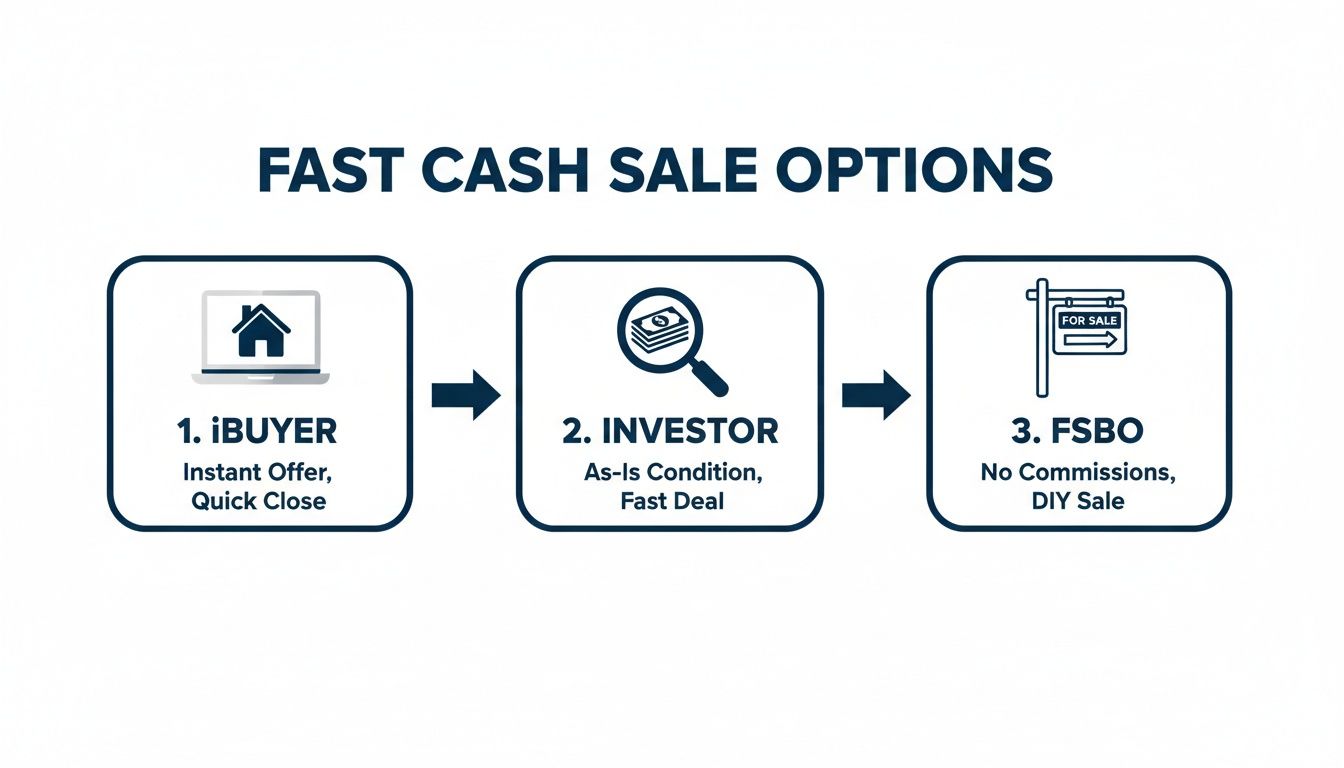
The three options of selling your home include iBuyer services and local investor sales and FSBO (For Sale By Owner) cash buyer searches. Each option delivers different benefits when it comes to speed of sale and convenience and final sale price. Your decision should focus on the most essential requirements for your specific situation.
The Property Walkthrough
A cash buyer needs to perform a fast walkthrough instead of getting a bank-ordered formal appraisal. Don’t stress about this—it’s not a white-glove inspection. They’re not there to critique your paint colors or dusty shelves.
This is a practical assessment. An experienced buyer can walk through a property in under an hour and get a solid idea of its condition. The inspection focuses on major components including the roof’s age and the HVAC system and electrical panel and any foundation problems that are visible. The evaluation enables them to determine the required repair expenses which will make the property market-ready for their final purchase price.
A little preparation work will help you even when you plan to sell your home without making any changes. For some great tips, check out this guide on decluttering your house for sale. The brief walkthrough becomes more impressive when the space appears larger.
Rounding Up Your Paperwork
To keep things moving smoothly, it helps to have a few key documents ready. A professional cash buyer won’t bury you in paperwork, but having this handful of items on deck proves you’re ready to sell and helps the title company do their job faster.
Gather these if you can:
- Your Property Deed: The official document proving you’re the owner.
- A Recent Mortgage Statement: If you still owe on the house, this shows the exact payoff amount.
- Your Latest Property Tax Bill: This confirms the tax status is current.
- HOA Info (if you have one): The buyer will need to see the community bylaws and confirm any dues are paid up.
Think of it as having your house’s “title” ready, just like you would for a car. It just speeds everything up.
Understanding the Cash Offer
Once the walkthrough is done, you’ll get a firm, no-obligation cash offer. A good buyer won’t just throw a number at you; they’ll often explain how they got there. Their offer is typically based on the home’s potential market value after repairs (the “ARV”), with deductions for the cost of those repairs, holding costs, and their business profit.
But the most important number isn’t the offer price—it’s the net amount you walk away with.
A true cash offer is an all-in number. Reputable cash buyers will often cover all the typical closing costs. That means no agent commissions and no surprise fees get subtracted from your check. What you’re offered is what you get.
That’s a huge difference from a traditional sale. A higher list price can get chipped away by a 6% agent commission, 2-4% in closing costs you have to cover, and repair credits for the buyer. A cash offer is simply a clear, guaranteed number.
Closing the Deal: The Final Steps
You’ve accepted the offer. Now what? The final stage is handled by a neutral third party, almost always a local title company or real estate attorney. Their job is to make sure the sale is 100% legal and that ownership is transferred cleanly.
Here’s the closing process in a nutshell:
- The Title Search: The title company first confirms that you have a “clear title”—meaning you’re the rightful owner and there are no outstanding liens or claims against the property.
- Preparing the Documents: Next, they’ll draw up all the legal paperwork, like the new deed and a settlement statement that breaks down every dollar in the transaction.
- Signing Day: You’ll sign the final documents. This usually happens at the title company’s office, but many buyers will send a mobile notary right to your home for convenience.
- Getting Paid: The buyer wires the funds to the title company. The title company then pays off your mortgage (if you have one) and wires the rest of the money directly to you or gives you a check. It’s that simple.
The whole system operates with the goal of achieving rapid performance. If you want to see a detailed step-by-step from a professional home buyer’s perspective, check out how the process works with Eagle Cash Buyers.
The typical mortgage-backed home sale takes between 45 and 60 days to close but cash sales can finish within 7 to 14 days. The combination of fast results and certainty appeals to many homeowners who need to sell their properties.
Navigating Common Reasons for a Quick Sale
The decision to sell a house fast for cash rarely comes out of the blue. A major life event that demands both speed and certainty usually triggers the need for quick decision-making.
Every situation is different, carrying its own unique weight of emotional and financial stress. But understanding how a direct cash sale can cut through the noise provides a clear path forward when you feel stuck.
These scenarios are more common than you might think. We see predictable patterns where sellers need to resolve urgent issues like stopping a foreclosure, settling an inherited estate, or finally getting rid of a problem rental. The main driver is almost always the need for a guaranteed, fast closing. A cash deal can wrap up in weeks, not the typical 45–60+ days that mortgage-backed sales require. You can see more on these seller motivations from NAR’s market research.
Avoiding Foreclosure
Homeowners face their most distressing situation when they begin the process of foreclosure. The countdown creates a sense of panic because you face two simultaneous threats: losing your home and damaging your credit score. A quick cash sale can be your lifeline.
The bank auction date will pass before your direct sale to a cash buyer gets completed. The funds enable you to pay off your mortgage and lender debt and in many cases you will receive the remaining equity as cash. The process allows you to regain control while ending things on your terms instead of following the bank’s timeline.
Managing an Inherited Property
Inheriting a house can feel like both a gift and a curse, especially if you live far away. Suddenly you’re on the hook for a property that might be full of old belongings, need a mountain of repairs, and come with its own property tax and insurance bills.
Selling an inherited home as-is for cash cuts through all that complexity. You don’t have to clean it out, manage contractors from another state, or try to get multiple heirs to agree on a path forward. Of course, you’ll still need to handle the legal side. For example, you may need to consult resources on Ontario wills and estate law to understand the requirements. A cash sale turns a complicated asset into simple, divisible funds.
A Practical Takeaway: When you’re dealing with probate or an inherited home, a cash offer gets rid of the arguments among heirs about repair costs or listing prices. It provides one clean number that makes settling the estate much, much easier.
Navigating a Divorce
The process of asset division during divorce creates emotional and legal difficulties for the parties involved. The family home stands as the most valuable asset which frequently turns into the main source of disputes.
Selling the house quickly for cash offers a clean, neutral solution. The process lets you bypass the lengthy steps of listing and showing and negotiating which become unbearable when you are already dealing with a separation. A quick sale allows you to split the proceeds and help both of you move on independently, without being chained to a shared property for months.
Quick Relocation or Offloading a Rental
Sometimes life just moves faster than the real estate market. A fantastic job offer in a new city or an urgent family matter doesn’t give you time for a traditional sale. On the other hand, being a landlord to a vacant or difficult rental property can become a serious financial black hole.
The certainty of a cash sale becomes a game-changing factor in these particular situations.
- For Relocation: You can lock in an offer, pick a closing date that fits your moving schedule, and avoid the stress of paying for two places at once.
- For Landlords: Selling a tough rental as-is means you can wash your hands of the problem. No more evictions, no more late-night repair calls, and no more hunting for new tenants. You just sell it and walk away.
Each of these scenarios demands a solution that puts speed, simplicity, and certainty first. While a traditional sale works for many, it often falls short when time is of the essence. Selling to a cash-buying company is one of several options designed for these exact moments. A company like Eagle Cash Buyers provides a guaranteed closing, allowing you to resolve your situation quickly and move on with your life.
What to Expect from a Reputable Cash Buyer

When you start looking into selling your house for cash, you’re entering a world with all sorts of players. The single most important thing you can do is learn how to spot a trustworthy, professional buyer. This is the key to a smooth, fair process.
A reputable cash buyer isn’t just trying to make a deal; they’re a problem-solver who values transparency. The good news is that the legitimate companies operate on a clear and predictable model. They get that you’re probably in a stressful spot and their goal is to offer a simple solution, not add more pressure.
Hallmarks of a Trustworthy Buyer
A true professional will always put you in the driver’s seat. They’ll present a clear offer and then give you the space and information you need to decide if it works for you—no obligation, no pushy sales tactics.
Here are the non-negotiable traits you should be looking for:
- Total Transparency: They should be able to walk you through exactly how they came up with their offer price. This typically involves the home’s After Repair Value (ARV), estimated repair costs, holding expenses, and their own profit margin. There shouldn’t be any mystery behind their math.
- No Upfront Fees: This is a big one. A legitimate buyer will never ask you for an application fee, an inspection charge, or any other kind of payment upfront. They only make money after they successfully purchase, repair, and resell the property.
- Proof of Funds: A serious buyer won’t hesitate to show you proof that they actually have the cash to close the deal. This is your assurance that they can follow through on their promise.
- Professional Closing Process: They will always insist on using a licensed and insured third-party title company or a real estate attorney to handle the closing. This protects both of you and ensures the entire transaction is above board and legally sound.
This level of professionalism is what separates the experts from the amateurs. The certainty of a sale is the main reason why sellers choose this option. The chances of a deal falling through become extremely low. Since they use their own capital, you don’t have to worry about the last-minute financing issues that often kill traditional sales. Most can close in just 7 to 21 days.
To learn more about how these firms operate, you can explore the details of house-buying companies on Bankrate.com.
Red Flags to Watch Out For
Knowing what to look for is only half the battle; you also need to know what to run from. If you encounter any of these warning signs, it’s time to pump the brakes and reconsider.
- High-Pressure Tactics: Be very skeptical of anyone who pushes you to sign a contract on the spot. Phrases like, “this offer is only good for the next 24 hours,” are usually just a tactic to create a false sense of urgency.
- Vague or Verbal-Only Offers: A professional offer always comes in the form of a clear, written contract that spells out every term of the sale. If it’s not in writing, it’s not a real offer.
- Refusal to Use a Title Company: Insisting on closing a deal without a proper title company or attorney is a massive red flag. This can open you up to serious fraud and legal headaches down the road.
- The Bait-and-Switch: Some shady operators might give you a great-sounding initial offer, only to slash it after their “inspection,” blaming surprise repair costs. While minor adjustments can happen, a huge, poorly explained price drop is a sign of bad faith.
Key Takeaway: A reputable buyer provides a clear, no-pressure solution. They operate with full transparency, cover all closing costs, and let you choose the closing date. Their goal is to make the process as simple and stress-free as possible.
Finding the Right Partner for Your Situation
Working with a company that buys houses directly is one of several fantastic options. It’s a path that puts speed, convenience, and certainty ahead of getting the absolute highest price you might see on the open market.
The service fits perfectly for homeowners who want to sell their property quickly without dealing with repairs or additional costs. A professional cash buying company will provide you with a fair offer and they will manage the entire process so you can close on your schedule. For instance, a company like Eagle Cash Buyers has built a straightforward process designed for exactly these situations.
Knowing what to ask is critical. You can get a head start by checking out our guide on important questions to ask a cash home buyer. By understanding what a great buyer looks like—and what red flags to avoid—you can confidently find a partner to help you move forward.
Got Questions About Selling Your House for Cash? Let’s Unpack Them.
The process appears simple but people frequently experience ongoing doubts. The decision to sell your house quickly for cash requires complete certainty before you proceed.
Let’s tackle some of the most common things homeowners ask.
Will I Get a Fair Price from a Cash Buyer?
This is usually the first thing on everyone’s mind. The honest truth? A cash offer will likely be less than the retail price you might get on the open market after months of waiting. But that top-line number doesn’t tell the whole story.
A cash offer is built around speed, certainty, and convenience. The buyer is shouldering all the risk—they’re the ones who will pay for repairs, cover holding costs, and deal with the market’s unpredictability. Think of their offer as your net number. You won’t be paying for:
- Agent Commissions: That’s a savings of 5-6% right off the top.
- Closing Costs: Reputable cash buyers typically cover these, saving you another 2-4%.
- Repair Costs: You’re not spending a dime on fixing that leaky faucet or outdated kitchen.
- Holding Costs: No more mortgage, tax, and insurance payments while you wait for a buyer.
When you add it all up, the difference between a cash offer and what you actually walk away with from a traditional sale gets a lot smaller. It’s a trade-off: a slightly lower price for a guaranteed, lightning-fast, and stress-free closing.
The Bottom Line: A “fair” price isn’t just about the highest number. It’s about a price that solves your immediate problem, puts a guaranteed amount of cash in your pocket, and lets you move on with your life.
Do I Really Need a Real Estate Agent?
Nope. When you sell directly to a cash home buyer, there’s no need to hire an agent. This is one of the biggest perks of the whole process.
Cutting out the middleman means no commissions, simpler communication, and a much faster timeline. You’re dealing directly with the person buying your house. A reputable cash buyer will manage all the paperwork and work with a professional title company, so your sale is just as legal and secure as any traditional closing.
What Does Selling ‘As-Is’ Actually Mean?
It means exactly what it sounds like. You sell the house in the exact condition it’s in right now. No repairs, no cleaning, no improvements whatsoever.
- Got a leaky roof or a kitchen from the 70s? Not your problem.
- Don’t feel like shampooing the carpets or painting over scuff marks? You don’t have to.
- You can even leave old furniture or junk behind for the buyer to handle.
The buyer takes on the property with all its imperfections. It’s a massive relief for homeowners who don’t have the cash, time, or energy for a big renovation project. The buyer simply factors the cost of repairs into their offer, and you get to walk away free and clear. For more in-depth answers, check out this comprehensive cash home buyer FAQ section that covers even more common questions.
Making the call to sell your house for cash is a significant decision, but it’s an incredibly powerful solution when life throws you a curveball. By understanding all your options and partnering with a transparent buyer, you can move through the process with confidence. If you determine that the speed and convenience of a direct sale are right for you, a company like Eagle Cash Buyers can provide a clear, no-obligation path. We give you a fair cash offer and handle every last detail so you can finally move forward. If a simple, guaranteed closing sounds like what you need, get your free cash offer from Eagle Cash Buyers today.