You get the inspection report back, and the roof section is a full page of problems. Curling shingles, flashing damage, maybe an active leak in the corner of the master bedroom. Now you are staring at a decision that can swing your net proceeds by thousands of dollars, depending on which direction you go, and everyone from your agent to your brother-in-law has an opinion about it.
Here is the short version: selling a house with a bad roof is possible. A bad roof does not make a house unsellable. You have three realistic paths. You can repair or replace the roof and list at full market value. You can keep the roof as-is and offer the buyer a credit or a lower price. Or you can sell the house in its current condition to a cash buyer who prices the roof into the offer upfront. The right choice depends on what kind of damage you have, whether you can afford repairs, how fast you need to close, and what else the house needs.
This guide walks through each option, how financing affects your buyer pool, and a step-by-step decision framework so you can work out the right move for your own situation. We also share a short story from our files, because selling an outdated house with deferred maintenance is something we see regularly.
This article is general information, not legal, financial or tax advice. Costs and rules vary by market and by state, so get local quotes and talk to a local professional before you decide.
What Counts as a “Bad Roof” (and Why It Matters for Your Sale)
A “bad roof” can mean anything from old shingles that still keep water out to an active leak rotting the deck beneath. The distinction matters. Cosmetic aging, functional damage and structural failure each call for a different selling strategy, and guessing wrong on the category is how sellers end up spending money they did not need to spend.
Cosmetic Aging vs. Functional Damage vs. Structural Failure
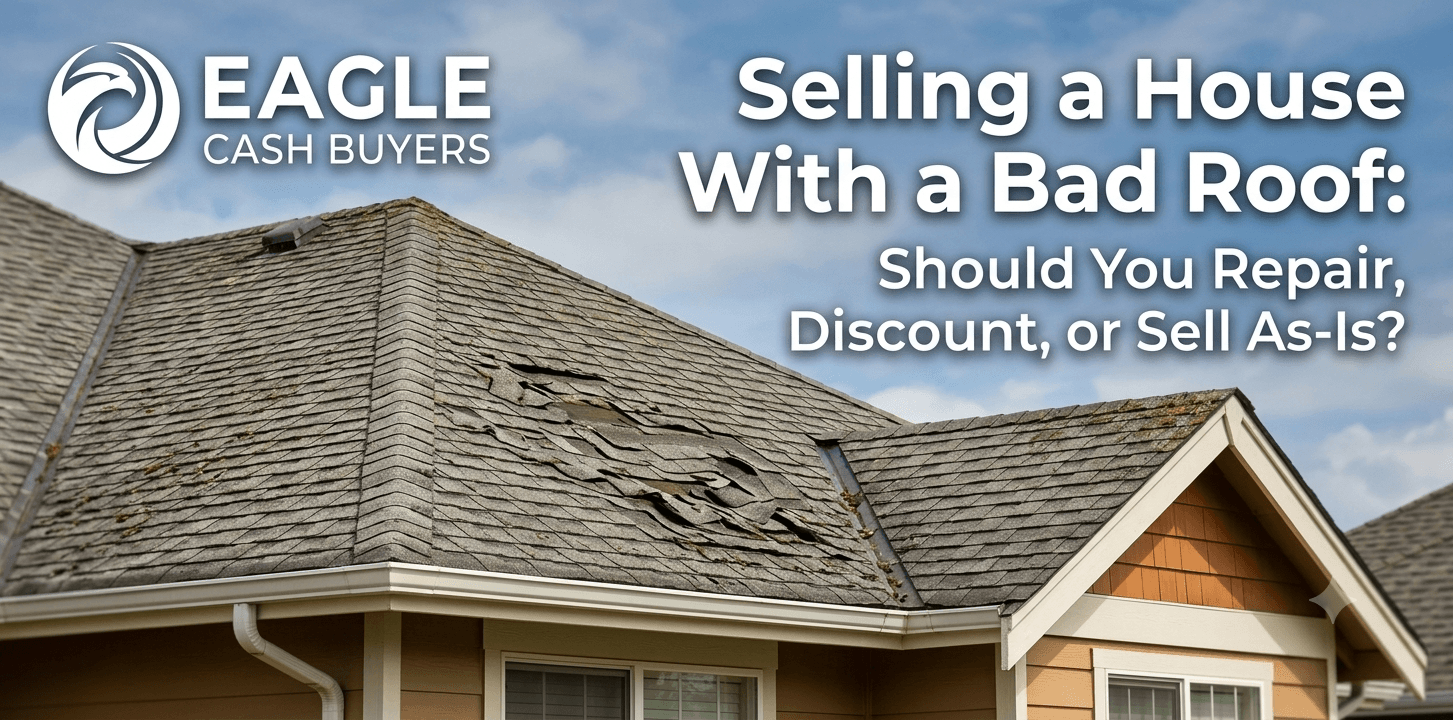
**Cosmetic aging** is the most common category. You see missing or curling shingles, granules in the gutters, faded or discolored sections, moss or algae. The roof is old and looks it. It is still keeping water out. The impact on your sale is usually minor to moderate. In many cases you can sell traditionally with full disclosure and a small credit, or make targeted repairs. Often both.
**Functional damage** means the roof is failing at its job. Think water stains on ceilings or walls, damaged flashing around vents and chimneys, ice dam evidence in cold climates, or daylight visible through the attic. The impact is significant. Do not ignore it. A lender’s appraiser may require repairs before a financed buyer can close.
**Structural failure** is the most serious. A sagging roof deck, rotted trusses or rafters, widespread mold from long-term moisture or collapsed sections. This is more than a failing roof. It is a safety issue, and buyers and lenders treat it that way. Most financed buyers are out of the picture, and fixing it means major structural work plus a new roof. That is a big project.
Knowing the type of damage points you toward a strategy, which is the whole reason to diagnose it before you pick a path. Cosmetic aging often allows a traditional sale, sometimes with nothing more than honest disclosure and a modest concession. Functional damage may need targeted repairs to keep financed buyers in play. Structural failure often points toward an as-is sale to a cash buyer or investor. Often, not always.
| Damage Type | Common Signs | Effect on Financing | Usual Path |
|---|---|---|---|
| Cosmetic aging | Curling or missing shingles, granule loss, moss | Lower risk if there are no leaks | Sell traditionally with disclosure |
| Functional damage | Active leaks, water stains, damaged flashing | Moderate to high risk; appraiser may require repairs | Repair, offer a credit, or sell as-is |
| Structural failure | Sagging deck, rotted trusses, mold | Very high risk; most financed buyers drop out | Often an as-is sale to a cash buyer or investor |
How Much Does a Bad Roof Reduce Your Home’s Value?
It depends on how bad the roof is, how your local market is behaving and who the buyer is. Cosmetic wear may cost you little. Structural damage can cost you a lot. We are not going to hand you a percentage. Any single figure would be a guess. You can get a real number from a roofer’s quote and a few local comparable sales, and that number will be worth more than any national average.
The drop is rarely just the repair cost. Buyers price in uncertainty, inconvenience and risk. A repair that a roofer would quote at one number can trigger a bigger reduction in offers. Buyers and their agents tend to assume the worst, price that in, and then add a hassle premium on top for the trouble of managing the work.
Appraisers can compound the effect. If the appraiser notes roof deficiencies, the report may come in lower, or the lender may require repairs before the loan funds, which limits what a financed buyer can borrow and means that even a buyer who truly wants your house may not be able to pay what it would be worth with the roof resolved, no matter how well the showing went.
Market conditions matter too. A lot. When inventory is low, buyers may accept roof issues with a credit rather than lose the house. When listings sit, a roof problem can add months to your time on the market. And every month the house sits, you pay the mortgage, taxes, insurance and utilities.
The Real Math: Comparing Net Proceeds Across the Three Paths
The best way to evaluate your options is to compare what you would actually keep under each path, using your own numbers. Fill in the same lines for every path:
| Line item | Repair, then list | List with a credit or lower price | Sell as-is to a cash buyer |
|---|---|---|---|
| Sale price | Your estimate with a sound roof | Your estimate, reduced for the roof | The offer you receive (below market, since the buyer takes on the repair) |
| Cost of the roof work | Your contractor’s quote, paid before closing | The credit you agree to | None |
| Agent commission | Usually applies | Usually applies | None on a direct sale |
| Your closing costs | Usually applies | Usually applies | Eagle pays them, except your mortgage payoff, back taxes or liens and your share of transfer tax |
| Carrying costs while you wait | Mortgage, taxes, insurance, utilities during repairs and listing | Same, during listing and the buyer’s loan process | Limited to the days until closing |
| Risk of the deal falling through | Lower after repair | Moderate to high if the appraisal flags the roof | Low; no lender appraisal |
The gap between paths is often narrower than sellers expect. Count the carrying costs, the risk of a deal falling through and the commission you avoid on a direct sale, and a cash offer can look very different than it did at first glance. A listing can net more than a cash offer when you have both the time and the money to put the roof right, wait through the listing period and the buyer’s loan process, and absorb the risk that an inspection or an appraisal sends the whole sale back to the start after you have already paid the roofer, paid the carrying costs and told your family a closing date. A cash offer is below what a repaired house might sell for on the open market. That is the trade. You give up some price and get speed and certainty. To see how a cash buyer builds an offer, read our breakdown of how cash buyers calculate offers.
What a New Roof Costs and What Comes Back
Roof replacement is one of the bigger single repairs on a house, and it usually returns only part of its cost at resale, which is why the decision deserves a real comparison of your options and not a gut reaction to a scary number on a contractor’s estimate. Industry cost-versus-value reports tend to show that partial recovery, though the exact figures shift each year and by region. The indirect benefits can still close the gap: keeping financed buyers in the deal, avoiding credits and selling faster.
Prices vary a lot. Skip national averages and get local bids. These are the factors that move a quote:
- **Roof size and pitch.** Steeper and more complex roofs cost more to work on, because crews need more safety equipment, move more slowly and often have to carry materials by hand to places a truck cannot reach.
- **Material.** Asphalt shingles, metal, tile and wood all price differently and last for different periods.
- **Layers to remove.** Extra layers add labor and disposal.
- **Local labor rates and season.** Spring and summer are peak roofing season, so waits can stretch into prime selling time.
- **Hidden damage.** Rotted decking or framing found after the old roof comes off can raise the bill.
Repair vs. Full Replacement
Not every roof problem needs a full tear-off. A patch, a few replaced shingles or new flashing may solve a localized leak. Larger problems, such as several damaged sections, wet decking or an aging roof with widespread wear, may make replacement the better value. Ask each roofer to price both a repair and a replacement, ask how long the repair is expected to last, and then compare the two side by side on the same page before you commit to either one.
The Hidden Costs Most Guides Skip
The quote on the new roof is not the whole picture. These costs catch sellers off guard:
- **Carrying costs during the project.** A replacement can take weeks from the first bid to the final inspection. If the house is listed or sitting empty, you pay the mortgage, taxes, insurance and utilities the whole time.
- **Solar panels.** If your home has panels, they usually need to come off before re-roofing and go back on afterward, which adds cost and scheduling.
- **Permits and inspection fees.** Many municipalities require a permit for roof replacement, and some require an inspection before the work counts as finished, which can add days or weeks to your schedule if the office is backed up.
- **Interior damage.** If the roof leak damaged ceilings, walls or insulation, those repairs are separate from the roofing bid. They add up.
- **Mold.** Long-term moisture can lead to mold. Remediation may need a professional, and it may trigger additional disclosure.
- **Contractor availability.** Peak-season waits can push your timeline past your target listing date.
FHA, VA and Conventional Loans: How Roof Condition Affects Your Buyer Pool
If your roof has visible damage, active leaks or little useful life left, buyers using FHA, VA or USDA loans may be unable to close until repairs are done. That shrinks the buyer pool, especially for starter homes and in areas where government-backed loans are common.
What Each Loan Type Looks For
| Loan Type | General Roof Standard | What Usually Causes Trouble | If the Roof Fails |
|---|---|---|---|
| FHA | The roof should keep moisture out and have reasonable remaining life (see HUD Handbook 4000.1) | Active leaks, holes, a roof near the end of its life | The lender can require repairs before closing |
| VA | The home must meet VA minimum property requirements, which cover safety and sound condition | Active or unrepaired leaks, structural problems | The appraiser can require repairs as a condition of the loan |
| USDA | Similar minimum standards for safe, sound housing | Moisture entry, structural concerns | Repairs may be required before funding |
| Conventional | The appraiser notes the condition and the lender decides case by case | Severe damage, safety or habitability issues | The lender may require repairs, change the loan amount or allow a price adjustment |
Standards and lender practices differ, and appraisers use judgment, so treat this table as general. Ask the buyer’s lender what it requires.
First-time buyers, who often use FHA loans, may not have cash left for a roof replacement after closing, since most of their savings went into the down payment and closing costs, and a lender that wants the work finished first will not wait for them to rebuild a cushion. They cannot simply plan to fix it later, because the loan may not fund until the work is done. Veterans using VA loans face the same kind of requirement. Same story. Conventional lenders vary. Some are flexible. Some let an appraisal issue slide when the price already reflects the condition, and others condition the loan on repairs.
The practical takeaway: if a roof fails a government-backed appraisal, your buyer pool narrows to cash buyers, conventional buyers who can handle the issue and investors. At that point you are selling as-is whether you meant to or not.
The Three Paths: Repair, Discount or Sell As-Is
Each path has a real cost and a real tradeoff. None is free. Repairing widens your buyer pool but takes money and time upfront. A credit or discount keeps more buyers in the game and shifts the cost to closing. Selling as-is to a cash buyer is the fastest route with the least hassle, but it brings a lower price than a repaired house might get on the open market.
Path 1: Repair or Replace the Roof Before Listing
**Best for:** cosmetic aging or moderate functional damage, when you have the cash or a home equity line available. It also works in competitive markets where move-in-ready condition drives bidding, since several buyers competing for a house with a sound roof can lift the price enough to help offset the cost.
**The math:** You spend money on the roof, and you typically recover only part of it in the sale price. But the price is not the whole picture. You may avoid a buyer credit, keep FHA and VA buyers eligible and sell faster. The net result is often better than the resale-value figure alone suggests.
**The risks:** Delays happen. Contractor delays can push you past your target listing date. Hidden damage to the decking or trusses can raise the cost once the old roof comes off. And there is always the risk of over-improving for the neighborhood. A premium roof on a starter home is unlikely to pay back.
**Timeline:** It depends on season, weather, contractor availability and permits. Build in a generous cushion, because roofing schedules slip more often than they hold.
**Practical tip:** Get three bids, and ask each contractor to break out materials, labor, permits and disposal so you can compare like with like. If the new roof carries a transferable manufacturer’s warranty, say so in the listing.
Path 2: Offer a Buyer Credit or Price Discount
**Best for:** functional damage where the appraisal outcome is uncertain, sellers who cannot fund repairs upfront, and markets where buyers expect room to negotiate.
**How it works:** You either lower the list price to reflect the roof, or you offer a closing credit, which is money back to the buyer at closing to fund repairs themselves. Credits are often preferred because they keep the recorded sale price higher, which can matter for appraisals and neighborhood comparable sales.
**Credit limits:** Caps exist. Loan programs cap how much a seller can contribute toward a buyer’s costs, and the caps differ by loan type. Ask the buyer’s lender before you promise a number.
**The catch that surprises many sellers:** A buyer credit does not fix an appraisal problem. If an FHA appraiser requires the roof to be repaired as a condition of the loan, a credit alone will not satisfy the requirement. The repair has to happen before closing. Credits help with negotiation. They do not override lender requirements. Full stop.
**What buyers ask for:** Buyers may ask for more than the repair estimate. They want to cover their own inconvenience and the chance that the project costs more than expected, and that is a normal part of the negotiation.
Path 3: Sell As-Is to a Cash Buyer or Investor
**Best for:** structural failure, sellers who cannot fund repairs, sellers who need to close quickly, inherited homes with years of deferred maintenance, and homes where several systems, not just the roof, need work and the total bill would be hard to justify.
**How it works:** Simple. You sell the house in its current condition. No repairs. No credits. No back-and-forth over inspection items. The buyer factors the roof into the offer from the start, so there is nothing to renegotiate after an inspection turns up what you already told them.
**The math:** A cash offer on a house with a bad roof is lower than what the same house might fetch repaired and listed, because the buyer takes on the repair cost, the hidden-damage risk, the holding costs and the work of reselling the house to somebody else. In return, you avoid agent commission on a direct sale, you avoid a long repair-and-listing period with its carrying costs, and you avoid losing a deal when a buyer’s lender rejects the appraisal. Eagle pays closing costs, except your mortgage payoff, back taxes or liens and your share of transfer tax.
**Timeline:** Cash sales can close in as little as 21 to 42 days, or longer if you need more time. You pick the date. A traditional route has more steps: the repair, finding a financed buyer, then waiting for that buyer’s loan to close, each with its own chance of slipping.
**When this makes more sense than you would expect:** When the roof is not the only problem. If the house also needs heating, plumbing, electrical or foundation work, the total repair bill can grow quickly. At that point, selling as-is may net more than the repair-and-list path once all costs are counted. For a side-by-side look, see our cash offer vs. listing cost comparison.
Wondering whether a cash buyer is the right fit? It helps to know what is legitimate and what is a red flag.
A Decision Framework: Which Path Fits Your Situation?
Four things decide it: the type of roof damage, whether you can afford upfront repairs, how quickly you need to sell and whether the house has other major issues. Work through these steps.
**Step 1: Diagnose the roof.** Get a professional roof inspection. Ask for a written report that classifies the damage as cosmetic, functional or structural, and keep it, because you may be able to share it with buyers later. If the inspector says cosmetic only, you can likely sell traditionally with disclosure, a minor repair or a small credit. If the report says functional or structural, move to Step 2.
**Step 2: Get bids.** Collect at least three bids for repair and three for full replacement, and compare them. If a repair costs close to a full replacement, the replacement or an as-is sale usually makes more sense.
**Step 3: Check your financing.** Can you pay for the repair out of pocket or with a home equity line? If so, the repair path is viable. If not, think credit, discount or as-is.
**Step 4: Check your timeline.** Can you wait for repairs, a listing period and a buyer’s loan process? If so, the repair or credit path works. If you need to close quickly because of a job move, financial pressure or another deadline, an as-is cash sale may be the only path that fits. If financial pressure includes missed payments, read about how to sell before foreclosure.
**Step 5: Check for compounding issues.** Is the roof the only major problem? Be honest. If yes, and you can afford it, repair is probably worth the investment. If heating, plumbing, foundation or electrical also need work, the total bill may exceed what the repairs add to the price.
**Step 6: Run the net-proceeds comparison.** Use the table in the “Real Math” section above with your own numbers for each path. The highest net to you wins. If the numbers are close, weigh your timeline, your stress tolerance and the risk of a deal falling through.
The Insurance Angle: When Your Roof Damage May Be Covered
If a covered event caused the damage, such as hail, wind, a fallen tree or fire, your homeowner’s insurance may pay for part or all of the replacement. Filing a claim before you sell can change the repair-versus-sell math in a big way.
**What is typically covered:** Sudden damage from wind, hail, fallen trees or debris, fire, lightning or the weight of ice and snow. Policies differ, so read yours.
**What is typically not covered:** Normal wear and aging. Gradual deterioration. Deferred maintenance. If your roof is simply worn out, insurance generally will not pay for a replacement.
**The claim process, briefly:** Document the damage with photos and video. File the claim promptly. The insurer sends an adjuster, assesses the covered damage and pays, minus your deductible. Some policies pay replacement cost and others pay actual cash value, which factors in depreciation.
**A timing consideration:** A roof claim can affect your premiums or future insurability. Some sellers file, get the roof replaced and sell with a new roof. Others file and assign the claim proceeds to the buyer at closing, though the rules on that vary by state and insurer.
**Important caveat:** Some insurers limit or exclude coverage for older roofs. Review your policy or call your agent before you assume you are covered. Do it early.
**Disclosure note:** If you have filed a roof claim, you may need to disclose it to buyers. Check your state’s requirements or ask an attorney.
Disclosure Requirements: What You Must Tell Buyers About Your Roof
In most states, sellers must disclose known material defects, and roof problems are on that list. Selling “as-is” does not generally remove the duty to disclose what you know, and a seller who stays quiet about a leak that a neighbor, a prior inspector or a repair invoice could later reveal is taking a bigger risk than a seller who writes it all down. If you know the roof leaks, has damage or has been patched, you usually have to say so, and hiding a known defect can lead to a lawsuit after closing.
Most states require sellers to complete a property disclosure form. Roof condition is commonly asked about. The form often covers current leaks, past leaks, repairs, the roof’s approximate age and related insurance claims.
“As-is” is among the most misunderstood terms in residential real estate. It generally means you are selling in the property’s current condition without agreeing to make repairs. It does not mean you can conceal problems you know about, and in many states courts have held that “as-is” language does not shield a seller from a fraud claim.
State laws vary a great deal. Some states, including Texas and California, have detailed disclosure forms with specific roof questions, while others have more limited frameworks. When in doubt, disclose, and confirm your state’s rules with a local real estate attorney. For more on the title side of a sale, see how cash buyers handle title insurance.
Real Seller Story: A 1954 Roof and a Fallen Tree
Across 42 seller transactions Eagle Cash Buyers documented in 2026, 4 involved properties in severe condition, such as fire damage, gutted interiors or extensive deferred maintenance. Many more had maintenance issues that were not severe but still shaped how the sale worked, from an aging roof to a furnace near the end of its life to a list of small repairs that had been put off for years until the owner no longer had the time or the money to finish them. (These are sellers who contacted a cash buyer, not a representative sample of all home sellers.)
One case from our files shows how roof problems play out in real life. A seller in Virginia inherited his father’s home. A tree had come down on the roof a couple of years earlier, and his father started the repair but died before he could finish. As the seller put it, his father “started fixing it before he died, and then he just didn’t get around to finishing it.”
The roof was far from the only issue. The property was a small three-bedroom, one-bath home of roughly 800 square feet, with a roof that dated to the 1950s. Beyond the unfinished roof repair, there were broken windows, a back porch that needed replacing and a kitchen that had never been updated. The bathroom had been renovated, and the furnace had been replaced about a year and a half earlier. The panel had been updated around 2002. It was a long list of deferred projects, some started and some never touched.
Asked about the roof’s current state, the seller said it was “currently not leaking” and there were “no water issues.” That is a useful detail for sellers in a similar spot: a roof can be old, partly repaired and still not leaking. The question is whether it passes the standard for the buyer’s loan type and how much risk that buyer is willing to take on, and a cash buyer can weigh that very differently than a lender can.
The family had already started winding the house down, with the utilities shut off and family members staying there to clean it out, one room and one load at a time, the way these things usually go when nobody lives nearby and everybody has a job. There was no mortgage and no liens. A clean file. What the seller had was an inherited house full of someone else’s unfinished projects, and no wish to become a renovation project manager.
Eagle’s transaction coordinator laid out the process in one call: verify the property details by phone, send a field agent to photograph and assess the home, bring in general contractors to evaluate and quote the repairs (“We’ll send a couple of our GCs so they can assess the property, tell us the repairs that the property needs, give us the quotes”), then move to the title company and set a closing date once title comes back.
(This account is from an Eagle seller file. The record ends before closing, so it does not show whether the sale closed.)
Every roof is different. But the process for getting a cash offer on a house with roof problems is the same as for any other as-is sale. You describe the property, a buyer evaluates it, and you get an offer that accounts for the condition so you do not have to fix anything yourself.
What Happens If the Roof Fails Inspection During a Sale
If a buyer’s inspection reveals roof problems in a traditional sale, the buyer typically has a few options: ask you to repair it, request a credit or price reduction, or walk away. What happens next depends on your contract, the buyer’s loan type and how serious the damage is.
**The inspection report arrives.** The buyer’s inspector flags the roof and shares the report with the buyer and their agent. This is where negotiation begins. It is often the most stressful part of a sale, especially for sellers who thought the roof was good enough and now face a page of findings from a stranger.
**If the buyer is using FHA or VA financing,** the appraiser, who is separate from the home inspector, may also flag the roof. If the appraiser requires repairs as a condition of the loan, a credit will not satisfy the requirement. The repair must be completed and re-inspected before the loan can fund, which means your timeline now depends on a roofer’s schedule and a second visit from the appraiser. Many sellers get caught off guard here. Do not be one of them.
**Typical negotiation outcomes include:**
- The seller agrees to repair before closing, which can delay closing while the work is finished and re-inspected
- The seller offers a credit at closing
- The seller and buyer split the cost
- The buyer walks away under their inspection contingency
- The seller refuses everything, and the deal may collapse
**The domino effect.** When a deal falls through over roof issues, the home goes back on the market, often with a few weeks of lost momentum, a note in the listing history that buyers can see, and a seller who is now more tired, more rushed and less able to bargain than before. Buyers and agents notice when a listing returns, and a second attempt can draw lower offers. Each month adds carrying costs. It compounds.
**How to get ahead of it:** Get your own pre-listing roof inspection. Knowing the issues before buyers find them lets you price accurately, prepare credits or make repairs on your own schedule. A seller who hands over a recent inspection report looks transparent and prepared, and that impression can calm a negotiation before it starts.
Frequently Asked Questions
Can you sell a house that needs a new roof?
Yes. Homes with bad roofs sell regularly, in every kind of market. Your options are repairing the roof before listing, offering a buyer credit or price reduction, or selling as-is to a cash buyer or investor. The right approach depends on the type of damage, your budget and how quickly you need to close. A bad roof narrows your buyer pool. It does not make a home unsellable.
How much does a bad roof lower home value?
It depends on severity, your market and the buyer. Cosmetic aging may have a small effect. Active leaks and structural damage can have a much larger one. Buyers also tend to add an uncertainty premium beyond the repair cost, so the discount they ask for is often larger than the fix itself. A local roofer’s quote plus recent comparable sales will give you a real number.
Should I replace my roof before selling my house?
It depends on the damage and your finances. If you can afford the work and your timeline allows it, a new roof can keep financed buyers eligible and reduce the credits they ask for. If you cannot afford it or need to sell quickly, a credit or an as-is sale may produce comparable net results once you account for commissions, carrying costs and time.
Does a new roof increase home value?
Usually, but not dollar for dollar. Cost-versus-value reports have generally shown that roof replacement recoups only part of its cost at resale. The indirect benefits, such as a faster sale, fewer negotiations and a wider pool of eligible buyers, can make the effective return higher than the figure alone suggests.
What happens if the roof fails an FHA appraisal?
The lender typically requires the roof to be repaired before the loan can proceed. A buyer credit will not satisfy this requirement, because the repair has to be completed and re-inspected. If the seller will not make the repair, the FHA buyer usually cannot close. Consult a real estate attorney about your obligations.
Can I sell my house as-is with a bad roof?
Yes. “As-is” generally means you are selling in the current condition without agreeing to make repairs. Your buyer pool narrows mostly to cash buyers, investors and conventional buyers who can handle the issue. You still have disclosure obligations in most states. As-is does not mean you can hide known problems.
Will a cash buyer purchase a house with a bad roof?
In many cases, yes. Whether Eagle can make an offer depends on the property, the title and our buying criteria. Cash buyers regularly purchase homes that need significant work, including roof replacement, and they price the repair into the offer. There is no lender appraisal to fail and no FHA or VA roof requirement to satisfy. The offer reflects the condition, but you avoid the cost, time and risk of repairing and listing.
Is it better to repair the roof or offer a buyer credit?
Repairing gives you more control and may bring a higher sale price. A credit keeps the deal moving without upfront cost, but it may not satisfy FHA or VA appraisal requirements, and buyers may ask for more than the repair would cost. If the roof issue is cosmetic or minor, a credit can be simpler. If it could block financing, the repair is usually the safer path to closing, and a conversation with the buyer’s lender early on can save you from an expensive surprise in the final week.