



A Certificate of Compliance (CoC) is an official document which local government authorities at city and county levels issue to prove that properties fulfill every required building code and zoning rule and safety standard. The document functions as an official certification which proves that a home together with its renovation work meets all safety requirements and legal standards and proper construction methods. The document serves as a vital document for home sales because it demonstrates that the property fulfills all relevant requirements.
Ever heard of a Certificate of Compliance (CoC)? Although it seems like technical jargon the document stands as one of the most essential papers which property owners need to possess. A CoC serves as an official document which your local city or county government issues to prove your property fulfills all required building codes and zoning regulations and safety standards.
The government uses this official stamp to verify that your home complies with safety requirements and legal standards and is ready for residential use. This piece of paper becomes absolutely critical when it’s time to sell.
A Homeowner’s Guide to Compliance Certificates
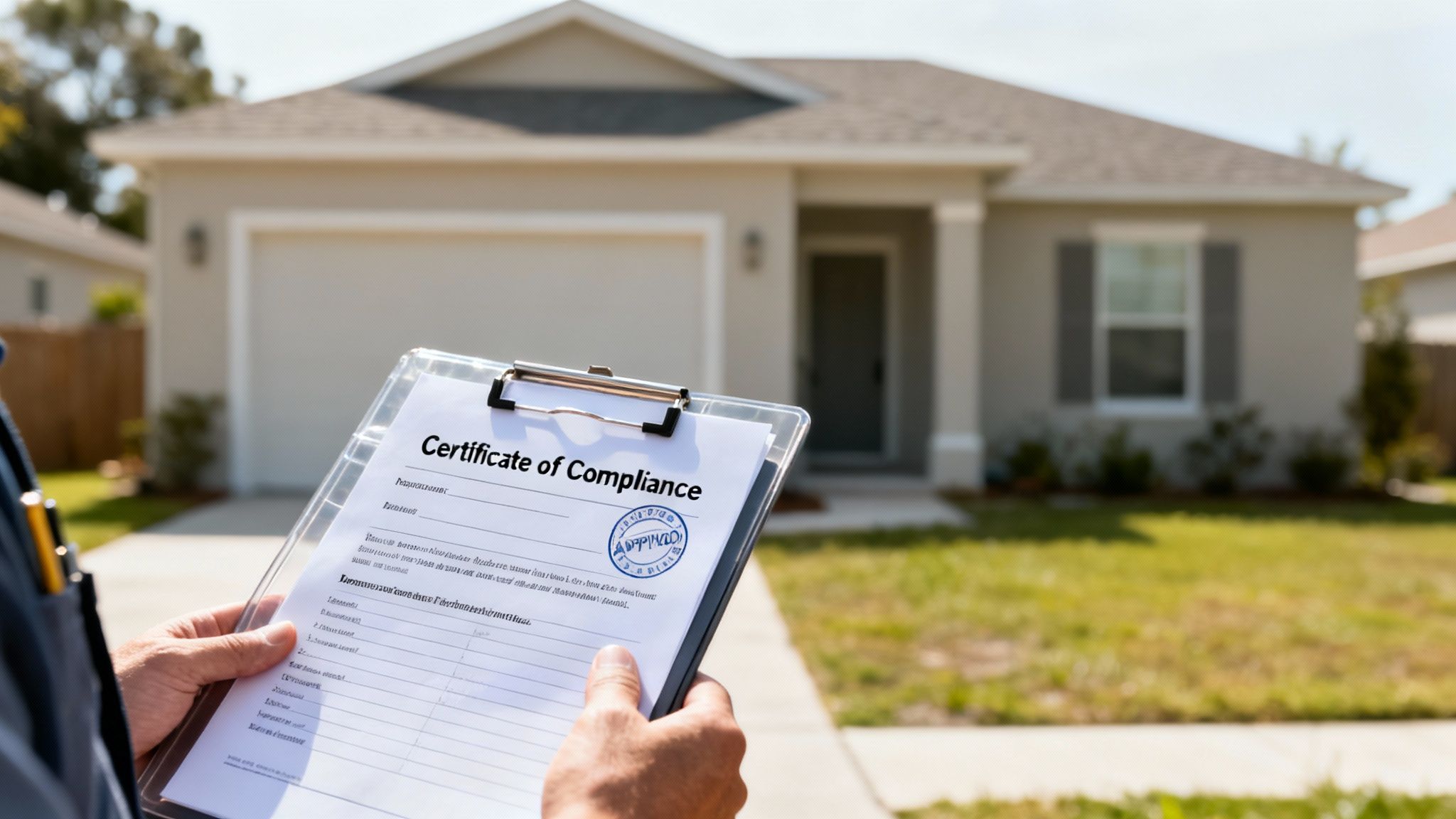
The best way to understand a Certificate of Compliance is to think of it as your home’s official report card. A house requires a Certificate of Compliance (CoC) to show that its construction meets safety standards just like a car needs an inspection sticker to prove it can be driven on the road. The document serves as the last verification which shows all construction work and major repairs and renovations meet local building codes and standards.
A single document exists to determine whether a real estate transaction will either succeed or fail. The document functions as the essential proof which shows your property meets all legal requirements while maintaining complete safety and building code compliance.
Why This Document Matters
So, why all the fuss? Your home sale process will face major difficulties because you do not have a valid CoC to prove your ownership. Most mortgage lenders, for instance, won’t even consider financing a property that isn’t compliant. The search for prospective buyers becomes limited to only a few investors who must purchase properties with cash payments.
The certificate delivers complete assurance to all parties involved. The document shows buyers that the home stands on a solid foundation and contains no hidden dangers which creates strong buyer trust.
The first step toward a successful property sale requires understanding what a CoC represents and why it exists. The tool enables you to discover potential problems which might show up during the closing process while protecting you from last-minute issues that could cause delays or complete deal failures.
A Certificate of Compliance functions as more than bureaucratic paperwork because it serves as the basic proof which shows your property maintains its safety standards and maintains its value and follows all legal requirements. The document serves to defend sellers from future legal claims while buyers receive protection against unexpected property issues and additional costs.
The organization faces a major obstacle because it fails to address its compliance issues. If you want to know about your home status then you should begin by studying the home sale process which applies to properties with code violations. Your knowledge about this situation enables you to take control by either fixing the damages personally or exploring different methods of selling your property.
Understanding Different Types of Compliance Certificates
You would never consider using a motorcycle license to operate a truck just like you wouldn’t. The same way, there exists no single Certificate of Compliance which applies to all situations. The particular type which you need depends wholly on the kind of work that was done on your property. The process needs correct execution because every certificate serves as an official approval for different safety features which protect your home and maintain its structural strength.
You can almost see them as specialized report cards for your house. A passing grade for your new roof doesn’t automatically cover the new wiring in the kitchen. The process of home sales will become simpler and more open when you know which certificates apply to your home’s history.
Building and Structural Certificates
Most people encounter the Building Certificate of Compliance during their everyday activities. The document serves as the primary requirement which builders need to proceed with any major structural construction work including full house construction and significant additional building work.
- Scenario: You built a stunning deck at your home’s back which serves as an ideal space for summer barbecues. The local building authority needs to approve this structure because it connects to your home while supporting heavy loads. The inspection team will verify that the structure includes correct footings and uses proper materials and meets all safety requirements. The deck will receive its own Building CoC after the inspection passes successfully.
The certificate serves as evidence which shows your building expansion or major renovation work does not endanger the fundamental structure of your home. The document functions as the official approval which allows you to begin using your new space.
System-Specific Certificates: Electrical and Plumbing
The house contains two sets of certificates which cover its structural framework and its vital system components. These installations and upgrades exceed the scope of minor repairs which include changing light fixtures and fixing leaking faucets.
-
Electrical CoC: You’ll need one of these if you do any major electrical work, like replacing an old fuse box with a modern breaker panel or rewiring an entire room. An inspector verifies that all wiring receives adequate grounding and that the electrical system operates within safe limits while following all relevant safety standards.
-
Plumbing CoC: If you’ve put in a whole new bathroom or had to re-pipe a large section of your house, a plumbing inspection is almost always required. The inspection verifies all pipes have proper slopes for drainage and full venting and no leaks which would result in major water damage and mold growth in the future.
These documents exist to make sure safety standards are met and all systems operate correctly. The Certificate of Occupancy serves as a related document which local authorities use to approve new homes for their final construction approval.
A Certificate of Compliance serves as more than a town file document because it provides official evidence which shows that licensed professionals completed all major work with proper safety protocols and correct results. The document protects you while it provides future buyers with complete trust regarding their property acquisition.
The process of viewing these certificates provides buyers with the same confidence they get from receiving an unblemished home inspection report. Home buyers get more trust when sellers provide home seller warranties which function similarly to this system. The certificates reveal positive evidence which proves the property received proper maintenance and stayed in the care of responsible owners.
When and Why a Certificate of Compliance Is Required
Homeowners experience the need for a Certificate of Compliance at particular times during their property ownership journey although they struggle to identify the exact moment when they should obtain this document. The procedures exist to safeguard your interests while they defend property market worth and they make sure your residence stays both secure and authorized and maintains its market value.
The most common trigger? Selling your property. A CoC functions as proof which buyers and their mortgage lenders need to see when you list your home for sale because it verifies your property meets all safety standards and building regulations. The absence of this document leads to buyer financing failure which reduces your pool of potential buyers while creating major difficulties during the closing process.
Major Renovations and Property Changes
The project requires a major renovation or construction work to reach its completion. Your local municipality wants to be sure that the changes you’ve made haven’t created any safety hazards or compromised the building’s structural integrity. The document functions as the ultimate approval which allows you to use your finished space.
Projects that almost always demand a new or updated CoC include:
- Building an addition, like tacking on a new bedroom or a sunroom.
- Converting a garage or basement into a proper living area.
- Major home improvements, such as a gut kitchen remodel, typically require specific kitchen renovation permits and subsequent compliance checks.
- Finishing a basement or attic to create new, habitable rooms.
The rules exist to protect your home from fire risks through proper wiring installation and to maintain adequate support for new walls. It’s all about safety.
Resolving Code Violations
The need for a CoC emerges during unfavorable circumstances when city officials issue violation notices. The inspector will issue a formal notice which starts a countdown for you to fix the problem when they discover unpermitted work or safety issues during their inspection.
A CoC serves as the official resolution to a code violation. The document proves that you have restored your property to compliance with all local rules which resolves the outstanding problem.
The process requires particular attention because a CoC proves that all property development followed legal procedures while meeting every subdivision rule which functions independently from conventional building permit requirements. The situation becomes critical because CourthouseDirect.com reports that about 75% of pre-1970 illegal parcels still lack proper certification.
A Certificate of Compliance shows proof that your work meets all required standards when you decide to sell your property or make upgrades or fix errors. Unpermitted issues discovered during your home purchase process will lead to title problems which you need to address right away to prevent future complications.
Your Step-by-Step Guide to Getting a Certificate of Compliance
The process of obtaining a Certificate of Compliance feels like a complex maze but you only need to follow a set of basic steps. The path shows me the right direction so I no longer feel scared about what lies ahead. The process requires you to follow a specific sequence while understanding the requirements which apply to each stage.
The flow chart shows you all the common reasons which lead people to need a Certificate of Compliance (CoC).
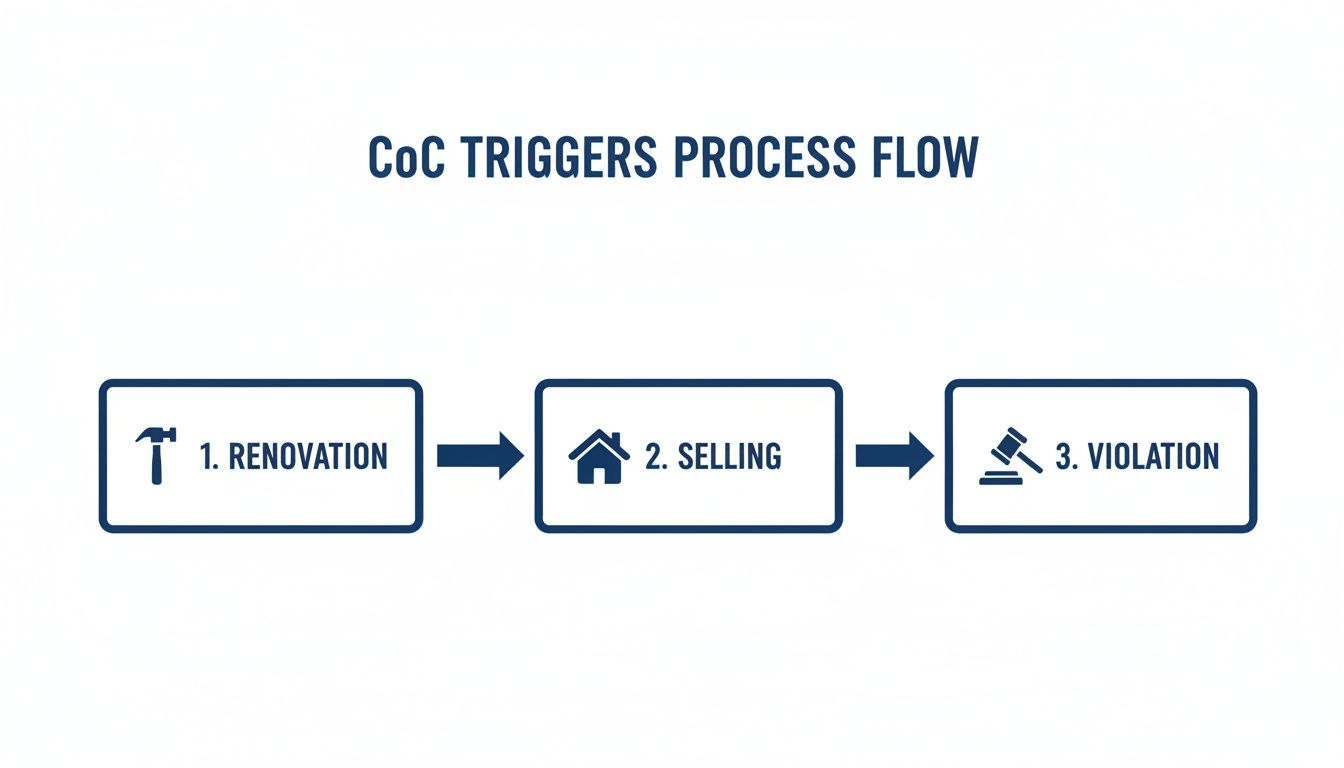
The process to obtain this certificate follows the same path for people who have just completed renovations or plan to sell their property or received a city notice. The entire process depends on inspection and verification.
Kicking Off the Process
The first step requires you to contact your local building department which also serves as the planning authority. Every town and county has its own quirks and specific rules. A quick call to them will clear up exactly what you need to file and which inspections are mandatory for your project. The source provides the ultimate authority on this matter.
Next up, you’ll need to pull together all the necessary documents for your application. The system shows its benefits when users keep accurate records.
- The local government requires you to complete these official forms for your permit application process.
- You must provide complete drawings of all structural modifications which you have made during your project.
- Most places want to see that certified professionals did the work.
The inspection process will begin after you submit your application which receives approval. A city inspector will come to your property to make sure everything was done to code.
Timelines and Associated Costs
You should enter this process with realistic expectations about the duration and expense of the process. The process of obtaining your certificate requires anywhere between several weeks and multiple months from your initial application date. Your project’s timeline and size of work will determine how busy your local department becomes.
Be prepared for a wide range of costs. The cost for a building permit ranges from a few hundred dollars for basic projects to thousands of dollars for complex projects which require multiple inspections and architectural plans.
People achieve better results during the process when they know what to expect from the situation. Official paperwork requires detailed attention because it helps with property ownership transfers and other real estate operations. You can obtain your Certificate of Compliance by following step-by-step instructions which will provide you with legal protection for your property.
Navigating Your Options When Selling Without A CoC

You will face a major obstacle when you discover that your home lacks the necessary Certificate of Compliance (CoC) for selling purposes. The problem exists everywhere but it creates major obstacles for selling homes through conventional methods. Most mortgage lenders refuse to provide financing for homes which have documented code violations.
The process immediately reduces the number of potential buyers who exist. The absence of a Certificate of Compliance (CoC) creates a major concern for lenders because it indicates possible safety risks and expensive hidden maintenance needs and potential legal issues. The bank will stop the deal because it requires a loan which will prevent you from selling the property so you need to start over.
Exploring Your Paths Forward
The good news is, you’re not stuck. You have several valid choices to select from but your best option depends on your schedule and available funds and your preferred level of involvement. The open market presents challenges for home sales because buyers doubt financing feasibility when properties lack a CoC. The main options which you can follow will become clearer once we proceed.
- Option 1: Fix the Issues Yourself. This is the most direct approach. The process requires you to hire contractors who will obtain proper permits and pass inspections before you can receive your Certificate of Compliance (CoC) which allows you to list your property. The process enables your home to reach the most extensive group of conventional homebuyers.
- Option 2: Offer a Seller Credit. You can list the house “as-is” but offer the buyer a credit or a price reduction to cover the estimated cost of the compliance work. The property appeals to buyers who want to work on home improvement projects but they must still secure financing for their purchase.
- Option 3: Sell to a Cash Buyer. You can sell your home to a cash buyer who will pay you immediately without needing to enter the traditional housing market. The investors focus on properties which have problems including compliance issues and they operate independently from lender approval requirements.
Homeowners make their decision between options based on which method provides the best financial return and fast transaction and simple process. The decision requires you to assess how much repairs will cost and how long they will take against the guaranteed speed of a quick sale.
The comparison table will show you all the information you need to understand these strategies more effectively.
Comparing Your Options for Selling a Non-Compliant Home
The table shows the benefits and drawbacks of each path which helps you select the best route for your particular needs.
| Option | Pros | Cons | Best For |
|---|---|---|---|
| Fix It Yourself | Maximizes potential sale price; Appeals to traditional buyers. | Requires significant upfront cash; Can be time-consuming and stressful. | Homeowners with the time, funds, and energy to manage a renovation project. |
| Offer a Credit | Avoids managing repairs; Can attract fixer-upper buyers. | Buyers often overestimate repair costs; Deal may still fall through. | Sellers who can afford a price reduction but don’t want to handle the work. |
| Sell to a Cash Buyer | Extremely fast closing; No repairs or fees; Sale is certain. | Offer will be below full market value. | Sellers prioritizing speed, certainty, and a hassle-free process. |
Each option has its place. Homeowners who need to sell quickly or lack funds for repairs or want to avoid dealing with compliance issues should consider selling their home to a cash buyer. The process offers a direct and assured path which eliminates market-based delays and unpredictable situations.
One such option is working with a company like Eagle Cash Buyers. The system enables you to obtain a proper cash offer while you determine your closing date and you never need to contact contractors or city inspectors. Our detailed guide provides all the information you need to sell your house as-is if you want to explore this method.
Common Questions About Certificates of Compliance
The process of property compliance brings up various questions when you start working on the details. People face challenges when they encounter particular documents and follow specific procedures. Homeowners have several common questions which we will now analyze.
The guide provides you with essential information which you need to know. The process of obtaining accurate information will help you save time and money while reducing stress when you plan to sell your property or verify its compliance with established codes.
CoC vs. Certificate of Occupancy: What Is the Difference?
The two terms create confusion for many people although they serve different functions in the system.
The Certificate of Occupancy (CO) serves as the official document which applies to all new building construction projects. The city issues this final approval seal which proves that newly constructed homes have reached their first stage of habitable safety. No one can legally move in until that CO is issued.
A Certificate of Compliance (CoC), on the other hand, deals with existing homes. It’s the document you need when you’ve done specific work after the house was built—like a kitchen remodel, a new deck, or a major electrical upgrade. The document proves that all work performed satisfies present safety standards and building requirements. So, in a nutshell: CO for new builds, CoC for work done on existing properties.
How Long Does a Certificate of Compliance Last?
The process duration depends on your residential location because it varies between different areas. The United States lacks any single national standard which applies to all situations.
A Certificate of Compliance for a specific project remains valid indefinitely in multiple jurisdictions. The document stays valid as long as you avoid performing any additional unauthorized work on that specific area.
Some cities and towns have established their own regulations which operate independently. The requirements might include property owners to obtain new Certificates of Compliance (CoC) each time they transfer ownership and they must schedule regular inspection appointments for their rental properties. The only way to know for sure is to check directly with your local building or planning department. They have the final say.
What Happens if My Property Fails an Inspection?
The first step requires you to stay calm. A failed inspection serves as a beneficial process which helps you improve your property. The mark will not stay on your property forever.
The inspector will produce a formal report which documents every code violation they discovered during their inspection. The report functions as your task list which provides you with an official set of instructions for necessary repairs.
Here’s how you move forward:
- Review the report and hire licensed professionals to correct each issue.
- Keep all your paperwork, including invoices and photos of the completed work.
- Call the inspector back for a re-inspection once everything is done.
The Certificate of Compliance will be issued to you after the inspector verifies that all violations have been properly corrected. The process follows a straightforward path which makes it easy to understand.
A failed inspection serves as a guide which helps you understand what needs to be fixed instead of being a final judgment. The report shows all necessary repairs which will make the property safe and legal so you can follow a specific process to reach compliance.
You have multiple choices which you can pursue when the repair list becomes too overwhelming to handle. You don’t have to sink time and money into a complex repair project, especially if your goal is just to sell the property and move on.
You have multiple options to handle your current compliance problems instead of completing the required repairs and obtaining permits and passing inspections. The process of selling your house to a cash buyer offers a simple and quick method which guarantees you a sale without any complications. Eagle Cash Buyers operates as a company which purchases homes in their current condition to provide you with a fair cash price and complete your sale process at your preferred pace. Visit us at https://www.eaglecashbuyers.com to get your no-obligation offer today.