



The government holds the authority to exercise eminent domain which allows them to acquire private property for building public infrastructure including roads and schools and parks. The U.S. Constitution through its Fifth Amendment requires the government to pay property owners “just compensation” which means they must pay the market value of the property they take. You have the right to contest the offered price and work toward obtaining an appropriate compensation even though you cannot stop a legal property taking.
Decoding Eminent Domain and Its Impact

The legal process of eminent domain requires courts to establish equilibrium between public infrastructure demands and personal property rights of landowners.
The city needs to build a fire station for emergency response time reduction so your property stands as the ideal location for this project. The government has the power to begin a judicial process which will allow them to acquire your land for their project needs. The government uses condemnation as its official process to claim private land through eminent domain power. The case follows a legal process which operates under its own specific set of rules that differ from normal real estate transactions.
The Two Pillars of Eminent Domain
The fundamental basis of eminent domain rests on two essential elements which the U.S. Constitution protects under its Fifth Amendment:
-
The government lacks the authority to seize your property for purposes which exceed their legal boundaries. The project has to serve a genuine public purpose. The list consists of three main categories which include infrastructure (roads and bridges), public facilities (schools and hospitals), and urban renewal initiatives that aim to improve depressed neighborhoods.
-
Just Compensation: This is the big one for homeowners. The government must pay you a fair price when they take possession of your property according to legal requirements. “Fair” is usually defined as the property’s fair market value—what a buyer would willingly pay a seller on the open market.
The right to receive just compensation stands as the fundamental right which property owners maintain during eminent domain cases. The government has a constitutional responsibility to provide you with financial compensation for any property they seize.
You need to find out the actual worth of your property because this situation demands it. A suitable offer needs to include more than the price of the land and building because it should represent the financial losses you will experience. The process of understanding real estate equity value helps people verify that government compensation matches their actual property value.
The government maintains the authority to seize property but citizens can contest their property assessment while requiring a fair assessment procedure. The first step toward understanding the path ahead requires you to grasp this essential concept.
Key Terms in an Eminent Domain Action
Understanding the process requires you to understand the terms which people use for it. Here’s a quick rundown of the essential terms and players you’ll encounter.
| Term | Definition | Role in the Process |
|---|---|---|
| Eminent Domain | The inherent power of the government to take private property for public use. | The government has this legal power which enables them to start the property acquisition process. |
| Condemnation | The formal legal process used to exercise the power of eminent domain. | The government files this lawsuit to court when they want to acquire property. |
| Public Use | The constitutional requirement that property can only be taken for a public purpose. | The government needs to demonstrate that the project will create advantages for the public through the construction of roads and parks. |
| Just Compensation | The fair market value of the property that must be paid to the owner. | Property owners face their primary negotiation challenges during this stage of the process. |
| Condemnor | The government agency or entity taking the property (e.g., DOT, city, school district). | This is the party initiating the action against the property owner. |
| Condemnee | The private property owner whose property is being taken. | This is you, the homeowner, whose rights are being affected. |
You will find it easier to understand your notices when you learn these terms which will also help you during your official meetings with government officials and legal representatives.
How Landmark Cases Shaped Modern Eminent Domain
You need to understand all historical rules which have evolved to determine government property acquisition potential for your current property situation. The Fifth Amendment grants the government eminent domain power which originally existed to enable public construction of roads and military installations.
The legal system has expanded the meaning of public use through several major court cases which now make it difficult to understand its true meaning. The Supreme Court delivered three landmark decisions which established new legal principles to grant the government more control while making it harder for property owners to protect their rights. The present legal system exists because of this historical background.
From Public Works to Urban Renewal
For a long time, eminent domain was simple. The government needed your land for a post office or a highway, and the “public use” was undeniable. Cities began to focus on large-scale urban renewal projects starting in the middle of the 20th century which led to this change.
The Supreme Court established Berman v. Parker as its landmark decision in 1954 which proved to be a turning point for legal progress. The court expanded the definition of public use through its decision which allowed urban “blight” control measures. All of a sudden, the government could take properties not just for a public building, but to hand them over to a private developer. The public viewed the act of cleaning up the dangerous area as a beneficial service to society. The process of determining how these cases transformed eminent domain requires researchers to study basic constitutional law principles.
The new law established a revolutionary system. This law introduced a new period which allowed eminent domain to serve economic development goals instead of building public facilities.
The Kelo Decision and Its Aftermath
The 2005 Kelo v. City of New London decision triggered a nationwide power grab which made people across the country start to worry. The Supreme Court approved a city takeover of pristine residential properties which they handed to Pfizer for their pharmaceutical development through a split 5-4 ruling. The city used the new development as justification because it would create employment opportunities and increase tax revenue which they claimed would bring about a “public benefit.”
The Kelo decision established that economic development could be considered a valid “public use,” even if the property wasn’t blighted and was being transferred to another private party.
The public reaction was immediate and furious. People were outraged. The situation became worse because Pfizer never built the promised development in New London; they left behind an empty space after they demolished the homes.
The backlash was so strong that 45 states scrambled to pass new laws to curb this kind of abuse and give property owners better protection. You can find detailed information about these important cases at the Institute for Justice which maintains an informative record of their historical development. The history of legal property development explains why developers select specific properties which appear to be distressed or underutilized for their redevelopment projects.
The Eminent Domain Process Step by Step
The government sending you a notice about property acquisition makes you feel like you have no protection in this dangerous situation. The process of eminent domain follows a specific sequence which allows you to determine what happens next. The process will become clear to you when you understand how it progresses from its initial notice to its final resolution. It puts you back in control.
The entire process begins at a time which exceeds the period when you receive a letter at your residence. A government agency which might be a city council or the Department of Transportation determines they require land for a public project which includes building highways and schools and utility lines. The legal process begins when they pass an official resolution to exercise eminent domain.
The timeline presents an overview of major legal decisions which have established the current property rights that homeowners possess against eminent domain acquisitions.
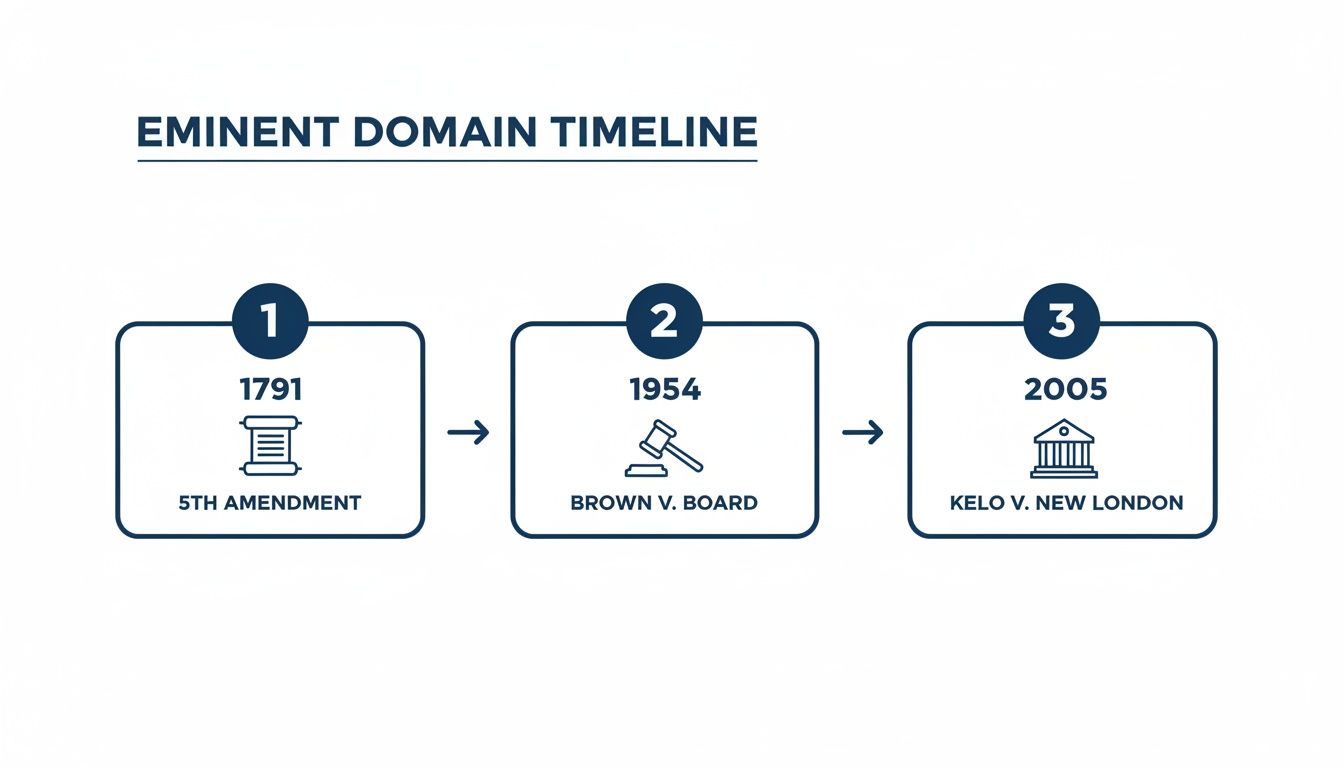
The definition of public use has changed numerous times throughout history which has created multiple major court cases that continue to generate controversy.
Initial Contact and The Government’s Appraisal
The government will inform you about their decision through a notice of intent which marks the first official contact between you and the government after they make their internal decision. The condemning authority sends you this formal letter which carries substantial importance. The letter serves as official notice which alerts you to upcoming projects that will affect your property while establishing the official beginning of the entire process.
The government will send an appraiser who will assess your property to find out its market value. The appraiser will visit your home to inspect its condition while they also analyze its position and check recent sales data for properties that resemble yours to establish a value. The appraisal exists to serve government needs instead of serving your personal interests.
The Offer of “Just Compensation”
The government will present a formal written offer based on their appraisal which represents what they refer to as just compensation. This represents the amount of money they have determined to be appropriate for acquiring your residence. You have absolutely no obligation to accept this first offer. The actual value of your property exceeds the typical compensation you would receive.
The purpose of just compensation exists to restore your financial position to what it would have been if the government never took your property. The coverage should protect you against both the current market worth of your property and any harm which occurs to your remaining land area (if applicable) and the costs of relocating your residence.
You need to make your first major decision at this point. You have the chance to fight back by presenting your own professional appraisal which will help you start the process of getting a higher price.
When Negotiations Stall: The Condemnation Lawsuit
The process stops when you fail to reach an agreement about the property’s value. The government continues its operations without any signs of ending. The process starts with them filing a condemnation lawsuit. You don’t need to worry about breaking any laws because this situation seems dangerous. The government must follow this legal procedure to take control of the property and the court will determine the appropriate compensation amount.
The following diagram shows how your actions match up with the government’s planned schedule.
Homeowner Action Plan vs. Government Process
| Government Action | Recommended Homeowner Response | Key Objective |
|---|---|---|
| Project Authorization & Initial Notice | Do not sign anything. Contact an eminent domain attorney immediately. | You need to learn your rights while creating a legal plan which will help you from the start of the process. |
| Government Appraisal | You should obtain an independent property valuation from a professional who specializes in representing property owners. | You need to get an unbiased property valuation which shows the actual market price of your property. |
| Initial “Just Compensation” Offer | You need to analyze the offer with your attorney before you should accept lowball offers. You need to reject these offers while you start the negotiation process. | You need to present evidence which shows the government undervalued your property so you can get better compensation. |
| Filing of Condemnation Lawsuit | Work with your attorney to file a formal response and continue negotiations. | You need to defend your legal rights while you get ready for either court battles or settlement discussions. |
| Possession & Court Proceedings | The government takes possession, but the fight for fair payment continues in court. | Your complete focus needs to be on obtaining the highest possible financial compensation which you deserve. |
The table shows crucial points when your active participation will produce essential effects which determine the final results.
You have multiple choices available after someone files a lawsuit against you:
- You need to keep negotiating until you reach an agreement which will prevent the case from entering the courtroom.
- You should fight against the seizure because the government lacks proper authorization to use public funds on your land and they failed to follow all necessary legal procedures.
- You need to find another method which will let you regain control of your situation while you get back some certainty.
The legal system appears as an endless road which stretches before homeowners who face inherited property issues or homes that require major repairs. Property owners who need to deal with these specific cases should understand how to transfer property ownership according to their personal timeline. You have the option to sell your property to a cash home buyer. The process guarantees a quick sale at a set price which allows you to avoid any legal problems.
Understanding Your Rights as a Homeowner
The government sends you an eminent domain notice which makes you feel like you have no power at all. The government seems to possess every advantage in this situation. The U.S. Constitution provides you with two powerful defensive tools which help you protect yourself. You need to identify your opponents as the first vital step to start defending your interests. You learn to defend yourself through this process which transforms you from a victim into your own strongest advocate.
Your first right allows you to get “just compensation” for your property. The government has a constitutional duty to pay you a fair price for your home. And “fair” means a lot more than the number on your latest tax bill.
The proper compensation amount needs to equal the fair market value of your property which represents its market price during an open market sale. The evaluation process should determine the land’s best possible use instead of assessing its current application. The government’s first offer is just that: an offer. You have every right to reject it and negotiate for a price that truly makes you financially whole again.
Your Right to Challenge the Taking
You have two essential rights in addition to receiving proper payment: you can fight against the property seizure. The legal battle which follows will be difficult but it represents an essential system which prevents government from exceeding its authorized powers. You and your attorney have the right to question every aspect which led to the government’s decision to take action.
A legal challenge typically focuses on two essential elements which form its core:
- The project serves two purposes: it will benefit the public through school and highway construction and it will generate profits for a private developer who plans to build a shopping mall.
- The government must prove they followed every rule which exists in the book. Any misstep, big or small, could be grounds to invalidate the entire condemnation.
You must demonstrate the government’s evidence to prove their case because this process shields citizens from unjust government actions. The process needs them to show that all property seizure requirements from both constitutional and legal sources have been met which creates a system that defends citizens from government intrusion.
The Power of Knowing Your Standing
The government has gained additional authority to seize land throughout its historical development. The federal government expanded its power during World War II by acquiring more than 20 million acres of land for national defense purposes. The 2005 Kelo decision which allowed cities to take homes for private development projects caused major public outrage. The response led 45 states to enact new regulations which made the existing rules more strict. The federal government has used eminent domain throughout history which you can study by visiting their website.
The historical record shows why people need to understand their rights in the present day. A competent attorney will examine all aspects of this case which includes both the public use assertion and your property ownership documentation. The case requires immediate resolution of title issues which might occur during closing to establish a strong legal position.
You can use your knowledge of these rights to get a better price during negotiations even if you decide not to contest the property seizure. Homeowners who want to avoid legal battles and get a guaranteed sale quickly should consider selling to a cash home buyer as their best option. Eagle Cash Buyers offers a solution through their quick cash offers which let you avoid the uncertainty of the condemnation process.
How to Respond to an Eminent Domain Notice
The official eminent domain notice which you received makes you feel trapped and without any defense. You will take control of the situation when you arrive at this location. The initial shock is understandable, but what comes next is a series of decisions where you can take back control and protect your interests.
You have complete control over this process. You have three primary options which will determine your response to this situation. Each has its own pros and cons, and the best one for you really depends on your specific situation and what you want the outcome to be.
Choosing Your Path Forward
Your options become clear when the government starts taking your property. You have three options to deal with it: fight against it, negotiate for better terms, or take control by selling the property on your own.
- Negotiate for a Better Offer: Think of the government’s first offer as an opening bid, not the final word. You have the right to get your own independent appraisal. With that in hand, you can push back and negotiate for a much higher payment—one that truly reflects your property’s value and any other damages you’re facing.
- Challenge the Taking in Court: This is the most aggressive approach. It involves legally challenging the government’s right to take your property in the first place. You might argue that the project doesn’t serve a real “public use” or that the agency didn’t follow the letter of the law.
- Sell Your Property Independently: You don’t have to be stuck on the government’s timeline. You can take the initiative and sell your house before the whole condemnation process drags to a close. This gives you certainty over the sale price and lets you decide when to move.
A prolonged legal fight would be the last thing anyone needs when they already face property inheritance or foreclosure threats. A fast guaranteed sale through this method presents itself as an attractive solution because it eliminates the need for litigation which adds uncertainty and costs to the process.
You can regain control through the sale of your property before the government finishes its condemnation process. The program lets you protect your equity while avoiding legal costs and you can proceed according to your own timeline instead of following government schedules.
The present moment provides an opportunity to study different buyer options which exist for your specific requirements. These businesses specialize in cash house buying because they handle all transactions with speed and simplicity.
One such option is working with a cash home buyer. A company like Eagle Cash Buyers, for example, can provide a clear-cut solution with a fair, guaranteed cash offer and a fast closing. The process enables you to avoid a stressful legal battle while you obtain a fair resolution which brings you peace of mind.
Why Distressed and Inherited Properties Are Vulnerable

The government applies different standards when it evaluates homes for potential eminent domain acquisition. You will face unique challenges right from the start because you own a property which is either distressed or inherited or sitting vacant.
The government usually identifies these properties when they need to demolish an entire area for their redevelopment projects. The property becomes an easy target because it displays visible signs of damage including peeling paint and an overgrown lawn and major code violations and outstanding property taxes.
The Problem of a “Blight” Designation
A government agency needs to designate specific properties as “blighted” during its first stage of neighborhood revitalization planning. The legal status of this word gives their argument for land acquisition through public use additional strength.
A distressed or neglected property, unfortunately, fits the bill perfectly. The home which has boarded-up windows and a deteriorating foundation becomes eligible for official blighted status which forces you to defend yourself while losing bargaining strength. Your home condition can be used against you even though it might be difficult to accept.
The urban renewal programs throughout history have used eminent domain to target specific communities which they want to displace. The current management of inherited properties by heirs faces ongoing challenges because code violations can lead to homes being labeled as ‘blight’ which makes them eligible for seizure.
The situation continues as usual. Urban renewal programs which operated between 1940 and 1970 used eminent domain to force millions of people out of their homes with most of those displaced being members of minority communities. The U.S. Commission on Civil Rights has published research which you can examine to understand the complete history of this subject.
Navigating Your Options Proactively
The process of receiving a condemnation notice causes extreme stress to people. The situation becomes even more stressful because you need to handle two difficult matters which include probate and foreclosure prevention. The thought of involving a lengthy legal battle in this situation seems completely unmanageable to me.
You need to take charge of this situation because it represents the point where you must start leading. You don’t need to accept the government’s initial offer which you can use as a starting point to negotiate for better terms. You have other choices.
You can manage your property through a fast cash sale which gives you complete control over when and how you sell it. The process allows you to access your equity quickly so you can move forward with your life instead of waiting for the government’s approval. Our guide provides a complete step-by-step process to help you sell your inherited house quickly.
Eagle Cash Buyers offers a direct approach which lets you get a quick cash deal without any obligation. The method protects your financial assets while giving you essential mental calmness.
Common Questions About Eminent Domain
The process of dealing with an eminent domain claim creates multiple practical questions which enter your mind. Clear and simple answers will help you feel ready because they give you control over the situation.
Let’s tackle some of the most common concerns homeowners have.
Can I Refuse to Sell My Property?
The situation presents a complex challenge because it requires an answer which goes beyond a straightforward yes or no response. The government maintains the authority to seize your property when they have properly completed all necessary procedures for a valid public use project.
You have the right to decline their first proposal. The power you have is in challenging what they’ve decided is “just compensation.” You have the right to negotiate for a better price and if that does not work you can take the matter of property value determination to court.
How Long Does the Eminent Domain Process Take?
The duration of eminent domain cases depends on multiple factors which lead to wide variations in their timelines. Some cases are simple. The entire process will reach completion within a few months after both parties agree on a fair price.
You must prepare for an extended legal battle because court proceedings will begin once you challenge the property valuation. The legal process of these cases typically lasts for more than one year.
What if I Owe More on My Mortgage Than the Offer?
The situation presents one of the most challenging circumstances which a homeowner might encounter. The government compensation amount you receive will not cover your remaining mortgage balance which means you must pay the difference.
You face a heart-wrenching situation because you lose your home ownership rights while you still owe money on your mortgage. You need to manage the physical task of packing and moving your entire possession during this entire process. A good guide to storage when moving house can be a lifesaver during this stressful transition.
You have several options when eminent domain threatens your property which includes both distressed and inherited properties. You can choose to negotiate, fight in court, or sell your property according to your own schedule.
Eagle Cash Buyers provides a no-obligation cash offer which lets you achieve a quick and certain property sale. Our service enables you to close your deal quickly while avoiding legal complications so you can start your new life. Learn more at eaglecashbuyers.com.