An older two-storey red brick house with painted shutters, a decorated porch with turned posts and clipped box hedges across the front lawn
Questions? Call us: (833) 330-1625

Sell My House Fast in Kentucky: We Buy Houses for Cash, As-Is, Any Condition

Any condition, from the Purchase to the Big Sandy. Tell us the address and we will put a real number in writing, free, with nothing to sign.

Sold as-is, no repairs to fund Free, no-obligation offer No agent commission to pay All 120 Kentucky counties

Eagle Cash Buyers evaluates residential property across 43 states, Kentucky included, from Louisville and Lexington out to Northern Kentucky, Bowling Green, Owensboro, Paducah and Ashland. One Kentucky number is worth knowing before anything else: a court appraisal is filed before a foreclosure sale, and whether the property brings two-thirds of that figure decides what rights you have afterwards.

Question 1 of a few

What is the Kentucky address?

We price against sales in your own county, and Oldham prices nothing like Hopkins, so this is where we have to start. The next few questions cover condition, ownership and your timing.

Free, and nothing to sign. If a traditional listing would leave you with more, we will tell you.

Next: condition of the house, who is on the title, and the date you would like to close by.
Google Reviews BBB Accredited
  • A+BBB rating
  • 4.5from 40 Google reviews
  • 1,000+transactions completed
  • 43states we buy in

Oren Sofrin, as quoted inMSNYahoo FinanceGOBankingRatesBiggerPockets

Finding your cash offer...

What a cash sale in Kentucky actually costs you

A cash offer comes in below what a prepared house would fetch on the open market. You are trading price for speed, an as-is sale and a much shorter list of things that can go wrong. Whether that trade makes sense depends on the condition of the house and what waiting is costing you.

Below is the honest comparison. Read the last two rows as carefully as the first ones.

 Listing with an agentEagle Cash OfferEagle Retail Max
Typical timelineAbout 50 days on market, then 30 to 45 days to closeRoughly 21 to 42 daysLonger than a cash offer, and driven by the end buyer
Agent commission 5% to 6% of $283,818About $14,200 to $17,000 from your proceedsNone from youNone from you. Eagle covers applicable commissions
Closing costs other than transfer taxSeller pays a shareEagle pays themEagle pays them
Transfer tax at 0.1% on the grantor, mortgage payoff, prorated property taxes, recording feesYoursYours, except the recording fees, which Eagle paysEagle pays the transfer tax and the recording fees. The rest is yours
Repairs before saleOptional, but selling as-is usually narrows the buyer pool and the priceNone. Sold as-isNone from you. Eagle covers approved repair and concession costs
ShowingsOngoing, on the buyer's scheduleProperty review and inspection onlyRequired. Normally scheduled 24 hours ahead when occupied
Financing riskA buyer’s loan can fail on underwriting, appraisal or property conditionNo lender on our sideDepends on the end buyer
Likely proceedsHighest, if the house is market ready and you can waitLowest of the threeBetween the two

Commission figure uses the Kentucky median sale price of $283,818 as of August 2026 and a typical 5% to 6% rate (it varies by market), for illustration only. Your numbers will differ. Kentucky's transfer tax falls on the grantor at 50 cents per $500 of value, which is 0.1%, or roughly $284 at that median price, worked out here from the statutory rate. A number of transfers are exempt, including between former spouses as part of a divorce, between parent and child on nominal consideration, and under a foreclosure or a deed in lieu, so ask your closing agent if yours might be on the list. Which structure fits depends on the property, your equity and your timing, and the written agreement controls in every case.

Two things decide this, and they are worth separating: whether you have the time to wait a sale out, and whether you have the money to put the house right before it goes on. Where you have both, list it with a good local agent. We would rather say that up front than spend three weeks getting to the same answer. Where one of them is missing, a cash sale is not the consolation prize. It is often the better outcome and sometimes the only one that closes: a house that needs work you cannot fund, a tangled title, a real deadline, or a situation that takes the listing route off the table.

How to Sell Your House Fast in Kentucky for Cash

Send us the address and enough detail about the property to work with. During business hours an initial no-obligation offer is often possible within minutes to a few hours, though plenty of houses need research, photographs or a walkthrough first. Most Eagle transactions close in roughly 21 to 42 days, depending on title readiness, liens, payoffs and the property review. If a foreclosure action has been filed, send the case number, because the appraisal in that court file is the document everything afterwards turns on.

1

Tell us about the house

The address on this page, or a call to (833) 330-1625. We ask about condition, who is on the title, what is owed and when you want to be out. Not your credit.

2

We underwrite, then put it in writing

Comparable sales in your county, what the repairs will cost us, and the resale risk. The written agreement states the price, the closing target and the contingencies.

3

Property review, title, closing

We inspect the house and open title. Payoffs, liens and ownership get verified. The title agency records the deed and disburses your proceeds.

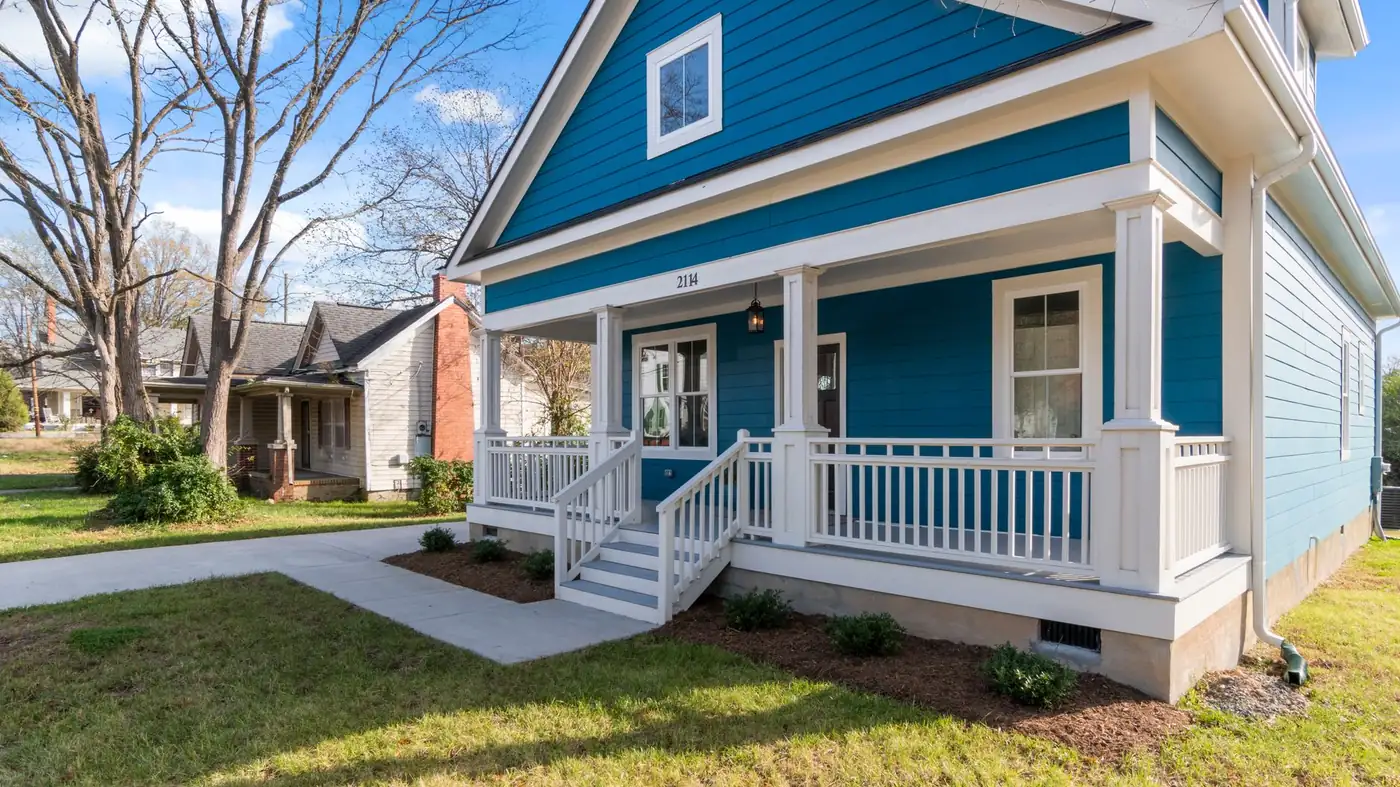
A freshly painted blue frame cottage with a deep front porch, white rails and turned posts, on a street of older houses
Roof, foundation, wiring and whether a basement takes water decide most financed Kentucky sales, well ahead of the kitchen.
Want to see the number before you decide anything?Tell us the address. The offer is free, there is nothing to sign, and if listing would net you more we will say so.
Get My Cash Offer or call (833) 330-1625

We Buy Houses Across Kentucky

Select a city to learn more

Cash Home Buyers Across Louisville, Lexington, Northern Kentucky and Every Kentucky Metro

Kentucky is a long state and it does not move as one. Louisville and Lexington behave separately from each other, Northern Kentucky trades with Cincinnati rather than with either of them, the Purchase looks to Nashville and St. Louis, and the eastern counties move on nothing that happens in any of those places. We operate across all of it.

The Louisville riverfront at night, with the lit cables of the downtown bridge, the yellow steel of the older truss spans behind it and the city reflected in the Ohio River
Louisville, Lexington, Northern Kentucky and the county-seat towns behave differently, and a statewide median tells you little about any of them.

Louisville

Jefferson County

The largest market in the state and one of the most varied. Shotgun rows and Victorian brick in the older neighborhoods, post-war ranch stock in the ring, and a spread of prices inside one county that a statewide figure cannot describe.

Sell Your House in Louisville →

The Louisville Suburbs

Jefferson, Oldham and Bullitt Counties

St. Matthews, Jeffersontown, Lyndon, Shively, La Grange, Shepherdsville and Mount Washington. Newer stock at a range of prices, on a buyer pool that mostly works in the city.

Sell Your House in The Louisville Suburbs →

Lexington and the Bluegrass

Fayette, Scott, Jessamine and Woodford Counties

Lexington, Georgetown, Nicholasville and Versailles. The university, the health system and the horse economy, with an urban growth boundary that keeps the city tighter than most of its size.

Sell Your House in Lexington and the Bluegrass →

Northern Kentucky

Kenton, Boone and Campbell Counties

Covington, Newport, Florence, Independence, Erlanger, Fort Thomas and Alexandria. Across the river from Cincinnati and trading with it in both directions, with a lot of nineteenth-century stock on the river side.

Sell Your House in Northern Kentucky →

Bowling Green and the South-Central

Warren, Barren and Simpson Counties

Bowling Green, Glasgow and Franklin. The university, manufacturing and the interstate, and one of the faster-growing corners of the state.

Sell Your House in Bowling Green and the South-Central →

Elizabethtown, Radcliff and Fort Knox

Hardin, Nelson and Taylor Counties

Elizabethtown, Radcliff, Bardstown and Campbellsville. A large military presence at Fort Knox drives a rental and relocation market that moves on postings rather than on prices.

Sell Your House in Elizabethtown, Radcliff and Fort Knox →

Owensboro and the Western Coalfield

Daviess, Henderson and Hopkins Counties

Owensboro, Henderson and Madisonville. The Ohio River, agriculture and what is left of the coal economy, at prices well below the metros.

Sell Your House in Owensboro and the Western Coalfield →

Paducah, Murray and the Purchase

McCracken and Calloway Counties

The far west, closer to Nashville and St. Louis than to Lexington. The university at Murray, the rivers, and some of the most affordable housing in the state.

Sell Your House in Paducah, Murray and the Purchase →

Frankfort, Richmond, Danville and the Central Towns

Franklin, Madison, Boyle, Clark and Anderson Counties

Frankfort, Richmond, Berea, Danville, Winchester and Lawrenceburg. State government, two more universities and the distilleries, in county-seat markets that each move on their own.

Sell Your House in Frankfort, Richmond, Danville and the Central Towns →

Somerset, Ashland and Eastern Kentucky

Pulaski and Boyd Counties

Somerset in the lake country and Ashland on the Ohio at the West Virginia line. Thin buyer pools over long distances, which is often what makes a cash sale the only realistic one.

Sell Your House in Somerset, Ashland and Eastern Kentucky →

Hopkinsville and Fort Campbell

Christian County

Hopkinsville and the Kentucky side of Fort Campbell, on the Tennessee line. Another market driven by the post rather than by the wider economy, with a large share of households that rotate through.

Sell Your House in Hopkinsville and Fort Campbell →

Shelbyville, Paris and the Small Bluegrass Towns

Shelby and Bourbon Counties

Shelbyville between the two big cities, and Paris in the horse country north-east of Lexington. Small, tightly held markets where a single sale can move the local figures.

Sell Your House in Shelbyville, Paris and the Small Bluegrass Towns →
Do not see your town on the list?We evaluate property in all 120 Kentucky counties, not only the cities with their own page.
Get My Cash Offer or call (833) 330-1625

Kentucky Counties We Cover

From Calloway and McCracken out in the Purchase across to Boyd on the West Virginia line, and from Boone and Kenton on the Ohio down to Simpson and Christian on the Tennessee border, our city pages cover 31 of the state's 120 counties, and we evaluate property anywhere in Kentucky. Being inside the footprint is not the same as an offer. Location, property type, condition, marketability, title and our current buying criteria all decide whether we can make one.

Anderson County
Barren County
Boone County
Bourbon County
Boyd County
Boyle County
Bullitt County
Calloway County
Campbell County
Christian County
Clark County
Daviess County
Fayette County
Franklin County
Hardin County
Henderson County
Hopkins County
Jefferson County
Jessamine County
Kenton County
Madison County
McCracken County
Nelson County
Oldham County
Pulaski County
Scott County
Shelby County
Simpson County
Taylor County
Warren County
Woodford County
Paducah and Fort Thomas are different markets entirely.We price against sales in your own county, because a statewide median tells you almost nothing about your street.
Get My Cash Offer or call (833) 330-1625

Kentucky Seller Situations: Foreclosure, Probate, Rentals, Older Houses and Divorce

These are the situations we run into most often in Kentucky, and what we can and cannot do about each one.

⚠ Facing a Kentucky Master Commissioner's SaleGo and read the appraisal that is already on file

If a foreclosure action has been filed against you, there is a document in the court file that almost nobody goes to look at, and it decides more than anything else about what happens after the sale.

The property is appraised under oath before the sale by two disinterested persons of the county, and the appraisal is filed among the papers of the case beforehand. Two-thirds of that figure is the line. Sell above it and that is the end of the matter. Sell below it and you have a window to redeem, and the laws section on this page sets out the detail.

Know one thing before you plan around that window: the buyer gets an immediate writ of possession. The right to buy the house back is real. Staying in it while you arrange that is not part of the deal.

Send us the case number, the appraisal if you have it, and the sale date. We will tell you honestly whether a sale before the auction is realistic. We cannot promise to stop a foreclosure or protect your credit, because that depends on your lender, the timing and whether a closing actually happens.

Related guide: How to Sell Your House Fast Before Foreclosure

🏠 Inherited Property and ProbateOlder stock, and what the family transfer actually costs

An estate cannot convey clear title until the personal representative has authority to sell, and Kentucky probate runs on its own timetable. We work with executors regularly and the usual constraint is the court rather than the house.

One useful thing while that is going on. If the plan is to move the property between family rather than sell it, Kentucky exempts transfers between parent and child or grandparent and grandchild with only nominal consideration, and transfers between spouses or former spouses as part of a divorce proceeding, from the transfer tax. That is worth knowing before anyone signs a deed on the assumption it will be charged.

Much of the inherited stock we see here is genuinely old: knob-and-tube wiring, a coal chute somebody bricked up, a stone or brick foundation that has moved, and in the eastern counties a septic system and a well rather than a municipal connection. Bring what you know and we will be straight about what it means for the number.

Related guide: How to Sell an Inherited House

🔑 Rentals, Tenants and Small MultifamilyWe buy occupied property

A tenant in place is not an obstacle and you do not need to remove anyone before talking to us. Existing leases generally survive a sale, and we would rather take the property with its tenancies intact than ask you to create a vacancy.

There is a Kentucky reason to keep the property occupied if you honestly can. The expedited sale for a vacant house keys on nobody being entitled to occupy the property, plus other signs of vacancy. A let property with a tenant in it is not that.

Louisville and Covington both carry a lot of small multifamily in nineteenth-century stock, Lexington, Bowling Green, Richmond, Murray and Morehead all run student tenancies on their own calendars, and around Fort Knox and Fort Campbell the rental market moves on postings rather than on the wider economy. Bring the leases, the rent roll, the deposits and any arrears or disputes. Security deposits are the item most often overlooked and they have to be accounted for at closing.

Related guide: Selling a Rental Property With Tenants

💧 Older Houses, Water and Rural PropertyWhat actually holds up a Kentucky sale

Outside the metros, and often inside them, the things that stop a financed Kentucky sale are rarely cosmetic.

Foundations move on the limestone and clay through the middle of the state, and a basement that takes water every spring is a real finding rather than a decorating problem. Older Louisville and Northern Kentucky stock brings knob-and-tube wiring, lead paint and roofs on their third decade. In the eastern counties and along the rivers, flood history and whether a property can be insured matter more than anything indoors, and sinkholes are a genuine question in the cave country around Bowling Green and Glasgow.

Rural property adds a well or a spring rather than a municipal connection, septic, and access easements across land nobody has surveyed in decades. In the coalfields there may be severed mineral rights attached to the land. We have not read the law on how that works in Kentucky and we are not going to pretend otherwise, but it is worth asking your attorney about before you agree terms with anyone.

We price all of this regularly. Tell us honestly what is wrong and we will give you a number that accounts for it rather than one that gets revised at inspection.

Related guide: Selling a House With a Bad Roof

💵 Divorce and Co-Owned PropertyBoth signatures, and one exemption worth knowing

A house is often the last asset to be settled and the one that keeps two people tied together after everything else is done.

The practical constraint is authority: both owners on title normally have to agree to a sale, and we cannot proceed on one signature where two are required. Where attorneys are involved we are happy to work through them, and where a decree already specifies what happens to the house, send it across and we will work to what it says.

If the plan is for one of you to take the house rather than sell it, Kentucky exempts a transfer between former spouses as part of a divorce proceeding from the transfer tax. Small, but it is real money and people pay it without asking.

We are not a party to the dispute and will not take a side in it. Our job is to give both of you the same number in writing so you can decide what to do with it.

Related guide: Selling a House During Divorce

Asked in Kentucky

Are home prices dropping in Kentucky?

No, though the market around them has softened a little.

In Redfin's August 2026 figures, the Kentucky median sale price was $283,818, up 3.2% on the year. The number of homes sold was down 3.5%, homes for sale were up 8.1%, newly listed homes were down 5.5%, and months of supply was unchanged at four. The median time to sell lengthened by four days to 50, the share going above list fell 1.8 points to 16.5%, and the share of listings taking a price cut rose 2.7 points to 21.6%, while the sale-to-list ratio held essentially flat at 97.5%. So prices are up and patience is down.

A house in good condition will still sell on the open market, usually for more than we pay. An older rural house on a well, a property heading to a master commissioner's sale, or a rental with tenants is where selling direct makes more sense.

Is there a court appraisal on file?In a Kentucky foreclosure it is filed with the court before the sale and you are entitled to read it. Two-thirds of that figure is the number that decides everything afterwards.
Get My Cash Offer or call (833) 330-1625

What Actually Happens on the First Call

People put off calling a company like ours because they do not know what they are walking into. Here is a real call, with the details that could identify anyone removed. We are not saying it was a Kentucky seller, because we do not attach cases to states they did not come from.

From our own call records

A man called about his wife’s house. She had sent the inquiry, he was out running errands, and he thought he would get things started. Our acquisition manager noticed the inquiry was in her name, asked whether she was unable to take part, and when the answer was no, she simply asked me to call, he stopped the conversation there. Not for a signature. We talk to the owner. They booked a three-way call for once he was home, around his drive rather than our calendar.

What that first call is for, in his words: it is pretty basic, really more for us to find out about the property and the condition it is in. No offer on the spot, no paperwork, no pressure.

Anonymised from a recorded call. No names, no location, no property details, because the record holds none and we do not invent them. This account ends where the record ends, with a follow-up scheduled.

Kentucky Real Estate Laws Every Seller Should Know

Kentucky sells foreclosed property through the court and a master commissioner, and it has the property appraised first by two people sworn in for the job. Whether the sale clears two-thirds of that appraisal is the line everything else turns on. Here is what generally applies before you sell, in plain language.

Before Any State Clock Starts: the Federal 120-Day Rule

Every state timeline on this page sits behind a federal one, and it is the single most useful thing to know if you have missed payments. Under Regulation X, 12 CFR 1024.41(f)(1), a mortgage servicer generally “shall not make the first notice or filing” required for a judicial or non-judicial foreclosure unless the borrower's mortgage loan obligation is more than 120 days delinquent.

That is roughly four months of missed payments before the state process is even allowed to begin. It is why a state sequence that looks alarmingly short on paper is usually longer in practice than the statute alone suggests.

The exceptions, because they are real. The rule does not apply where the foreclosure is based on a violation of a due-on-sale clause, or where the servicer is joining the action of a superior or subordinate lienholder. Small servicers are not exempt from this particular prohibition. Loan types and servicing arrangements vary, and some loans are outside Regulation X altogether.

So treat 120 days as the general floor rather than a guarantee, and work from the dates on your own paperwork. If a notice has arrived and you do not believe you are past that point, that is a question worth putting to a HUD-approved housing counselor or an attorney before you do anything else.

Two Sworn Appraisers, And Then The Two-Thirds Line

Kentucky foreclosures go through the court, and a master commissioner sells the property. Before that happens, somebody has to put a value on it, and the way the statute does it is worth reading in its own words.

Under KRS 426.520, before any real property is sold under an order or judgment of a court, the commissioner must have it appraised, under oath, by “two (2) disinterested, intelligent housekeepers of the county”, and “if they disagree, the officer shall act as umpire”. That is the live wording, not a quaint historical footnote.

The appraisal is filed with the court before the sale. Section 426.520(2) requires it in writing, signed, returned to the court and “filed among the papers of the cause” prior to the sale. So it is a document you can go and read, and you should, because one number on it governs everything that happens afterwards.

That number is two-thirds of the appraised value. Under KRS 426.530, if the property “does not bring two-thirds (2/3) of its appraised value”, you may redeem it within six (6) months from the day of sale, by paying the original purchase money, ten percent (10%) per annum interest on it, and any reasonable costs the purchaser has incurred since the sale for maintenance or repair. The statute lists utility expenses, insurance, association fees, taxes and the cost of bringing the property up to local nuisance code standards. You pay it to the clerk of the court, and the master commissioner conveys the property back to you.

Now the part that decides whether that is any use to you. Section 426.530(3) says that when the right of redemption exists, the purchaser receives an immediate writ of possession, and a deed carrying a lien in your favor reflecting your right to redeem. The right to buy it back is real. Living there for those six months is not part of it. Anyone who describes the six months without telling you that is not being straight with you.

The federal rule above generally sits in front of this whole sequence. Free HUD-approved housing counseling is available before you commit to anything, including to us.

Official sources: KRS 426.520 and KRS 426.530

An Empty House Is Not A Neutral Choice Here

This is the Kentucky rule most likely to change what happens to you in the next month, and almost nobody knows it is there.

Under KRS 426.205, where a court determines that property in a foreclosure action is vacant and abandoned, “a sale of the property shall be ordered expeditiously”. The master commissioner then has to sell it within seventy (70) days of the order, and the lender has to apply to confirm the sale within twenty (20) days of it.

The test is a checklist, and it is not hard to meet. No legal resident or other person entitled to occupy the property for forty-five (45) or more consecutive days, plus two or more of the following: overgrown or dead vegetation; a build-up of flyers, mail or trash; disconnected utilities; no window coverings or furniture; uncorrected hazardous conditions or vandalism; or statements from neighbors, delivery people or government employees that the property is vacant. Proof may be offered by affidavit.

What we are saying and what we are not. We are not telling you to stay in a house you cannot afford to stay in, and we are certainly not telling you that staying stops a foreclosure, because it does not. What we are telling you is that moving out, turning the power off and letting the post pile up is not a neutral decision in Kentucky. It is most of a statutory checklist, and it can take months off the time you have.

If you have already moved out, that is not a disaster and it is not a reason to move back. It is a reason to find out where the case actually is, quickly, and to tell us the truth about the property when you call.

Official source: KRS 426.205

The Transfer Tax Is On You, And The Exemptions Are Worth Knowing

Kentucky is clear about who pays. KRS 142.050(2) imposes the tax “upon the grantor named in the deed” at fifty cents ($0.50) for each $500 of value or fraction thereof. That is 0.1%, so roughly $284 at the August 2026 statewide median and $200 on a $200,000 sale. The county clerk computes and collects it before accepting the deed for recording, and keeps 5% as a collection fee. The statute names the grantor, so that is the default; who ultimately bears the cost is still negotiable in the purchase contract like any other closing item, and worth reading before you compare two offers.

Watch the definition of value. Section 142.050(1)(b) says that on a deed which is not a gift it is the full actual consideration “including the amount of any lien or liens thereon”, and on a gift or a nominal-consideration deed it is the estimated open-market price. So writing a token figure on the deed does not by itself make the tax small.

What does make it nil is the exemption list, and we read all of it. Section 142.050(7) exempts a transfer of title, among others:

  • Between husband and wife, or between former spouses as part of a divorce proceeding.
  • Between parent and child, or grandparent and grandchild, with only nominal consideration.
  • Under a foreclosure proceeding, or by a voluntary surrender under a mortgage in lieu of a foreclosure proceeding.
  • Solely to provide or release security for a debt, on partition, between a trustee and a successor trustee, or on a deed correcting an earlier one.

Those cover a great many of the people who end up on a page like this one. The list also runs to government transfers, tax sales, corporate mergers and conversions and transfers between an LLC and its members. If yours might be on it, say so to your closing agent rather than paying it and finding out afterwards.

On notice, we will only say what we read. KRS 426.560 requires public sales under execution, judgment or decree to be advertised by publication under KRS Chapter 424, “unless otherwise agreed upon by the parties”, with no newspaper advertisement needed where the appraised value is under $100. We did not read Chapter 424, so we are stating no number of publications and no publication period. The fifteen days and the “three other places” you may see quoted come from KRS 426.200, which governs sales under execution rather than mortgage foreclosures, and the two should not be mixed up.

Official sources: KRS 142.050 and KRS 426.560

General information, not advice. This section describes Kentucky practice in general terms and was checked in September 2026 against the Kentucky Revised Statutes, 2025 edition, as published from the Legislative Research Commission's own text. Laws, timelines and local procedures change, and how any of it applies to your property depends on facts we have not seen. It is not legal, tax or financial advice, and it is no substitute for talking to a Kentucky attorney, accountant or HUD-approved housing counselor about your own situation.
Moved out and left the house empty?An empty house plus two other signs of vacancy can get a Kentucky sale expedited. Tell us the situation before it goes further.
Get My Cash Offer or call (833) 330-1625

Kentucky Housing Market Snapshot

Kentucky prices are up while the market around them has softened a little, which is a more mixed picture than a single number can carry. Figures below are Redfin statewide data for August 2026.

$283,818Median sale priceRedfin, August 2026
50 daysMedian days on marketRedfin, August 2026
+3.2%Year-over-year price changeRedfin, August 2026
18,831Homes for sale, up 8.1%Redfin, August 2026
16.5%Homes selling above list priceRedfin, August 2026
97.5%Sale-to-list price ratioRedfin, August 2026
Two horses standing at a weathered plank fence on green pasture, with mature trees and farm buildings behind
Kentucky prices rose 3.2% in the year to August 2026 while listings took four days longer to sell and price cuts became more common.

Prices still rising in a market that has softened

The median sale price was $283,818 in August 2026, up 3.2% on the year, with sales down 3.5%, homes for sale up 8.1%, months of supply unchanged at four and the median time to sell four days longer at 50. Two things decide whether listing is better for you: the time to wait a sale out, and the money to put the house right first. Where you have both, list it, and we will say so, because at 97.5% of list price a good Kentucky house is still being paid for properly. If a foreclosure action has been filed, the appraisal in the court file matters more than any market figure, and the laws section on this page explains why.

Selling Just Over the Kentucky Line?

Kentucky touches seven states, and plenty of Kentucky sellers own a second property, an inherited house or a former rental across one of those borders. The rules change the moment you cross. Kentucky ties a redemption right to what the property fetched against a court appraisal, and its neighbors do not work that way. We evaluate property in all of these.

Indiana

Straight across the Ohio from Louisville, and the suburbs on that side are part of the same commute. Indiana runs its foreclosures through the court as well, but the deadline that matters there attaches to a settlement conference the homeowner has to ask for, not to an appraisal. See Jeffersonville or New Albany or Evansville.

Ohio

North over the river from Covington and Newport, and the Cincinnati market pulls in both directions across it. Another judicial state, with its own answer period and its own way of handling a shortfall. Do not carry the two-thirds rule across with you. See Cincinnati or Dayton or Columbus.

Tennessee

South, and the closest big market to the whole southern half of the state. Tennessee does not use a court sale at all in the ordinary case, which makes the timing and the paperwork quite different from anything on this page. See Nashville or Clarksville or Knoxville.

West Virginia

East from Ashland and the Big Sandy. West Virginia has its own procedure, covered on its own page, so treat nothing on this page as applying there. See Huntington or Charleston or Morgantown.

Virginia

South-east beyond the mountains, and a common tie for families in the far eastern counties. A different route again, and the protections a Kentucky homeowner has after a sale do not travel with them. See Bristol or Roanoke or Blacksburg.

Illinois

West across the Ohio from the Purchase. Illinois is a judicial state too, but its redemption arrangements work on a different basis from Kentucky's and are not triggered by what the property fetched. See Carbondale or Marion or Belleville.

Missouri

West beyond the Mississippi. Missouri is a trustee state, and the deadline that matters there attaches to a notice the homeowner has to give before the sale rather than to anything that happens after it. See Cape Girardeau or St. Louis or Springfield.

What Sellers Say About Working With Us

DeAnna RobinsonRated 5 out of 5
I had fallen behind on my mortgage and was in the pre foreclosure stage. The property was in a completely different state from where I lived. Eagle Cash Buyers completely saved my peace of mind and sanity. From the initial contact throughout the entire process they, especially Kelly, have been nothing but professional and informative.
Todd KillianRated 5 out of 5
Experienced and trustworthy! It has been great to work with Oren from Eagle Cash Buyers.

4.5 from 40 reviews on Google · read them all

2019

Founded, and headquartered in Columbus, Ohio.

1,000+

Transactions since 2019 across a 43-state footprint. Coverage does not mean every property qualifies.

A+

Eagle Cash Buyers, LLC is BBB Accredited with an A+ rating. Accreditation is not an endorsement. See the profile.

Ready to See What a Kentucky Cash Sale Looks Like?

Sold as-is. No agent commission. Most transactions close in roughly 21 to 42 days.

Get My Free Cash Offer

Or call us: (833) 330-1625

Kentucky Home Selling Questions, Answered Straight

Real answers about Kentucky law, timelines and how the process actually works here.

How fast can you close on a Kentucky home?

Most Eagle transactions close in roughly 21 to 42 days. The timeline depends on title readiness, liens, payoffs and the property review. If a foreclosure action has been filed against you, send us the case number and the sale date if one has been set, because in Kentucky the court file already contains an appraisal and that document sets up everything that happens after a sale.

What is the fastest I can realistically sell?

To a buyer who does not need a mortgage, does not need the house repaired first and can work to a title company's timetable, it is usually 21 to 42 days. What it is not is same-day or 24 hours, and we would be wary of anyone promising that. Title work, existing liens, mortgage payoffs and the property review all take real time and none of them can be skipped. With a listed Kentucky home taking a median of 50 days just to go under contract, three to six weeks to a completed sale is genuinely quick.

Do I get a redemption period after a Kentucky foreclosure sale?

Only if the property sold for less than two-thirds of its court appraisal. Then you may redeem within six months from the day of sale by paying the original purchase money, ten percent per annum interest on it and the buyer's reasonable costs since the sale. But the buyer gets an immediate writ of possession, so the right to buy the house back does not include living there meanwhile. The laws section on this page has the detail, and a Kentucky attorney can say how it applies to your case.

I have moved out. Does that change anything?

It can speed things up considerably. If a court finds the property vacant and abandoned, the sale has to be ordered quickly, and the test is that nobody entitled to live there has done so for forty-five or more consecutive days, plus two or more signs such as disconnected utilities or mail piling up. We are not telling you to stay somewhere you cannot afford, and staying does not stop a foreclosure. The laws section on this page has the detail.

Can my lender come after me for the shortfall after a Kentucky foreclosure?

We are not stating a position, because we did not read a section that addresses it, and we would rather tell you that than publish a conclusion we have not verified. Anything about a deficiency after the sale is a question for a Kentucky attorney, and it is worth asking early rather than after the confirmation.

Who pays the closing cost in Kentucky?

On the one item the statute actually assigns, it is you. Kentucky imposes the real estate transfer tax upon the grantor named in the deed, at fifty cents for each five hundred dollars of value or fraction of it. That is 0.1%, so about $284 at the August 2026 statewide median of $283,818 and about $200 on a $200,000 sale, both worked out here from the statutory rate rather than looked up. The county clerk computes and collects it before accepting the deed for recording and keeps 5% as a collection fee. The statute names the grantor, so that is the default; who ultimately bears the cost is still negotiable in the purchase contract like any other closing item. Everything else at a Kentucky closing, including the title work and who bears which fee, is set by your purchase contract rather than by statute, so read what yours says before you compare two offers.

Is there any way the transfer tax does not apply?

Often, and we read the whole list. Kentucky exempts a transfer of title between husband and wife, or between former spouses as part of a divorce proceeding; between parent and child or grandparent and grandchild with only nominal consideration; under a foreclosure proceeding, or by a voluntary surrender under a mortgage in lieu of foreclosure; solely to provide or release security for a debt; on partition; between a trustee and a successor trustee; and on a deed that confirms or corrects one already recorded. The list also covers government transfers, tax sales, corporate mergers and conversions and transfers between an LLC and its members. Watch the definition of value while you are at it: for a deed that is not a gift it is the full consideration including any lien remaining on the property, and for a gift or nominal-consideration deed it is the estimated open-market price, so a token figure on the deed does not by itself make the tax small.

What can I do to get my house to sell faster?

The honest answer depends on which situation you are in, and most pages only answer for one of them. If you are listing, the things that move a Kentucky house are price, photographs, and dealing with the findings a buyer's inspector will raise anyway: the roof, the basement if it takes water, the electrics in older stock, and anything that stops a lender insuring it. If you are on this page because a sale has to happen by a date, that advice is close to useless, because every item on it costs money and weeks you do not have. In that case the lever is not the house, it is the buyer: someone who does not need a mortgage and is not asking you to repair anything first. We will tell you which of those two situations we think you are in, even when it is the one that does not involve us.

Should I just list it instead?

It turns on two things: whether you have the time to wait a sale out, and whether you have the money to put the house right before it goes on. Where both are true, list it, and we will say so, because a Kentucky market still paying 97.5% of list is paying properly for a good house. Where one of those two conditions is missing, a cash sale becomes the better answer and often the only one that closes: a foreclosure action already filed with a sale being scheduled, a house standing empty with the expedited-sale clock running, a basement or foundation problem you cannot fund, an inherited house in probate, a rural property with well, septic or flood problems, or a title issue that has to be cleared before anyone can buy at any price.

Oren Sofrin

Reviewed by Oren Sofrin, Founder and CEO of Eagle Cash Buyers

Oren has more than ten years in real estate, and he and the Eagle team have completed over 1,000 transactions. His market commentary has been quoted by MSN, Yahoo Finance, GOBankingRates and BiggerPockets. Last reviewed October 2026.

See How We Calculate Your Kentucky Cash Offer

Get My Cash Offer →