


The process of selling your Florida home brings excitement but requires knowledge of all expenses to determine your exact profit. The Florida real estate commission stands as the sole closing expense that buyers need to pay but sellers must handle various other closing expenses.
The seller closing costs in Florida usually range from 1-3% of the final home sale price but these costs do not include the real estate agent’s commission. For a median-priced Florida home of $410,000, this can amount to $4,100 to $12,300 in fees.
This guide will break down exactly what those costs are, how they’re calculated, and what your options are for managing them.
Your Quick Guide to Florida Seller Closing Costs
The last payment you make to complete the property transfer serves as the official key handover to the new owner. The collection of fees covers all legal and administrative work and tax-related expenses which occur during property transfers. While most sellers are focused on the agent’s commission, these other expenses can take a surprisingly big bite out of your proceeds.
Knowing these costs upfront is the best way to avoid any last-minute financial surprises. To put it in perspective, for a typical $410,000 Florida home, sellers could pay around $4,100 to $12,300 in closing fees before factoring in commissions.
What Can You Expect to Pay For?
So, where does all that money go?The standard expenses for Florida sellers include multiple fees which differ from one transaction to another. These aren’t just suggestions; many are required by state law or are standard practice in the industry.
- Documentary Stamp Tax (Doc Stamps): This is a state tax levied on the deed transfer, calculated at $0.70 per $100 of the sale price in most counties.
- Title Insurance & Search: It’s customary for the seller to pay for the owner’s title insurance policy, which protects the buyer from any future ownership claims or title defects.
- Prorated Property Taxes: You’ll have to pay your share of property taxes for the portion of the year you lived in the home, right up to the day of closing.
- HOA Estoppel Letter: If your property is part of a Homeowners Association, you’ll need to pay for an official document (the estoppel) that proves your dues are paid in full.
Estimated Seller Closing Costs in Florida (Excluding Commissions)
The following breakdown shows typical expenses you would encounter when buying a property at $410,000 which represents the median home price in Florida.
| Cost Item | Typical Percentage of Sale Price | Estimated Cost (on a $410,000 Home) |
|---|---|---|
| Documentary Stamp Tax | 0.7% (outside Miami-Dade) | $2,870 |
| Owner’s Title Insurance | 0.5% – 1.0% | $2,050 – $4,100 |
| Title Search & Other Fees | N/A | $300 – $600 |
| HOA Estoppel Letter | N/A | $250 – $500 |
| Prorated Property Taxes | Varies widely | Highly dependent on location and closing date |
| Settlement/Attorney Fee | N/A | $400 – $800 |
| Total Estimated Range: | 1.0% – 2.5% | $5,870 – $8,870+ (plus prorated taxes) |
The table provides an estimate of costs. Your final figures will depend on your specific location, the details of your contract, and the professionals you work with.
It’s also worth noting that while you’re focused on your own costs, understanding the buyer’s expenses, like the high cost of Homeowners Insurance in Naples, Florida, can give you valuable context during negotiations. And if these costs seem daunting, some sellers look into other routes to save money; you can learn more by checking out our guide on how to sell your house without a realtor.
How to Read Your Florida Seller Closing Statement
The first time you receive your closing statement which also goes by settlement or ALTA statement you might find it overwhelming. The financial statement consists of many pages with numerous columns that show all debit and credit transactions. Don’t let it intimidate you. The best way to think about it is as a final, detailed receipt for your home sale, showing exactly where every dollar came from and where it went.
This document’s job is to create a crystal-clear financial record of the entire deal. The calculation starts with the sale price and deducts all fees and costs to show you the exact profit you will receive. The initial confusion disappears when you learn how to read it.
Decoding the Key Line Items
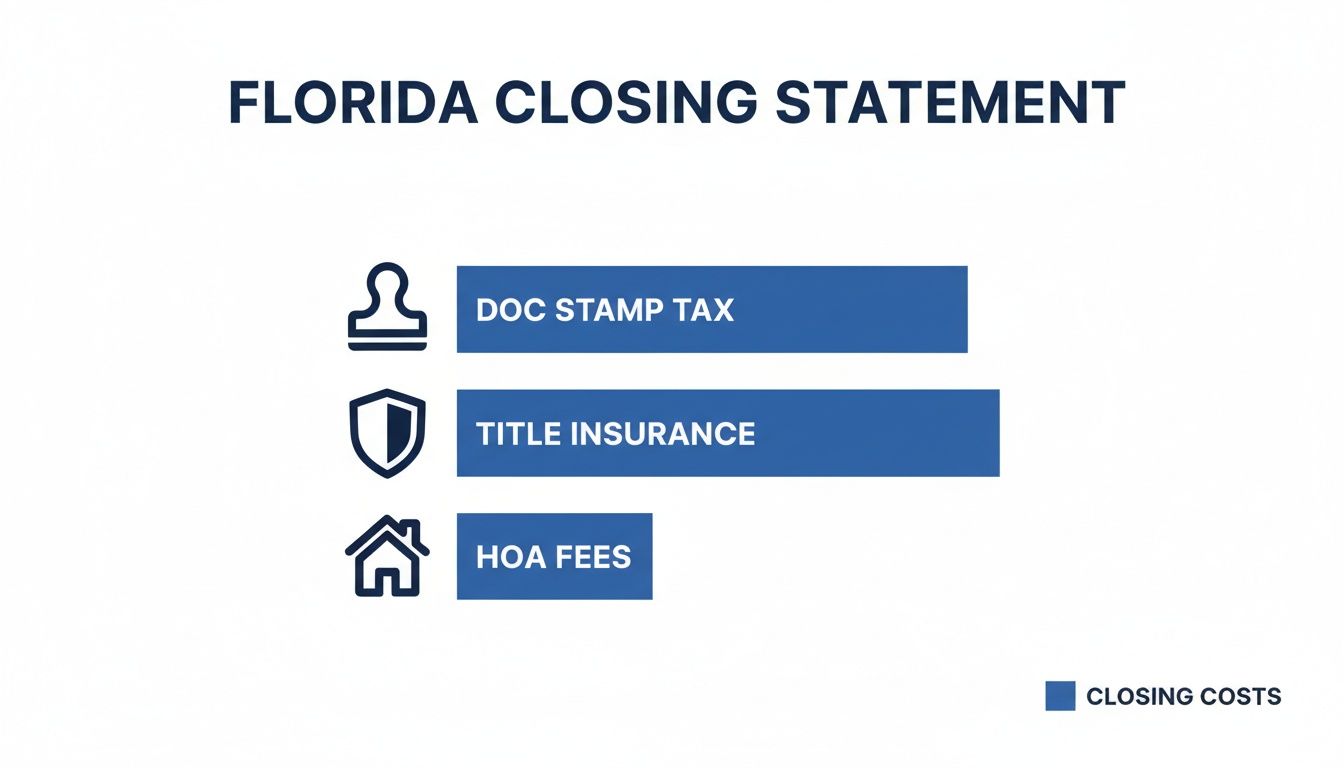
The closing statement for sellers in Florida includes several mandatory fees which you will find when reviewing your documents. The layout might look a little different depending on the title company, but the main items will always be there. Let’s break down the big ones you’re almost guaranteed to see.
- Documentary Stamp Tax: Everyone calls them “doc stamps.” This is the state’s tax on the transfer of property, and it’s a non-negotiable cost for sellers. It’s one of the biggest closing costs you’ll face in Florida.
- Owner’s Title Insurance: In the vast majority of Florida counties, it’s customary for the seller to buy the new owner’s title insurance policy. This is a one-time fee that protects the buyer from any old claims, liens, or other headaches from the property’s past.
- Title Services & Settlement Fee: This fee pays the title company or closing attorney for all their behind-the-scenes work.Think title searches, preparing all the legal documents, and actually running the closing appointment.
- HOA Estoppel Fee: If your home is in an HOA, you’ll see this charge. It’s for a legal document from the HOA confirming that your dues are all paid up. It’s the official proof the buyer needs to know they aren’t inheriting any of your old HOA debts.
Think of your closing statement as the final scorecard for your home sale. Each line item, from the doc stamps to the title fees, represents a play that happened behind the scenes to get you to the finish line. The final number is your net profit—the “game-winning” amount you take home.
Florida’s Documentary Stamp Tax Explained
The documentary stamp tax in Florida stands as the most expensive and mandatory cost which sellers must pay. It’s a straight-up calculation: $0.70 for every $100 of your home’s sale price, which works out to 0.70%. This isn’t a local quirk; it’s a state tax that applies whether you’re selling a condo in Orlando or a beachfront house in Naples.
The tax amount would reach $2,866 for a home that sells at the median price of $409,400. You can dig deeper into Florida’s state-specific transaction costs to see how this and other fees stack up.
Prorations and Final Adjustments
The closing statement is also where you’ll see prorated expenses squared away. The costs get divided between you and the buyer according to the dates when each of you owned the property.
Property taxes are the most common example. You’re on the hook for the taxes covering the part of the year you owned the home, right up to the closing day. The title company does the math, figures out your exact share, and gives the buyer a credit for that amount on the statement. That way, the buyer has the funds to pay the entire tax bill when it comes due later in the year.
If you want to get a better handle on how this works, check out our complete guide on who pays property taxes when you sell a house.
Putting It All Together: What Closing Costs Look Like in the Real World
The real impact of percentages and fee ranges becomes clear when you analyze actual transactions that show how these numbers work in practice. To get a handle on what you’ll actually pay, let’s walk through a few scenarios from different Florida markets.
Your settlement statement’s final amount results directly from your home’s sale price together with its geographical position. The Gulf Coast area with its high property values will produce different financial results for sellers than inland counties which have lower prices.
The final proceeds from your sale will decrease because of the major expenses which include Documentary Stamp Tax and title insurance and HOA paperwork.
Sample Closing Cost Scenarios Across Florida Markets
The best way to understand this is by studying various “seller net sheets.”A net sheet functions as a straightforward calculation tool which begins with your sale price and deducts all anticipated expenses to present your projected net profit. The following table shows how these costs change based on home value and location before you include agent commissions.
| City | Median Sale Price | Estimated Doc Stamp Tax | Estimated Title Fees | Total Estimated Costs (Excl. Commission) |
|---|---|---|---|---|
| Jacksonville | $310,500 | $2,174 | $2,378 | $4,552 |
| Orlando | $409,400 | $2,866 | $2,722 | $5,588 |
| Sarasota | $484,000 | $3,388 | $3,095 | $6,483 |
The final cost you pay depends on your home’s price and the local market practices in your area. Your doc stamp and title insurance costs will increase as your home sells for a higher price.
Let’s dive deeper into some specific examples.
Example 1: Starter Condo in Orlando
For a more entry-level property, the costs are still substantial.
- Sale Price: $250,000
- Documentary Stamp Tax (0.7%): $1,750
- Owner’s Title Policy (est.): $1,375
- HOA Estoppel Letter: $350
- Title/Settlement Fees: $600
- Total Estimated Closing Costs (excl. commission): $4,075
The mandatory fees start to build up quickly even when you sell your home for a lower price. This seller is looking at over $4,000 walking out the door before even thinking about real estate commissions.
Example 2: Median-Priced Home in Jacksonville
The market prices in Jacksonville start at $310,500 which makes the total expenses increase accordingly. The other fees that sellers must pay in addition to agent commissions can reach up to 2.3% of the total sale price.
For a median-priced home in Florida at $409,400, that’s roughly $9,416 in closing costs alone. That number can swing dramatically, jumping to $11,132 in a pricier market like Sarasota (median $484,000) or dipping to $7,141 in Jacksonville.
Example 3: Waterfront Property in Sarasota
Now, let’s look at a higher-end sale where the numbers get really serious.
- Sale Price: $750,000
- Documentary Stamp Tax (0.7%): $5,250
- Owner’s Title Policy (est.): $3,875
- HOA Estoppel Letter (if applicable): $400
- Title/Settlement Fees: $900
- Total Estimated Closing Costs (excl. commission): $10,425
For this luxury property, the seller’s closing costs soar past $10,000—and that’s without commissions. It’s a powerful reminder of how these costs are directly tied to your home’s value, making a precise budget absolutely essential.
The examples demonstrate that your home’s final sale price determines how much you will pay in closing costs. The following options enable sellers to eliminate these ongoing expenses from their selling process. A cash buyer usually pays closing costs through a “net offer” system which means the buyer covers these fees and the agreed price becomes the exact amount the seller receives.
Navigating Commissions and Seller Negotiations
You’ll find the most substantial closing cost for Florida home sales emerges from real estate agent commissions. The fee ranges from 5% to 6% of your home’s final sale price which ends up costing more than all your closing expenses combined.
You need to divide this payment into parts because it does not represent a single payment to your agent. Your home listing agent will receive a commission that gets divided with the buyer’s agent who brings the buyer to the transaction. The service includes marketing your home and running open houses and managing all documentation until the deal reaches completion. Our guide on real estate commissions provides an in-depth explanation of this process.
Understanding Your Negotiation Power
The commission represents your starting point to determine which expenses are fixed and which ones you can negotiate. The process will help you protect your financial stability while achieving the highest possible profit.
Some costs are what they are. The Florida Documentary Stamp Tax requires sellers to pay $0.70 for every $100 of the sale price according to state regulations. The state does not allow any form of negotiation. The sales contract determines which closing costs you and the buyer will pay because these items are negotiable.
Common Areas for Seller Negotiation
Being flexible in your home selling approach will attract more buyers while reducing your stress and expenses. The following list shows the most common items that sellers negotiate about:
- Buyer’s Closing Cost Credits: In a tough market, offering to pay some of the buyer’s closing costs can be a game-changer. The offer functions as a strong bargaining tool which makes the deal more attractive enough for someone to sign it.
- Repair Credits: The home inspection report is a classic negotiation point. You are not required to hire contractors for repairs that the buyer requests. The buyer can choose to do the repairs themselves by accepting a credit at closing which allows them to hire their own contractors.
- Home Warranty: Sometimes, offering to buy a one-year home warranty for the new owner is a smart move. The solution offers buyers peace of mind and proves to be more cost-effective and straightforward than negotiating over multiple small repairs.
Knowing what you can and cannot negotiate is like having a roadmap at the closing table. While you can’t change the state’s tax rate, you can strategically offer concessions on other items to create a win-win scenario that gets your home sold on your terms.
For homeowners who want to avoid the unpredictability of negotiations and commissions and changing fees alternative selling methods offer a straightforward solution.
Exploring Different Ways to Sell Your Home
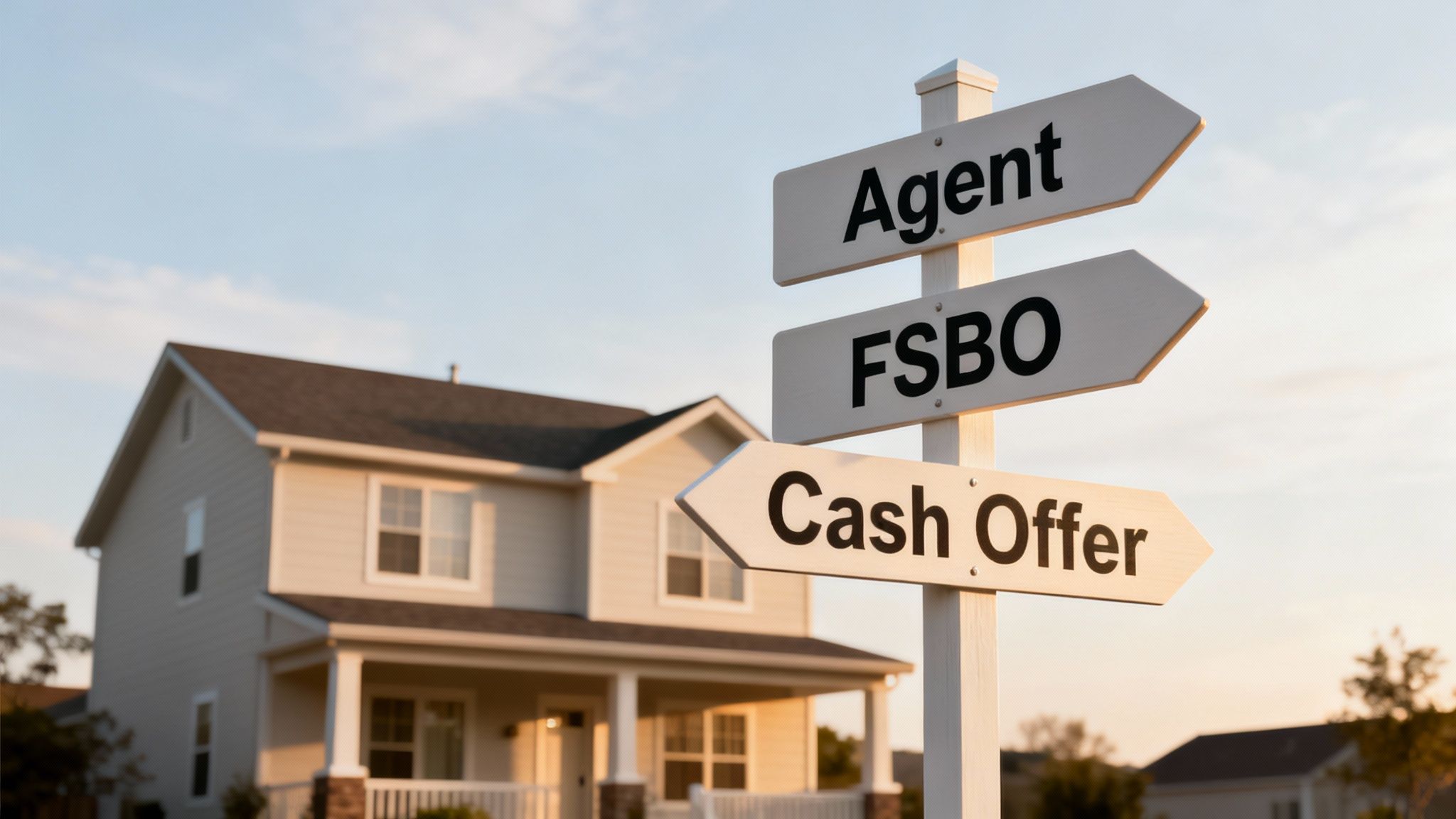
Your first requirement involves determining the total amount of money you will need to cover closing costs. Your home sale method will define your financial results and how long the process takes and how much stress you’ll experience.
There is no universal solution which applies to every situation. The best path for you depends entirely on what you value most—be it the highest possible sale price, the fastest closing, or the least amount of hassle. Let’s break down the most common options.
The Traditional Agent-Led Sale
The majority of people choose this path by default. The real estate agent you hire will handle the process for you. The package includes professional marketing services and expert guidance and negotiation expertise which your representative will provide. Of course, that full-service experience comes with the biggest closing cost of all: the 5-6% agent commission.
Working with an agent means you’re paying for their expertise and network. The agents will handle professional photography and MLS listing creation and all phone inquiries and property showings and complete paperwork management.
- The Upside: A good agent’s primary goal is to fetch the highest possible price for your home. The system establishes a competitive atmosphere which helps you save time and effort by handling everyday tasks.
- The Downside: That commission takes a serious bite out of your final profit. The timeframe remains uncertain because it might take several months to find a buyer and the sale depends on the buyer’s loan approval and home appraisal.
For Sale By Owner (FSBO)
The For Sale By Owner (FSBO) method enables you to reduce your expenses when you handle the work yourself. When you sell your home yourself, you’re the one in charge of pricing, marketing, hosting open houses, and negotiating with buyers.
Selling your home without an agent lets you avoid paying the listing agent’s fee which usually costs between 2.5% and 3% of the sale price. The path demands more work than people normally realize. The process requires significant time investment from you while learning about local market trends and managing legal paperwork independently.
Selling Directly to a Cash Home Buyer
The third option exists to provide quick and easy home sales with absolute certainty. The method functions as a complete alternative to standard home sales. A company that buys houses with cash will present you with a direct offer instead of listing your home to wait for buyer offers.
The main objective shifts from getting the highest price possible to selling the property quickly and with minimum hassle. Cash buyers acquire properties in their current condition so you should stop spending money on home repairs and improvements.
The process eliminates many of the typical uncertainties that occur during a standard home sale. Cash buyers who use their own funds avoid the common deal-breaking problems that stem from financing and appraisal issues at the last minute. Our guide on cash home buyers in Miami shows you how this process works in specific market conditions.
If you want a fast and simple sale this method works well with Eagle Quick For Cash. Our service offers straightforward cash deals which cover all standard seller closing fees. That means the offer you accept is the cash you walk away with. Skip the showings, the back-and-forth, and the surprise fees. See how we can make your sale easier by visiting https://www.eaglecashbuyers.com today.