



When you receive an inherited property your first thought usually focuses on how the tax system will affect this new asset. I need to pay any money? You need to pay capital gains tax on inherited property when you sell it for profit but you will not have to pay this tax during your initial home inheritance.
The step-up in basis tax rule provides strong protection which reduces the expected tax amount to zero for most situations.
The Tax Regulations Which Apply to Property That People Inherit

The financial responsibility of an inherited home seems overwhelming but the related tax obligations prove to be less complicated than most people expect. The main concept you need to understand is that tax applies only to the profit you make after you take legal ownership of the property.
The stepped-up basis becomes your top resource when you reach this stage.
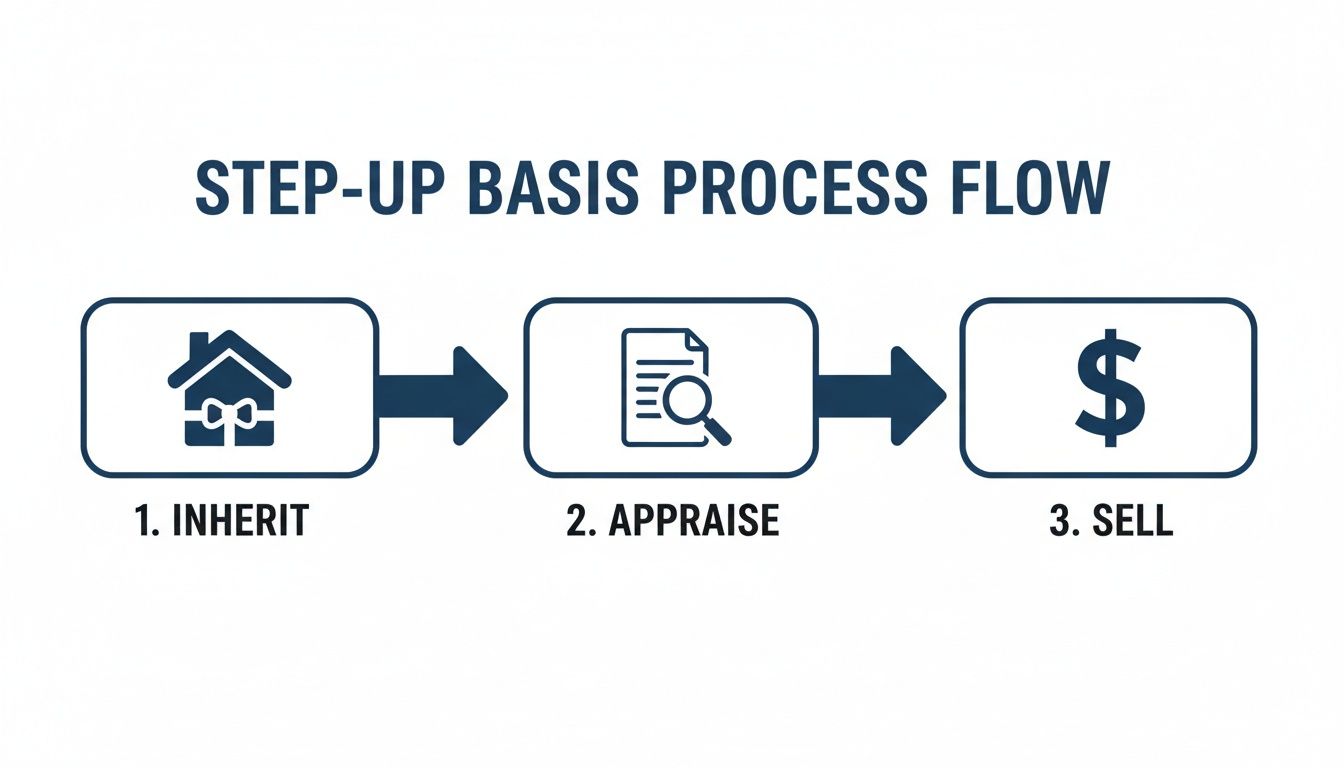
When your parents bought their home forty years ago they paid $50,000 for it. On the day the last parent passed away, the house was appraised at a fair market value of $350,000. The IRS deletes all previous records to start fresh for tax-related matters. They treat the property as if you had just purchased it for $350,000.
The minor but vital modification lets you keep all your property value growth from $300,000 without having to pay any taxes during your parents’ ownership period.
Your Big Advantages As An Heir
The step-up rule offers three main advantages which simplify what would otherwise be a costly and complex situation. You need to understand these points before you can decide what to do with the house.
- Your Tax Bill Shrinks: You’re only on the hook for capital gains tax on any increase in value from the date you inherited it to the day you sell. If you sell quickly, that gain could be zero.
- You Get a “Fresh Start”: All those years—or even decades—of appreciation are effectively erased from a tax perspective.
- You Qualify for a Better Tax Rate: The IRS automatically classifies inherited property as a “long-term” asset. This means you qualify for the lower long-term capital gains tax rates, even if you sell it a week after you inherit it.
The single rule contains all the necessary information to protect you from losing money. The property cost basis changes to its market value at the time of death for the original owner so you will only pay taxes on the value increase which happens after you receive the property.
The impact of this rule is so significant that it’s worth seeing the numbers side-by-side.
Tax Basis Comparison Old Vs Stepped-Up
The following table demonstrates how the step-up basis rule creates major tax advantages for taxpayers. Our example shows a home which was purchased for $50,000 and then inherited at a value of $350,000 before being sold for $360,000.
| Metric | Without Step-Up Basis (Hypothetical) | With Step-Up Basis (Actual Rule) |
|---|---|---|
| Sale Price | $360,000 | $360,000 |
| Cost Basis | $50,000 (Original Purchase Price) | $350,000 (Fair Market Value at Death) |
| Taxable Gain | $310,000 | $10,000 |
The absence of step-up would require you to pay taxes on a $310,000 gain. The rule reduces your taxable gain to $10,000 which represents a small fraction of the total amount.
Tax rules differ based on the area where you live. The guide on Deceased Estate Tax Returns and Capital Gains Tax demonstrates how another nation deals with these matters. The United States follows a fundamental rule which provides heirs with an equal financial position when they receive their inheritance.
How the Step-Up in Basis Rule Works for You
The IRS provides you with a major tax benefit when you receive an inherited property. The step-up in basis stands as the most essential tax regulation which every heir needs to understand. The right solution will help you save tens of thousands of dollars.
Imagine your parents bought their home during the past century while its market value continued to rise throughout the years. The step-up rule resets the property value to zero when you receive an inheritance. All the appreciation that happened while they owned it? Forgiven. Wiped clean for tax purposes. You get a fresh start.
Your parents bought their home for $40,000 but it became worth $400,000 when you received it through inheritance. Your new cost basis isn’t what they paid—it’s $400,000. You don’t need to pay taxes on the $360,000 growth because it belongs to you. You only need to pay capital gains taxes on property value increases which start at $400,000.
Pinpointing the Fair Market Value
The entire step-up process depends on the property’s market value which exists at the time when the original owner passes away. This number represents more than just a rough estimate which you would find on a real estate website. The market price represents the amount which buyers and sellers freely agree to exchange in an open marketplace.
You should hire a licensed certified appraiser to determine this value. The IRS requires this report as their official document. The system provides an exact starting point which you can use to determine all your tax numbers. Spending a few hundred dollars on an appraisal now can save you from a world of hurt and potential tax penalties later.
The “stepped-up basis” rule sets the property value for tax purposes to its market price at the time when the former owner died. The rule stands as the essential regulation which helps you reduce or completely avoid inherited property capital gains tax.
The legal transfer process needs this particular step to be done correctly. Our guide on how to transfer property ownership provides a step-by-step process which helps you handle ownership change procedures when you find them overwhelming.
What Happens with a Step-Down in Basis?
The rule operates as a two-way system which functions in both directions. A step-down in basis will occur when the property value decreases during the time you hold the property.
The property was purchased for $300,000 during the market peak period. The value of the property determined your new basis because it dropped to $250,000 when you received it through inheritance. If you turn around and sell it for $260,000, you actually have a $10,000 taxable gain, even though you sold for less than the original purchase price.
The Long-Term Capital Gains Shortcut
The IRS provides an excellent benefit which allows heirs to receive it. Normally, you have to hold onto an asset for more than a year to get the lower, long-term capital gains tax rates. But with inherited property, that rule goes out the window.
The IRS treats all inherited assets as long-term holdings from the moment you receive them until you decide to sell them. You could inherit a home on a Monday and have a deal closed by Friday—and any gain would still be taxed at those favorable long-term rates. This system provides you with complete freedom to quickly sell property for estate settlement or ownership cost avoidance while avoiding steep short-term tax penalties.
Calculating Capital Gains Tax On An Inherited Home
Now that you have a handle on the powerful concept of step-up basis, let’s get practical. The process of determining capital gains tax on inherited property will not cause you any more stress than you already face. It really just comes down to a simple formula.
The entire calculation depends on subtracting your final adjusted cost basis from the net amount you get from the sale.
The process begins with you needing to obtain a correct market value for the home when you inherited it. That number is your new starting line for any tax math.
The Core Capital Gains Formula
The core of this calculation consists of basic mathematical operations which make it easy to understand. You can figure out your taxable gain with this equation:
Sale Price – (Stepped-Up Basis + Selling Costs + Capital Improvements) = Taxable Gain
The formula contains multiple elements which need to be evaluated independently. The correct placement of your financial details will help you reduce your tax obligations by using legal methods.
Defining The Key Numbers
The correct solution requires you to identify the actual meaning of each term in this equation. People who fail to handle their taxes correctly end up paying more money to the IRS because of their mistakes.
- Stepped-Up Basis: We’ve already covered this, but it’s worth repeating—this is the property’s fair market value on the day the previous owner died. A formal appraisal is your best friend for documenting this critical number.
- Selling Costs: These are all the direct expenses you pay to get the house sold. Think realtor commissions, attorney fees, transfer taxes, title insurance, and other typical closing costs.
- Capital Improvements: This is a big one. These are not routine repairs but significant, value-adding upgrades you make after inheriting the property. A new roof is a capital improvement; fixing a leaky faucet is just maintenance. A full kitchen remodel counts; repainting a bedroom probably doesn’t.
You must keep detailed records which show every single dollar you spend. Every legitimate cost you add to your basis directly reduces the gain the IRS can tax. The process needs particular attention when you work with properties which passed through probate because this legal procedure generates its own unexpected expenses. Our guide on navigating probate property sales will assist you if you find yourself in this situation.
A Practical Calculation Example
We need to analyze an actual situation which demonstrates this concept. The system shows you how to connect every component to its proper place while demonstrating how you can avoid paying any taxes.
You receive a home inheritance from your aunt.
- Stepped-Up Basis: You hire a certified appraiser who determines the home’s fair market value on the date of her passing was $500,000. That’s your starting basis.
- Capital Improvements: The roof is shot, and you know it won’t sell without a new one. You spend $20,000 on a complete replacement.
- Sale Price: With the new roof installed, you list and sell the house for $550,000.
- Selling Costs: The real estate agent’s commission plus other closing fees add up to $30,000.
Now, we just plug those numbers into our formula:
$550,000 (Sale Price) – ($500,000 [Basis] + $30,000 [Selling Costs] + $20,000 [Improvements])
$550,000 – $550,000 = $0 Taxable Gain
The house sale price exceeded its inherited value by $50,000 but you need to pay no taxes on this gain. Your documented expenses will completely eliminate all capital gains tax obligations. Every heir should keep detailed records which serve as their most vital responsibility.
How State Taxes Can Impact Your Final Profit
The federal step-up in basis rule provides a major tax benefit to taxpayers but this advantage only represents one aspect of the entire situation. The other, often overlooked, piece of the puzzle is state taxes. The failure to remember these assets becomes the most severe financial error which an inheritance recipient can commit.
The rules for state-level taxes on an inherited home are all over the map. Some states offer extremely generous inheritance rights to their residents. Florida, Texas, and Nevada residents only need to worry about federal capital gains tax because these states do not impose state-level capital gains taxes. This creates a direct path which helps you understand your financial situation better.
Most states follow a different approach which proves to be less understanding. The tax system treats capital gains as regular income which pushes taxpayers into higher tax brackets while taking more money from their investment returns. You simply can’t assume a one-size-fits-all approach when estimating what you’ll owe.
The Wide Spectrum of State Tax Rules
The cost difference between selling inherited property in states with no taxes versus states with high taxes can reach into the tens of thousands of dollars. You must find your state position on this spectrum before you can proceed with anything else.
Some states require heirs to pay high taxes on the property they receive. New Jersey and New York residents face a combined federal and state tax rate which reaches almost 48%. New Jersey taxes long-term gains at its standard income tax rate, which can be as high as 10.75%. The total tax expenses for sellers will exceed 30% through this process. You can see just how stark the differences are by exploring how the top states tax capital gains.
You need to have a complete map to plan a road trip because missing half your map will disrupt your trip planning. The path to your destination remains unknown because you will experience expensive tolls which will destroy your entire budget.
Practical Steps for Managing State Taxes
- Find Your State’s Method: First, figure out if your state has a separate capital gains rate or if it just taxes the gain as ordinary income. Nine states have no income tax at all, which means you’re in the clear on state capital gains.
- Don’t Forget Other Property Taxes: Capital gains tax isn’t the only cost you’ll face. The homeowner must pay property taxes until the house ownership transfers to another person. Our guide on who pays property taxes when selling a house walks you through these ongoing expenses.
- Talk to a Local Pro: Tax codes are notoriously complicated and always changing. The best way to protect yourself involves consulting with a tax advisor or real estate attorney who practices in the state where the property exists. They will provide you with the most up-to-date and accurate details which apply to your particular case.
Understanding both federal and state tax obligations is crucial to making an informed decision. For those who find that a quick sale is the best financial and logistical path, an “as-is” cash sale can provide a clean exit, especially in high-tax states where carrying costs quickly diminish profits.
Deciding The Best Path For Your Inherited Property
You will transition from emotional property inheritance to practical management after you understand the financial aspects of inheritance taxation. What do you do with it? You need to make a major choice because you face three different paths to select from. Each comes with its own financial and personal implications.
The process requires more than number calculations because it needs to find the best solution for your personal situation. The selection process depends on real estate suitability for your life and financial goals and your ability to handle property ownership. The evaluation process will help you understand the advantages and disadvantages of each choice which enables you to transform your inheritance into a positive asset instead of a financial burden.
Option 1: Keep The Property And Move In
Many people find living in a family heritage home to be an extremely attractive idea. The process requires you to make a financial decision which will help you turn your asset into a home where you can build your own memories.
Pros of Moving In:
- Emotional Connection: You get to preserve a family legacy and live in a place that means something special.
- No Immediate Sale Hassles: You completely sidestep the process of listing, staging, showing, and negotiating a sale.
- Future Tax Breaks: If you make it your primary residence for at least two of the five years before selling down the road, you could qualify for the home sale tax exclusion. The program offers tax protection for up to $250,000 of financial gain which becomes $500,000 for married couples.
Cons of Moving In:
- Ongoing Costs: The financial responsibility is now yours. The property requires payment for property taxes and insurance and maintenance work and all necessary repairs and updates.
- Personal Fit: The home does not match your requirements because its location or size or layout fails to suit your way of life or your family needs.
- Tied-Up Capital: Your inheritance remains inaccessible because it exists exclusively in the property. The equity exists as unusable capital which prevents you from using it for investments or debt payment or reaching other financial targets.
Option 2: Keep The Property And Rent It Out
You need to decide between moving in and selling the property because moving in does not seem like a good option for you. The property generates income through rental operations which makes it a smart investment choice. This strategy enables you to generate wealth by receiving monthly rental payments and watching your property value increase over time.
Pros of Renting:
- Passive Income Stream: A good tenant provides a steady monthly check that can cover the property’s expenses, and hopefully, leave you with a profit.
- Asset Appreciation: You hang onto the property, giving its value more time to potentially grow.
- Tax Deductions: Being a landlord comes with perks. You can deduct a wide range of expenses, including mortgage interest, property taxes, insurance, and repair costs.
Cons of Renting:
- Landlord Duties: This isn’t truly “passive” income. You need to find tenants while handling plumbing repairs and managing empty units and possible eviction procedures.
- Capital Gains Implications: When you eventually sell, you’ll still use your step-up in basis. However, any depreciation you claimed over the years will be “recaptured” by the IRS and taxed.
- Market Risk: Real estate values do not increase at all times. The rental market might experience a decline while property values decrease. You can use a tax-deferral strategy when you sell later; our guide on what is a 1031 exchange shows you how to use this method.
Option 3: Sell The Property
The process allows you to turn your inherited house into cash which you can distribute evenly to your heirs or use for your personal needs. The step-up in basis rule makes this option highly attractive because it usually eliminates all inherited property capital gains tax obligations.
The amount of untaxed gains that exist is beyond what anyone could imagine. In 2021, unrealized capital gains in inherited property were equivalent to a staggering 154% of the entire U.S. GDP. The step-up in basis system enables this by resetting the tax value of property appreciation which has accumulated over many years. You can read more about this massive wealth transfer in this Brookings Institution analysis.
You have two main options when you want to sell your property.
1. The Traditional Market Sale
The traditional approach involves working with a real estate agent to prepare your home for showings through repairs and painting and staging before you list it for sale. The process aims to achieve the highest possible sale price but it creates a lengthy and stressful experience which lacks predictability.
2. A Direct Cash Sale
The alternative is selling the property “as-is” directly to a real estate investment company. The method switches the order of priorities by putting speed and certainty and convenience above the need to get maximum monetary value.
A direct cash sale functions as a strong solution which helps heirs quickly resolve their estate needs while they avoid the costs and challenges of property repairs and they can secure a guaranteed closing without paying agent fees.
You need to manage your inheritance properly because it serves as the foundation for your future financial stability. A high net worth estate planning guide provides useful information about various strategies for estate management. Eagle Cash Buyers offers a simple solution for people who want to sell their property quickly and easily. We buy properties as-is, which means you don’t have to fix a thing. There are no realtor commissions to pay and no waiting around for a buyer’s financing to come through. For those who prioritize speed and convenience, we provide a fair, no-nonsense cash offer and let you close when it works for you.
When a Fast Cash Sale Makes the Most Sense

Selling an inherited home on the traditional market isn’t always the best move. It can be a slow, expensive, and emotionally exhausting process, especially when you’re already navigating grief and settling an estate. In these situations, a fast cash sale can be a refreshingly practical solution.
This approach gives you speed and a guaranteed outcome right when you need it most. It lets you tap into the home’s equity without the usual headaches, unforeseen costs, and delays that can pop up in a standard real estate deal.
When Speed and Certainty Are the Priority
A few common scenarios make a direct cash sale the clear winner. If any of these sound familiar, the benefits of avoiding the open market can easily trump the chance at a slightly higher offer.
- The Home Needs a Lot of Work: Inherited properties often come with a long list of deferred maintenance—think leaky roofs, outdated wiring, or a kitchen from another decade. A cash buyer will almost always purchase the home “as-is,” so you don’t have to spend a single penny or weekend on renovations.
- You Live Out of State: Trying to manage a home sale from hundreds of miles away is a logistical nightmare. A cash sale simplifies everything, often requiring just one quick trip to the property, if that.
- Multiple Heirs Need a Clean Split: When siblings or relatives inherit a property together, disagreements over the sale price, repairs, or timelines can quickly surface. A fast, straightforward sale provides a clear dollar amount that can be divided fairly and without fueling family drama.
A direct cash sale offers a no-nonsense solution. It cuts out agent commissions, repair costs, and months of waiting. For heirs watching carrying costs like taxes and insurance pile up, a guaranteed closing date provides immediate financial relief.
Avoiding Financial and Emotional Burdens
The financial weight of an inherited property can hit you fast. You’re suddenly on the hook for property taxes, homeowners insurance, utilities, and general upkeep. These carrying costs can eat into an estate’s funds, making a quick sale a top priority.
While inheritance taxes are becoming less common worldwide—contributing just 0.5% of total tax revenues in OECD countries that levy them—the tax implications for heirs are still very real. The U.S. federal estate tax only applies to massive estates (over $13.61 million in 2024), but the potential for inherited property capital gains tax from the sale is something every heir needs to consider. You can read more about these global inheritance tax trends from the OECD.
Ultimately, opting for a cash sale is about choosing peace of mind. It eliminates the stress of staging, open houses, drawn-out negotiations, and the ever-present risk of a buyer’s financing falling through. If this streamlined path sounds right for you, working with one of the reputable companies that buy houses for cash, like Eagle Cash Buyers, can provide a fair offer and a smooth experience that works on your schedule.
Got Questions? We’ve Got Answers.
Inheriting a property brings up a lot of “what if” scenarios. It’s completely normal to have questions. Let’s tackle some of the most common ones that heirs run into when dealing with the financial side of things.
What Happens If I Sell The House For A Loss?
It’s not uncommon for an inherited property to sell for less than its stepped-up basis, especially in a changing market. If this happens, you have a capital loss. Don’t think of it as just a financial hit; it’s actually a useful tool for your taxes.
First, you can use that loss to cancel out capital gains from other investments, like stocks or mutual funds you sold. If you have more losses than gains, you can then deduct up to $3,000 of the loss against your regular income (like your salary) each year. Any loss left over after that can be carried forward to offset gains or income in future years.
Are The Rules Different When Inheriting From A Spouse?
Yes, and they’re usually much better. For a surviving spouse, the rules are often more generous, particularly in community property states like California, Arizona, or Texas. In these states, the entire property—both the deceased spouse’s half and the surviving spouse’s half—gets a full step-up in basis to its value at the time of death.
In most other states (known as common law states), only the deceased spouse’s half of the property gets the step-up. Even so, this provides a significant tax break if the surviving spouse decides to sell down the road, as it wipes out a good portion of the potential capital gain.
Understanding how your state handles spousal inheritance is a big deal. This benefit can dramatically increase how much cash you walk away with after a sale, so it’s always smart to check with a local tax pro.
How Long Do I Have To Sell An Inherited House?
There’s no ticking clock from the IRS. You can hold onto an inherited house for years if you want. The pressure to sell usually comes from a more practical place: money.
The moment that property becomes yours, so do all the bills. We’re talking about:
- Property taxes
- Homeowners insurance
- Utilities (water, electric, gas)
- Upkeep and maintenance
- HOA fees, if there are any
These carrying costs add up fast and can become a real drain on the estate’s funds or your own bank account. This financial reality is why most heirs feel a natural sense of urgency to decide whether to sell, rent, or move into the home.
Deciding what to do with an inherited home is a balancing act between your financial goals and the day-to-day realities of property ownership. Whatever path you choose—moving in, renting it out, or selling—understanding the tax implications is the first step to making a smart decision.
If you find that a quick, straightforward sale is the best solution for your situation, Eagle Cash Buyers offers one of several options available to you. We buy properties as-is, which means you don’t have to fix a thing. There are no realtor commissions to pay and no waiting around for a buyer’s financing to come through. For those who prioritize speed and convenience, we provide a fair, no-nonsense cash offer and let you close when it works for you. Get your no-obligation cash offer today.