
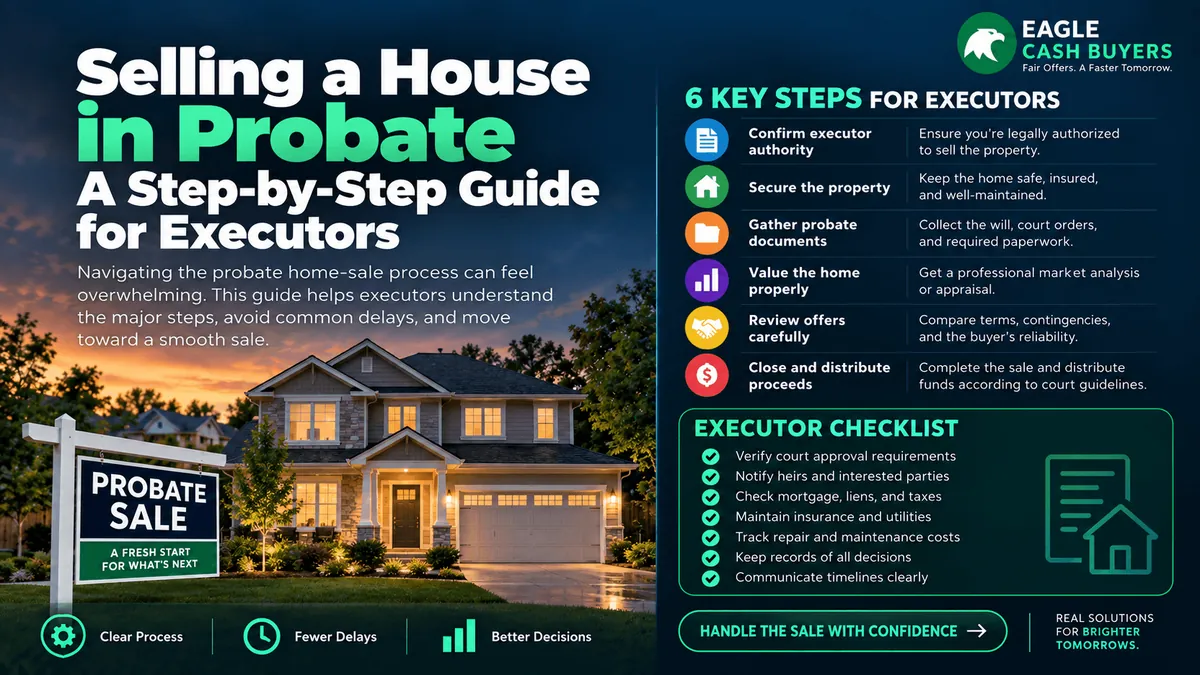
You've just been named executor of an estate, and among the bank accounts, paperwork, and family conversations is a house that needs to be sold. Selling a house in probate is a different process from a normal sale, and you may never have done it before.
Maybe you knew this was coming. Maybe you didn't. Either way, you're now responsible for selling someone else's property through a legal process that has its own rules. And every month that house sits unsold, it may be costing the estate money.
This guide walks through the probate home sale process step by step: what documents you need, how the court is involved, what selling path makes financial sense, and how to protect yourself as executor along the way. Probate rules differ by state and sometimes by county, so treat this as a map rather than legal advice, and confirm each step with a probate attorney where the estate is opened.
Can You Sell a House During Probate?
Probate is the court process for transferring a person's property after they die. The court confirms that any will is valid, makes sure the debts are paid, and sees that whatever is left goes to the right people. How long all that takes depends on the probate court and the estate. A house is one of the assets. Often the biggest.
So can you sell it while the case is open? Often, yes. An executor or administrator can generally sell estate real estate once the court has given legal authority, usually through Letters Testamentary (if there's a will) or Letters of Administration (if there's no will). In many cases you don't have to wait for the whole probate case to finish, although some states require the court to approve the sale first.
How long probate lasts depends on the state, the county and how complicated the estate is. Our guide to how long probate takes covers what drives the timeline. Selling during that period is common and often necessary: to pay estate debts, to distribute proceeds to heirs, or to stop the carrying costs on a property the estate can't afford to maintain.
The critical starting point: generally, nothing legal happens until the court issues your Letters. Without them you usually can't sign a listing agreement, accept an offer, or close a sale. That document is the executor's legal foundation. A few situations are different, and our guide on selling a house before probate explains when.
If the property was held in a living trust, had a transfer-on-death deed, or was owned as joint tenants with right of survivorship, it may pass outside probate entirely. For that process, our guide to selling an inherited house covers the full picture.
What You Need Before You Can Sell (Executor Checklist)
Before you can legally sell a probate property, you need court appointment, the right documents, and in some states, specific approvals. Here's what to gather before you contact a buyer or list the property.
- Letters Testamentary or Letters of Administration (from the probate court; your legal authority to act)
- Certified death certificates (several copies; title companies, banks and the court will each usually want one)
- The original will (if one exists)
- An EIN for the estate (Employer Identification Number; the IRS tells a personal representative to apply for one as soon as possible, because it goes on the estate's returns and other filings; see IRS Publication 559)
- Professional appraisal establishing fair market value as of the date of death
- Property insurance that still covers the house (a homeowner's policy may not cover a vacant or inherited home, so ask the insurer what the policy does after a death)
- Will review for sale authority (does the will give the executor the power to sell, and does your state require court supervision or approval?)
- Title search to identify liens, unpaid taxes, or encumbrances
- Beneficiary and heir notification per your state's requirements
- Court approval to sell (if supervised administration applies in your state)
This list isn't exhaustive for every state, and probate rules vary. A probate attorney in your jurisdiction can confirm what's needed before you proceed.
The 7 Steps to Selling a House in Probate
The probate home sale follows a fairly predictable sequence. The timeline and the details vary by state and administration type, but the core steps are the same.
Step 1: File the Will and Open Probate
File the will (if one exists) and a petition with the probate court, usually in the county where the deceased lived. Filing deadlines and hearing schedules vary by state and court, so ask the court clerk or your attorney early. The court reviews the petition and appoints the executor or administrator.
If there's no will, the court appoints an administrator, usually the closest surviving relative who petitions for the role.
Step 2: Get Your Letters Testamentary
The court issues Letters Testamentary (with a will) or Letters of Administration (without one). This document is your legal authority to act on behalf of the estate. Keep several certified copies. Title companies, banks, and buyers will usually want one. Order extras early.
Step 3: Secure the Property and Stop the Bleeding
Change the locks. Transfer or obtain property insurance in the estate's name. Keep utilities on, especially in winter, to prevent pipe damage. Keep property taxes and any mortgage current from estate funds, as far as your attorney advises. Small steps count.
This is where carrying costs begin. A vacant inherited home keeps generating bills: mortgage payments if there is a loan, taxes, insurance, utilities, and basic maintenance. Every month the property sits unsold is money leaving the estate.
Step 4: Get the Property Appraised
Order a professional appraisal to establish the property's fair market value as of the date of death. Do it early.
The appraisal serves three purposes: it documents the stepped-up tax basis for the heirs (more on that below), it sets the benchmark for fiduciary pricing, and it gives you a defensible number if anyone later questions the sale price.
The house is not the only thing to value. Many courts also expect an inventory of the estate's assets, listing the bank accounts, investments, vehicles and personal property alongside the real estate. In California, for example, the personal representative must file an inventory within four months after appointment (Alameda County Superior Court). Other courts set their own requirements and deadlines, so ask the clerk early. Miss one and everything stalls.
Step 5: Decide How to Sell
You generally have three options: list traditionally with an agent, sell to a cash buyer, or auction. The right choice depends on the property's condition, your timeline, the estate's carrying costs, and whether the heirs are aligned. Each route has trade-offs.
A traditional listing may bring the highest gross price, but it usually takes longer and comes with commissions, carrying costs, and repair expenses. A cash sale can close faster and avoids commissions and repairs, but the price is below market. We compare the two in detail below.
An auction is the odd one out. It sets a fixed date, and the property usually sells as-is, but the price depends entirely on who shows up to bid on the day, and whether an auction suits an estate at all varies by state and court.
Whichever route you pick, expect to sell the house as it stands. Estates rarely have cash for repairs, and heirs who live far away don't want to run a renovation from a distance. Buyers know that. They price in the work, which is why a rough house in probate can draw cash offers from investors, who can take on a project and close without a lender, as well as offers from families.
Step 6: Follow Your State's Notice and Approval Requirements
Notice and approval rules depend on the state and on how the estate is administered. Check early.
Under what many states call independent administration (where the will grants broad authority or the court approves it), the executor can often sell with limited court involvement, usually after notifying the beneficiaries of the proposed sale. Under supervised administration, you typically have to petition the court to approve the sale, and the court may hold a hearing. Each approval step adds time. California shows how the split can work: an executor with "full" authority under its Independent Administration of Estates Act can sell real property after giving notice of the proposed action, while one with "limited" authority needs court approval first (Alameda County Superior Court). Other states do it differently.
Always confirm the requirement with your probate attorney before you accept an offer.
Depending on the state, the court may need to approve the listing price, the accepted offer, the final transaction, or none of those. Where approval is required, a signed contract is only the start. The court can still say no. Ask your attorney what it needs, and by when, before you promise any buyer a closing date.
Step 7: Close the Sale and Distribute Proceeds
The title company handles closing, just like any home sale. The executor signs in their capacity as executor, not as an individual. Proceeds go into the estate bank account. From there, pay estate debts (mortgage, liens, taxes, probate costs) and distribute what remains to beneficiaries per the will or intestacy laws. File final tax returns, give the court a final accounting if it requires one, and close the estate. Keep every receipt.
For more on how the title process works in a cash sale, that guide covers the seller's side.
Independent vs. Supervised Administration: Why It Matters for the Sale
One of the biggest variables in selling a probate house is whether the estate operates under independent or supervised administration. The distinction can add months to the timeline or cut them. It matters.
| Factor | Independent Administration | Supervised Administration |
|---|---|---|
| Court involvement | Usually lighter after appointment | Active throughout; the court reviews major decisions |
| Sale authority | The executor can often sell after notifying beneficiaries, if the will or the court allows it | The executor typically petitions the court for permission to sell |
| Timeline impact | Usually shorter | Usually longer; each approval step adds time |
| How you get it | Varies by state: often the will grants it, heirs consent, or the court approves | Varies by state: the default in some places, and it may apply if the will is silent or heirs object |
| Best for | Straightforward estates with cooperating heirs | Contested estates, unclear wills, disputes among heirs |
Names and defaults differ from state to state, and some states use different terms altogether. If the will gives the executor a power of sale, the process is usually simpler. If the will is silent, or there's no will, some states require court approval before the executor can accept an offer. Your probate attorney can tell you which rules apply to your estate. Ask before acting.
Who Is Involved in a Probate Sale, and Who Gets Paid First
More people sit at the table in a probate sale than in an ordinary one. Each can change the schedule.
- The executor or administrator makes the decisions for the estate and signs the sale documents. That means finding time for filings, appraisals and heir updates alongside a job and a family, usually while grieving.
- The probate court oversees the estate. It checks the rules were followed.
- Creditors are the people and companies the deceased owed. They may have claims against the estate, and the process and deadlines vary by state.
- Beneficiaries inherit what is left after debts and expenses. They don't run the sale, but a dispute among them can stall it badly.
Creditors shape what heirs actually get. Sale proceeds generally go first to the mortgage and any liens, then to taxes, medical bills and other debts, in an order your state sets, and only then to the beneficiaries, so the check an heir receives can be far smaller than the sale price suggested. Talk about the debts early. Before anyone starts planning how to spend the inheritance, ask your attorney how your state ranks the claims.
What a Vacant Probate House Costs Every Month
A vacant inherited property doesn't just sit there. It costs the estate money every month it isn't sold.
An Illustrative Monthly Cost on a $250,000 Home
The figures below are hypothetical and rounded. Swap in your own bills.
| Monthly Expense | Illustrative Amount |
|---|---|
| Mortgage payment (if applicable) | $1,200 |
| Property taxes | $350 |
| Homeowners/vacant property insurance | $150 |
| Utilities | $150 |
| Lawn care and basic maintenance | $100 |
| Total monthly carrying cost | $1,950 |
At $1,950 per month, in this hypothetical:
- 6 months: $11,700
- 12 months: $23,400
- 18 months: $35,100
Every dollar in carrying costs comes directly out of what the heirs receive. That is why the selling method can matter as much as the sale price. In this example, each month saved is $1,950 back to the estate.
Selling a Probate House for Cash vs. Listing Traditionally
An executor can sell a probate house to a cash buyer or list it with an agent. The example below is hypothetical. Every number is rounded and made up to show how the math works, not to predict what your house will sell for.
Assume a house that would sell for $250,000 once it is fixed up, and the $1,950 monthly carrying cost from above. A cash offer is lower than what a fully prepared listing might bring. How much lower depends on the condition, the title and the buyer, and $200,000 is used here only as a round number. The mortgage payoff and other estate debts come out of the proceeds on either path, so they are left out.
| Factor | Cash Sale (hypothetical) | Traditional Listing (hypothetical) |
|---|---|---|
| Sale price | $200,000, as-is | $250,000, after prep |
| Agent commission | None on a direct sale with Eagle | $12,500 (5%; commissions are negotiable) |
| Closing costs to the estate | Eagle pays customary closing costs; the mortgage payoff, back taxes and liens, and the seller's share of transfer tax still come out of proceeds | $5,000 (about 2%; varies) |
| Repairs and prep | None required | $10,000 |
| Carrying costs | $3,900 (2 months) | $15,600 (8 months) |
| Net to the estate | $196,100 | $206,900 |
In this example the listing nets about $10,800 more. It gets there only if the estate has both the time to wait and the money to put the house right, and only if the sale doesn't fall through. Stretch the listing to 14 months and the carrying costs alone ($27,300) close the gap, leaving the two paths about even. A buyer who relies on a mortgage can also back out late, which restarts the clock.
So the honest answer is that a listing can net more when the estate can afford to wait and to prepare the house. A cash sale tends to make sense when the house needs work the estate can't fund, the carrying costs are heavy, or the heirs want a quicker close.
If you ask Eagle Cash Buyers for an offer, Eagle may buy the house directly or assign the contract to another buyer, and that is disclosed in the agreement before you sign. Closing can happen in as little as 21 to 42 days, or later if the estate needs more time, and the seller picks the date. The court's timetable may set the earliest possible date. If speed is your main concern, see our guide on selling a house fast during probate.
For a deeper dive, our cash offer vs. agent comparison runs the math across more scenarios. And our offer formula breakdown explains how cash buyers arrive at their number.
One more habit worth building: get more than one offer if you can. Compare them line by line. Look at who pays what at closing, whether the buyer may assign the contract, and how much time the buyer needs before and after the closing date, because a higher number on paper can hide a weaker deal.
Your Fiduciary Duty as Executor (And What Can Go Wrong)
As executor, you have a fiduciary duty to act in the best interest of the estate and its beneficiaries. When selling real estate, that generally means seeking fair value, avoiding self-dealing, and treating all heirs equitably. Failing to meet that duty can have serious legal consequences. California's court form DE-147 is one example of how a court explains a personal representative's duties and what can happen if they are not fulfilled.
Practical steps:
- Get a professional appraisal before selling. This documents fair value and protects you from claims the house sold too cheaply.
- Don't sell to yourself, a family member, or a business partner at a below-market price without full transparency to all heirs and, where your state requires it, court approval.
- Document every decision. Why this buyer? Why this price? Why this timeline? A paper trail is your protection.
- Keep estate funds separate. Use a dedicated estate bank account with its own EIN. Never commingle estate money with personal funds.
- Communicate with all beneficiaries throughout the process. Transparency can reduce disputes.
A fiduciary's job is to get fair value for the estate, which is not always the same as the highest possible price. A sale at a documented price, with the carrying-cost savings and the reasons for selling quickly written down, can be a reasonable choice, but courts look at the facts of each case. Ask a probate attorney if you have any doubt.
From Our Transactions: Proving Who Has Authority to Sell
Authority questions can come up in family and estate sales. One transaction in Eagle's files involved a house in the eastern U.S. where the deed was in the father's name and the son handled the negotiating. It was not an estate sale, because the father was alive, but an executor faces the same question: is the person on the phone the person who can sign?
Eagle's acquisition manager wouldn't proceed on the son's word alone, even though the son was clearly running the conversation. "Legally I still gotta hear your voice," the manager told the son, asking to speak directly with the father. Both were brought onto the call, and the father gave verbal consent authorizing his son to handle everything on behalf of the property.
Then the contract was walked through line by line with both of them listening: the as-is condition, how closing costs were handled, the earnest money deposit, and the assignment clause, which was disclosed up front rather than buried. The son also had a realtor review the contract independently before signing, and Eagle encouraged it: "That's totally fine... any questions, anything, you shoot me a text message."
For an executor the practical lesson is to expect a legitimate buyer to ask for your Letters and to verify who can sign. If a buyer doesn't ask, treat that as a red flag.
(This account is from an Eagle seller file. The record does not confirm whether the sale closed.)
The Stepped-Up Tax Basis (How It Can Save Heirs Money)
When you inherit a property, the tax basis generally "steps up" to the property's fair market value on the date of death. That can reduce or even eliminate capital gains tax if the property is sold near that value.
Here's a hypothetical. The original owner bought the house for $80,000 decades ago. Had they sold it for $250,000 while alive, they'd have owed tax on $170,000 of appreciation. The heir's basis is instead about $250,000, the date-of-death value. Sell it at or near $250,000 and the taxable gain is small or zero.
That means selling sooner can be tax-friendly. The longer you hold the property after the date of death, the more it may appreciate above the stepped-up basis, which can create a taxable gain that a quicker sale would have avoided. Timing matters.
A date-of-death appraisal is the usual way to document that value, which is another reason to order it early. There are exceptions, such as an estate that elects an alternate valuation date. See IRS Publication 551 on the basis of assets, and talk to a tax professional about your situation, since state inheritance and estate taxes vary.
What Happens When Heirs Disagree About Selling
Heir disagreements can stall or even derail a probate sale. One heir wants to sell fast. Another wants to keep the house. A third thinks the price should be higher. As executor, your fiduciary duty is to the estate as a whole, not to any individual heir's preference.
If the will directs the property to be sold, the executor generally has authority to proceed even if not all heirs agree. Heirs can usually file objections with the court, but they need legal grounds, such as a below-market price, self-dealing or a breach of duty, and not just personal disagreement. The details depend on your state and the will.
If there's no will and heirs disagree, the executor may need to petition the court for authority to sell. The court weighs the estate's interest: are carrying costs mounting? Are debts going unpaid? Is the property deteriorating?
Real Seller Story: "Do All the Heirs Have to Sign?"
A woman in New England was named executor of her late father's estate. Its main asset was a small house in rough shape. Her first question to Eagle wasn't about price. It was about her sister. She had read that her sister might have to sign the sale, or could fight it through probate if she thought it was unfair.
In her case, the answer she was given was that the sale needed her signature as executor, and her sister had already agreed to selling. Whether that holds for you depends on the state, the will and the court, so ask your probate attorney. But the fear was real enough to hold her up, and many executors carry it into the first conversation.
(This account is from an Eagle seller file, which ends the day the purchase agreement was signed. It does not say how the sale finished.)
Practical advice: communicate early and often. Share the appraisal, the carrying cost math, and the reasons for your recommended selling path. A partition action (a lawsuit to force the sale of jointly held property) is the nuclear option. It is expensive, slow, and hard on families. Mediation or a frank conversation is usually better.
A fast sale can sometimes be the path of least conflict. It shortens the window for disagreement, removes months of decisions about repairs and staging, and puts proceeds in the estate account for distribution.
Frequently Asked Questions
How long does it take to sell a house in probate?
It depends on your state, the county probate court, how the estate is administered, and how you sell. Simple estates move faster and contested ones take longer. A cash sale can close in as little as 21 to 42 days once you have the legal authority to sell, while a traditional listing adds the time to prepare, list, and close. Ask your probate attorney for a realistic timeline in your court. Do not guess.
Can an executor sell a house without all beneficiaries approving?
Often, but it depends on the state, the will and the court. If the will gives the executor authority to sell, or the court orders the sale, the executor can usually proceed. Heirs can file objections, but they generally need legal grounds. The executor's duty is to the estate as a whole.
Does a house have to go through probate before it can be sold?
Not always. Property held in a living trust, with a transfer-on-death deed, or owned as joint tenants with right of survivorship may pass outside probate. If the property was solely in the deceased person's name with no such designation, probate is generally required before a sale can close, though some states have simplified procedures for small estates.
What is the difference between Letters Testamentary and Letters of Administration?
Letters Testamentary are issued when the deceased left a will naming an executor. Letters of Administration are issued when there's no will and the probate court appoints an administrator. Both documents grant legal authority to act for the estate, which generally includes selling real estate, subject to your state's rules.
Do you have to pay capital gains tax when selling an inherited house?
Often little or none if you sell near the date-of-death value. Inherited property generally receives a stepped-up tax basis equal to its fair market value on the date of death. Hold the property and sell later at a higher price, and you may owe capital gains tax on the appreciation above the stepped-up basis. A tax professional can confirm how it applies.
Can you sell a probate house to a cash buyer?
Yes, a probate sale can go to a cash buyer as long as the executor has legal authority (Letters Testamentary or Administration) and follows the state's notice and approval requirements. A cash offer can close faster, which reduces carrying costs. The sale must still meet fiduciary standards for fair pricing, and the cash price is below what a fully prepared listing might bring.
Can I sell a probate house without making repairs?
Often, yes. A probate house can be sold as-is. Say so honestly. Expect the price to reflect the condition, and expect investors as well as families to bid on a house like this, since investors are often the ones willing to take on a new roof, aging systems and a long list of small repairs that an estate would rather not touch.
Do I need a real estate agent to sell a probate house?
Not always. An agent who knows probate sales can help price an as-is house and handle showings, while your attorney handles the court side. If you sell directly to a cash buyer, there is no agent commission on a direct sale with Eagle. Simple.
How much does probate cost?
It varies widely by state and estate. Probate court filing fees, attorney's fees, appraisals, executor compensation and accounting costs all differ. Ask your attorney for an estimate, and note that probate expenses are generally paid from the estate.
What happens if the executor doesn't sell the house?
If the will directs a sale, the executor generally has a duty to carry it out. If the estate has debts that must be paid from the sale, failing to sell can create problems for the executor. Even without a mandate, an executor who lets a property deteriorate or pile up avoidable carrying costs can face hard questions from the probate court or the heirs. Talk to a probate attorney about your executor duties.