
How long does probate take? There is no single answer, and anyone who offers you one number is guessing. Some estates close quickly. Others stay open for a year or longer, especially when the local court is busy or the family cannot agree on who should get what. Plan for the slow end.
The wait matters most when the estate includes a house. Why? Property taxes, insurance, utilities and upkeep keep coming while the court process runs. This guide covers what sets the clock, the five stages where the time goes, what an inherited house costs you while you wait, and what you can do in the meantime.
Everything here is general. Probate rules and timelines vary by state and often by county, so confirm the details with a local probate attorney or the court clerk.
How Long Does Probate Take? What Sets the Clock
Probate is not one hearing. It is a series of steps, and some of them carry waiting periods written into state law. How long a probate case runs depends on the kind of estate far more than on any average, and the factors below do most of the work.
Michigan's court forms show what those built-in waits can look like in one state. The court's notice to creditors form gives creditors four months after the notice is published to present their claims. The letters of authority form says that if the estate is not settled within a year of the personal representative's appointment, the representative must file a notice explaining why it is still open. Other states set different numbers. Treat these as an illustration. Not a forecast.
| Factor | Tends to move faster | Tends to take longer |
| The will | A clear, valid will with the original available | No will, a disputed will, or only a copy |
| The heirs | They agree and answer the court and the executor quickly | Disputes, or heirs who are missing or hard to find |
| The assets | A house and a few accounts | A business, out-of-state property, or items that are hard to value |
| Debts and taxes | Few creditors and no tax questions | Large debts, or tax filings under review |
| The court | Uncontested filings and a responsive clerk | Required hearings and a backlog in your county |
Taxes can add steps too. A federal estate tax return is only required above a threshold, which the IRS lists as $15,000,000 for deaths in 2026. Some states have their own estate tax at a lower level. Washington does, for example.
Averages from other places will not tell you how your probate court runs. Ask the clerk or a local probate attorney what is typical in your county. Local knowledge beats a national figure.
The Five Stages of Probate and Where the Time Goes
The order and the names change from state to state. Still, most estates move through the same five stages, and when an estate drags on, the delay almost always hides in one of them. Find it.
| Stage | What happens | What tends to slow it |
| 1. Filing the petition | The executor or a close relative asks the court to open the estate, and the court appoints a personal representative with legal authority | The court's calendar, required hearings, a missing original will |
| 2. Notifying heirs and creditors | Beneficiaries and known creditors get formal notice, and a public notice reaches creditors nobody knows about | A creditor window set by state law, which cannot be skipped |
| 3. Inventorying and valuing assets | The executor finds, documents and values everything the person owned | Businesses, out-of-state property, accounts nobody knew about |
| 4. Paying debts and taxes | The estate settles what it owes before heirs receive anything | Large debts, tax questions, too little cash in the estate |
| 5. Distributing assets and closing | The executor prepares a final accounting, a judge may need to approve it, and the assets go to the beneficiaries | Objections from heirs, court approval timing |
Inventorying and Valuing Assets
This stage often takes the most work. The executor has to track down the house and any land, bank and investment accounts, retirement accounts, vehicles, jewelry, collectibles and business interests. A house usually needs a professional valuation.
Unusual assets are where the months go. A family business, commercial property, rare collectibles or real estate in another state can each call for an accountant, an appraiser, an attorney and extra court filings. Expect delays here.
Paying Debts and Taxes
Creditors come before heirs. The bills can include funeral costs, medical bills, credit cards, mortgage balances, property taxes and the final income tax return, and large debts slow everything behind them. Short on cash? Then the executor may have to sell the house to cover what is owed, and a sale stops being optional. Our guide on how to sell a house in probate fast explains what a sale can and cannot do while the estate is open.
What a Missing, Disputed or No Will Does to the Timeline
A person who dies without a valid will is called intestate. The estate still goes through probate, but the court follows state law instead of the deceased person's wishes, which usually means extra steps such as identifying the legal heirs, appointing an administrator and applying the state's rules for who inherits what. A family dispute can add far more time than any of that.
Contested wills are one of the biggest causes of delay. A relative might claim that:
- The person lacked mental capacity when the will was signed
- Someone pressured or manipulated them
- A newer will exists
Once a claim like that is filed, probate stops being paperwork and becomes a lawsuit. Hearings follow. Sometimes a trial does too, and no executor can schedule or speed those up alone.
A missing original will creates its own delay. Many courts want the original, and what they accept when only a copy survives varies by state. Ask the attorney's office early who holds the original.
Real Seller Story: When the Original Will Went Missing
A woman was administering her late father's estate and wanted to sell his house. The house itself was in good shape. The paperwork was the problem. The family had a copy of the will, but the original had never come back from the attorney's office, and each visit to ask about it ended the same way. Her mother and brother were still living in the house.
Eagle's first contract set a 60-day closing. She called back because her mother and brother needed more time to pack up a house they had lived in, and the contract was changed to 90 days during that same call. Later, with the missing original threatening to push past the planned closing date, she raised the idea of pausing for a year. She knew a pause could mean a different contract, a different value and new inspections. Eagle's acquisition manager asked her to send the paperwork so the company's attorneys could look at it, and said he would come back with what they said.
How the probate question was resolved is not something we can share. The point is how the timeline bent around a real family: a closing date that moved, and a lawyer's review instead of pressure.
What Happens to an Inherited House While Probate Is Open
An inherited house does not sit for free. It costs money every month. The estate stays responsible for:
- Property taxes
- Insurance and utility bills
- Lawn care, snow removal and basic maintenance
- Repairs and HOA fees, if there is an association

Empty homes also deteriorate. Leaks, mold, vandalism and storm damage are more likely when nobody is there to notice. Tell the insurer that the owner has died and ask what a vacant house does to your coverage, because some policies limit it. We cover the practical side in our guide to selling a vacant house.
If there is a mortgage, the payments are still due. Federal servicing rules generally keep a servicer from making the first foreclosure filing until a loan is more than 120 days delinquent. That is a short cushion. Probate can take months. Our guide on how long the foreclosure process takes shows how fast things can move once a lender starts.
Your Options for the House During Probate
If nothing is wrong with the title and the family agrees, heirs generally choose among three paths.
Keep the House Until Probate Ends
Some heirs hold the house and decide after the court transfers it. That works best when the estate has cash for the carrying costs, the family agrees and the property is in good condition. The downside is plain. The holding costs continue every month.
Prepare for a Traditional Sale
An executor can start preparing the house for a listing while the estate is open. That usually means:
- Cleaning out and decluttering, once the person in charge has authority to do it
- Repairs the house needs
- Choosing a real estate agent and a price
- Accepting an offer that depends on court approval
You cannot close until the court has given the executor authority. Early preparation can still save months. Do it anyway. A listing can also net more than a cash sale when the estate has both the time and the money to put the house right and wait for a retail buyer.
Line Up a Cash Buyer
Some families would rather have certainty than a long listing. A cash buyer purchases the house as is, so there are no repairs to arrange and no agent commission on a direct sale. The cash price is below what a repaired, well-marketed listing could bring, so you are trading some price for speed and certainty.
A contract can be written around the court's timetable. At Eagle Cash Buyers, closing can happen in as little as 21 to 42 days, or later if the seller needs more time, and the seller picks the date. The sale still cannot close until the person selling has legal authority. Eagle may buy the house directly or assign the contract, and that is disclosed in the agreement before you sign. Whether we can make an offer depends on the property, the title and our buying criteria. Our guide to selling a house before probate ends covers what is and is not possible while the estate is open, and how to sell an inherited house covers the tax and mortgage questions.
How to Keep Probate Moving
Probate cannot be made instant. You can avoid some delays that families create for themselves:
- Keep deadlines and records organized
- Talk with the other heirs early and often
- Answer court and attorney requests quickly
- Hire a probate attorney who works in your county
- Deal with property problems before they get expensive
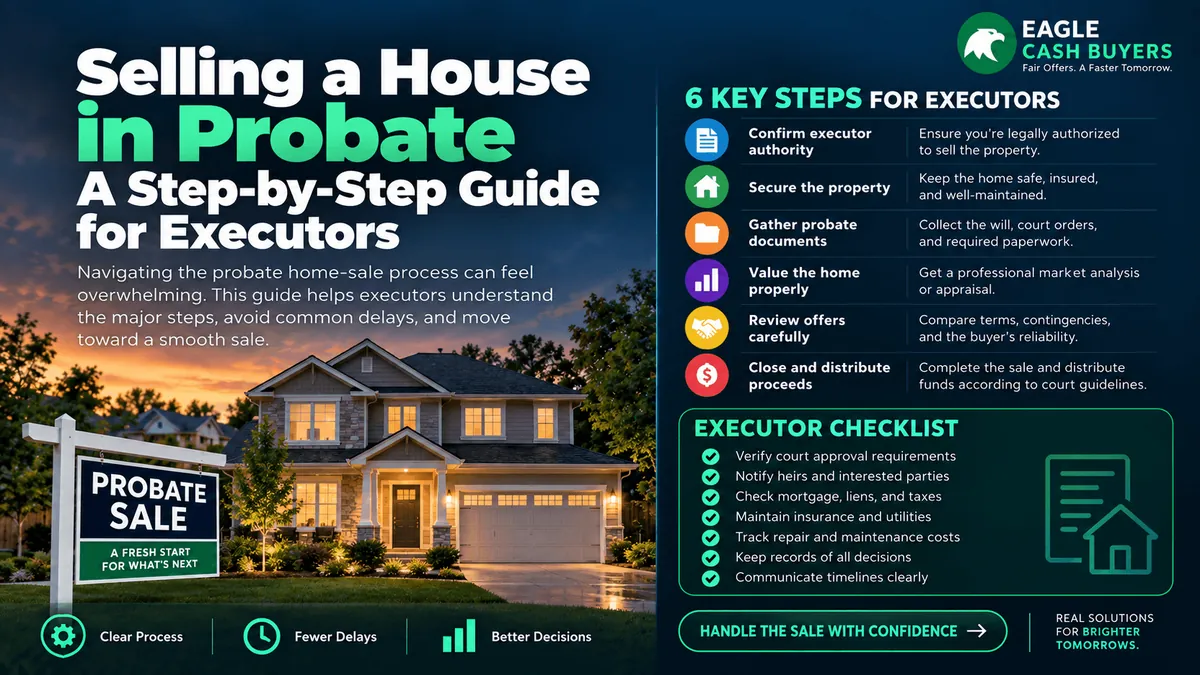
The executor's organization often decides whether probate stays manageable or turns overwhelming, and a house in the estate adds another set of decisions on top of the court paperwork. Our step-by-step guide for executors shows what that work looks like when a sale is part of the plan.
Probate Timeline FAQ
Does a Living Trust Avoid Probate?
Often, for assets that are properly titled in the trust. That is the catch. A trust that was set up and funded correctly lets those assets pass without going through the probate court, which can mean less waiting, more privacy and lower court costs. A house that was never deeded into the trust may still need to go through the probate process, and the trust itself still has to be administered. Ask an estate attorney how it works in your state.
Can the House Be Sold Before Probate Ends?
Often the marketing and the contract on an inherited house can start early. The closing generally has to wait until the probate court has given the executor authority, and the rules vary by state. See the options section above for how that plays out, and confirm the details with a local probate attorney.