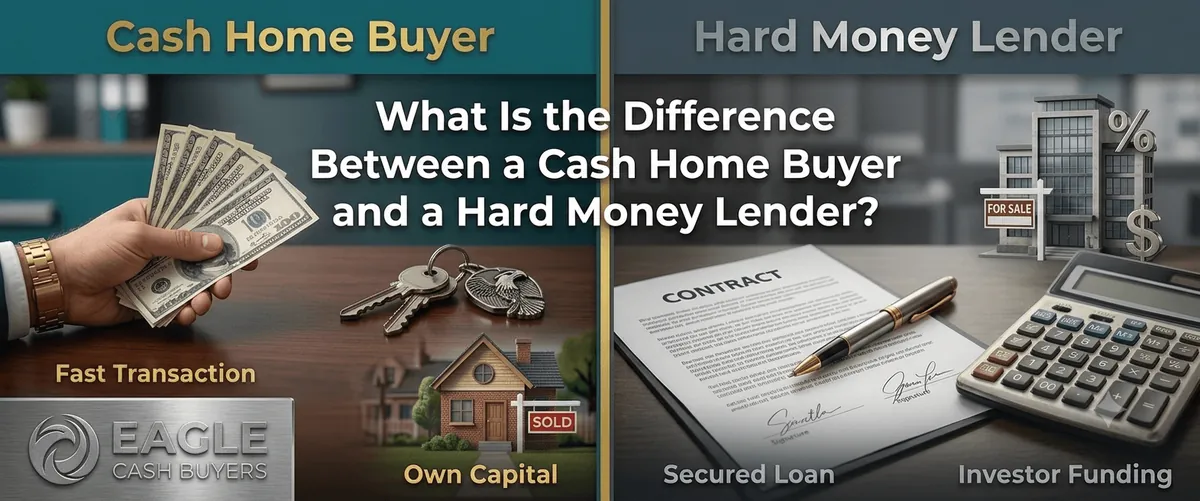
If you're looking for a way to sell your house fast, you may have run into two terms that sound alike: cash home buyer and hard money lender. They are not the same. The difference between a cash home buyer and a hard money lender comes down to this. One buys your house. The other lends money against a house, and the loan has to be paid back.
Mixing them up can be costly for a homeowner. This guide explains what each one is, who uses them, how to tell which one you're talking to, and where Eagle Cash Buyers fits, so you can spot the difference before a phone call turns into a signed agreement. It is general information, not legal, tax or financial advice, and we are not attorneys. Terms, licensing and rules vary by state, so talk to a loan officer and an attorney about your situation.
What Is a Cash Home Buyer?
A cash home buyer is a person or company that buys a house outright, paying cash, without a mortgage lender in the middle. At closing, ownership transfers to the buyer and you receive the sale proceeds you agreed to. You then have no loan from the buyer. No payments. No ongoing role with the house.
It's a sale. Nothing more. What the buyer does next is the buyer's business, whether that means repairing the house, renting it out or reselling it down the road.
What Is a Hard Money Lender?
A hard money lender is a private person or company that makes loans secured by real estate. The California Department of Real Estate's reference book describes hard money loans as loans funded by private investors or lenders and secured by liens on real property, such as deeds of trust or mortgages. New York's financial regulator has described hard money lenders as offering short-term, high-interest loans secured by real estate.
Here is the key point. You still own the house, and now you also owe the lender, and if the loan isn't repaid as agreed, the lender can generally foreclose, because the property is the collateral that backs it up.
Who Actually Uses Hard Money Loans?
Anyone who wants to borrow against real estate. The same California reference book says the money can go toward buying the property that secures the loan, or the loan can be taken against property the borrower already owns. Either way, the property is the security. That is a very different need from a homeowner who just wants to sell.
If you are a homeowner who wants to sell your own house, a hard money loan doesn't solve that problem. It solves a borrowing problem. Not a selling one.
The Difference Between a Cash Home Buyer and a Hard Money Lender
- With a cash home buyer, the house and the sale are both finished at closing. You are paid, and you owe nothing to the buyer afterward.
- With a hard money lender, you add a new debt. You keep the house, owe the money back with interest and often on a tight schedule, and your house secures it.
A homeowner trying to get out from under a house, whether because of financial pressure, an inherited property or the grind of a long listing process, usually doesn't need another loan. They need a buyer.
| Cash home buyer | Hard money lender | |
|---|---|---|
| What happens to the house | Ownership transfers to the buyer | You keep ownership |
| What you receive | Sale proceeds | Loan funds you must repay |
| Obligation after closing | None to the buyer | Repayment with interest |
| What it is for | Selling a house | Borrowing money secured by property |
| If things go wrong | Nothing further once the sale closes | The lender may foreclose on a default |
Why the Mix-Up Matters to Homeowners
If you are in financial trouble, a hard money loan can make the situation worse. It doesn't erase what you owe. It adds to it, and your house is on the line, with a repayment clock running that may be shorter than you expect. In 2014, New York's Department of Financial Services opened an investigation into hard money lenders over concerns about high-interest, short-term loans secured by borrowers' homes. Whether any rule protects you on a particular loan depends on the loan, the lender and your state, so ask a licensed professional. The basic risk is the same, though. The house secures the debt.
One more thing to check. What matters to you is whether the buyer has proof of funds and a written agreement that you understand, which our guide on how to vet a cash home buyer walks through.
How to Tell Which One You're Talking To
Ads and cold calls blur the line. Just ask.
- "Are you buying my house, or lending me money against it?" If you would keep making payments to them, that is a loan, not a sale.
- "Does ownership transfer to you at closing?" In a sale, the answer is yes.
- "Will I owe you anything after closing?" In a purchase, the answer should be no.
- "Why do you need my deed before I get paid?" Be cautious about any deal that asks you to sign over your deed without a clear sale. The FTC lists mortgage relief scams that ask homeowners to transfer the deed, and it warns against anyone who tells you not to contact your lender or a housing counselor.
Struggling with the mortgage? A HUD-approved housing counselor can walk you through your choices before you decide anything, and it is worth doing that before you sign with anyone. Our guide on selling your house fast before foreclosure covers the timeline pressure that often drives these decisions.
Where Eagle Cash Buyers Fits
Eagle Cash Buyers buys houses. We are not a lender, and we do not lend money to home sellers. We don't make hard money loans or any other kind of loan. You can read more about who we are on our about page.
- It is a purchase. At closing, ownership transfers and you owe us nothing afterward.
- No agent commission on a direct sale. Eagle pays closing costs except your mortgage payoff, back taxes and liens, and your share of transfer tax.
- Eagle may buy directly or assign the contract. If it assigns, that is disclosed in the agreement before you sign.
- Closing can happen in as little as 21 to 42 days, or later if you need more time. You pick the date.
Eagle evaluates properties in 43 states and can buy many conditions, so you generally don't have to make repairs first. Whether we can make an offer depends on the property, the title and our buying criteria. Liens and back taxes are usually paid from the closing proceeds. See how it works for the steps, and short sale vs. cash sale if you owe more than the house is worth.
Frequently Asked Questions
Is a cash home buyer a hard money lender in disguise?
No. A cash home buyer buys the house and takes ownership at closing, while a hard money lender makes a loan secured by real estate that you repay with interest and that stays attached to the property until it is paid. One is a sale. The other is a loan.
Do I have to pay a cash home buyer back?
No. You aren't borrowing, so there is no loan and no mortgage to repay. You are selling something you own, and it ends at closing.
Can a hard money loan help me sell my house?
Not directly. A hard money loan is a way to get financing by borrowing against property. If you are selling, you need a buyer, not a lender.
What happens if I default on a hard money loan?
Because the loan is secured by real estate, the lender can generally foreclose to recover the debt, much as with a mortgage. The details depend on your loan documents and your state's law, so consult an attorney. Don't guess.
Does Eagle Cash Buyers offer loans?
No. We buy houses. We don't offer hard money loans, second mortgages or any other financing.