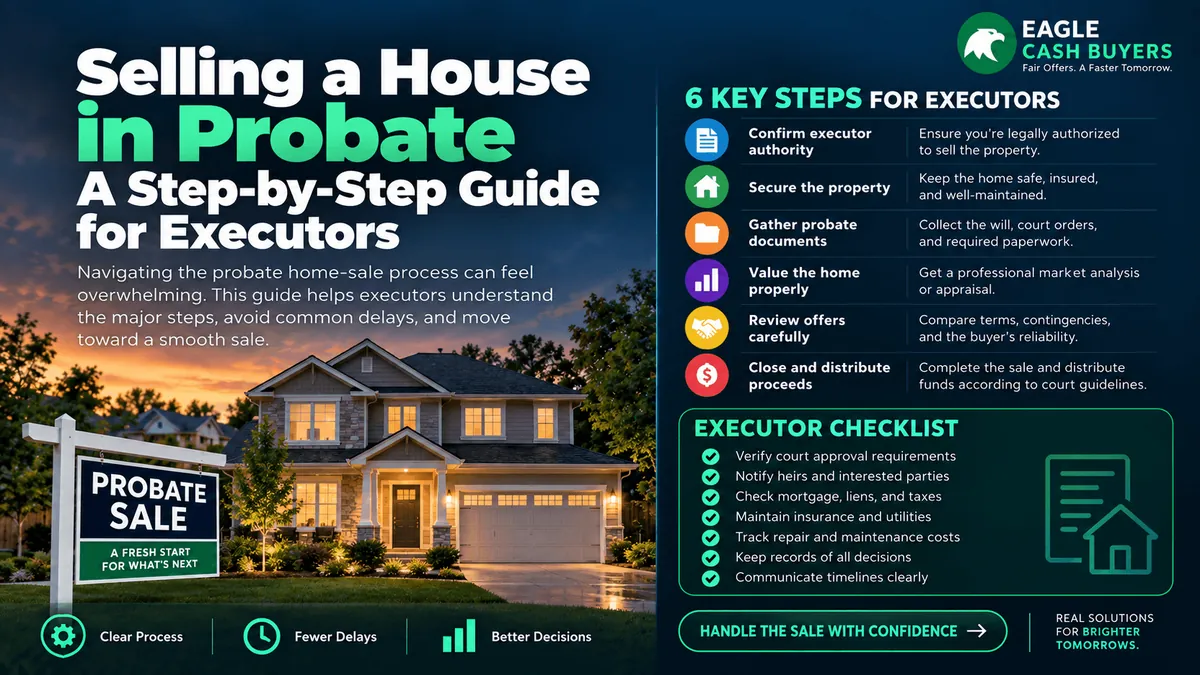

Inheriting a house is often described as a windfall. In practice you can also inherit a legal process you never asked to learn, a mortgage or a tax bill, and sometimes co-heirs who disagree about what happens next. If you are working out how to sell an inherited house, it helps to take the pieces one at a time: the legal side, the tax side, the family side and the sale itself. One step at a time.
This guide covers what has to happen before you can sell, how taxes usually work, what to do if there is a mortgage, how to handle co-heirs who disagree, and how an as-is cash sale compares with a traditional listing.
This article is for informational purposes only and should not be considered legal, tax or financial advice. Because state laws about probate, inheritance and taxes can vary greatly, and depend on individual situations, you may want to consult an estate attorney, a tax professional or your local probate court about just what situation you might be in.
You Usually Cannot Sell Until Probate Gives You Authority
Ownership does not pass cleanly to the heirs on the day someone dies. If the house was in the deceased person's name alone, it usually has to go through probate: the court-supervised process that validates the will (or applies state law when there is none), pays debts and formally transfers the property to the heirs. Some homes skip probate, for example when title was held jointly with survivorship rights or in a trust, so check how the deed reads.
You typically cannot close on a sale until the court has named an executor or personal representative and given that person authority. That is usually shown by a document called Letters Testamentary (when there is a will) or Letters of Administration (when there is not), and a title company will ask for it. Get copies early. Timelines depend heavily on the state and on how complicated the estate is. Our guide on how long probate takes looks at what the wait means for a house and walks through the stages.
While probate is open, the estate stays responsible for property taxes, insurance, utilities and basic upkeep, so an unused inherited house can quietly become expensive. Many executors use the wait to prepare the house for sale, or to line up a buyer whose contract is conditional on court approval, with closing after the court gives its go-ahead. Our guide on how to sell a house fast during probate explains how that timing works, and can you sell a house before probate covers what is and is not possible while the estate is open.
The Tax Cost of Selling an Inherited House
Taxes are a common worry for heirs.
Inherited homes generally get a "stepped-up" basis. For tax purposes, your cost basis is usually reset to the home's fair market value on the date of death (or an alternate valuation date in some estates) instead of what the previous owner paid years earlier. According to the IRS, that is the general rule for property inherited from a decedent. You generally owe capital gains tax only on appreciation after that date, so heirs who sell soon after inheriting often owe little or nothing. That depends on your facts, so confirm it with a tax professional.
Federal estate tax rarely applies. The IRS lists a basic exclusion amount of $15,000,000 for deaths in 2026, and most estates fall below it. Some states have their own estate taxes with much lower thresholds (Washington's is $3,000,000 for deaths on or after July 1, 2026, for example), so do not assume you are clear just because you are under the federal number. Check the rules in your state.
Getting the valuation right matters. Your basis is tied to what the home was worth at the date of death, so having an appraisal or comparable market analysis from that period gives you something tangible to rely on later instead of piecing together a value years later.
None of this replaces specific recommendations for your property, and basis, date-of-death valuation and state-level taxes can get very complicated very quickly. A tax pro is able to talk through your specific numbers. Ask early.
What Happens if Your Inherited House Has a Mortgage
A mortgage does not disappear when the borrower dies. It stays attached to the property, and someone has to deal with it. Federal rules protect heirs more than most people expect.
Most mortgages include a due-on-sale clause, which normally lets a lender demand full repayment when the property changes hands. The federal Garn-St Germain Act of 1982 limits that. For a home with fewer than five dwelling units, a lender generally cannot enforce the clause when the property transfers to a relative because the borrower died. Confirm how this applies to your loan with an attorney.
The loan is secured by the house, so if payments stop, the lender can foreclose on the property. Do not ignore the loan. Whether an heir is personally responsible for the debt, and how the estate's other debts are handled, depends on the loan paperwork and on state law, so ask a probate attorney.
Federal servicing rules also help heirs get information about the loan. According to the Consumer Financial Protection Bureau, a lender does not have to assess your ability to repay before you take over the existing loan when you already hold title through inheritance, although you may need to show proof of your right to the home, such as a death certificate or a letter from the executor. The CFPB has also clarified that servicers should communicate with surviving family members, and that heirs named as borrowers may more easily get account information, pay off the loan or ask about a loan modification.
Heirs with an inherited mortgage generally have a few options:
- Take over the existing loan and keep paying it
- Refinance the loan into your own name
- Pay off the debt, if the estate or the heirs have the money
- Sell the property and pay off the loan when you close
If the home's value comfortably covers the mortgage, selling is often the simplest option. The loan is paid off at closing, so you do not have to take it over or refinance. Keeping a low-rate loan can be tempting, but it is a long-term commitment you may not want. Think it through. If the balance is close to or above the value, our guide to what happens to your mortgage when you sell for cash explains how the payoff works.
When Multiple Heirs Don't Agree
Few situations are harder than a house left to several people with different priorities. One heir wants a quick, clean sale. Another loves the property and wants to keep it or fix it up first. A third needs their share of the proceeds soon. Each view is understandable.
When two or more people inherit a house, they usually become co-owners, and selling generally takes agreement from all of them. If they cannot agree, a co-owner can sometimes ask a court to decide, depending on state law. A few things tend to help:
- Get everyone's priorities on the table first. Do not assume everyone wants the same thing.
- Keep the keepsakes separate from the money. Deciding who keeps, sells, donates or throws out the belongings is emotional and slow. It should not hold up the decision about how and when to sell the house.
- Get a written valuation so the conversation is about one number everyone can see, not competing guesses.
- Decide whether speed or price matters more to the group. For co-heirs who live far away or need their share sooner, a faster sale may be worth more than a higher number a longer listing might produce.
If a disagreement turns into a legal dispute, talk to a probate attorney.
Traditional Sale vs. Cash Sale When Selling an Inherited House
You have two main options for selling an inherited house: a traditional listed sale or a cash sale.
| Factor | Traditional Listed Sale | Cash Sale (As-Is) |
| Repairs before selling | Often expected by buyers and lenders | Not required by Eagle; the offer reflects the condition |
| Waiting for probate authority | Still required | Still required |
| Agent commissions | Paid by the seller on a listing | None on a direct sale with Eagle |
| Price | Can be higher when you have the time and money to prepare the house | Below market; you trade some price for speed and certainty |
| Existing mortgage | Paid off from the proceeds at closing | Paid off from the proceeds at closing |
| Co-heirs | Everyone still has to agree | Everyone still has to agree |
| Timeline once the seller has authority | Listing, a buyer's financing and closing; often longer | As little as 21 to 42 days, or longer if you need it |
| A vacant house | You carry the holding costs and showings during the listing | Eagle buys the house in its current condition |
Eagle Cash Buyers evaluates inherited homes in many conditions, and in some cases while probate is still under way. Whether we can make an offer depends on the property, the title and our buying criteria. Here is what the process generally involves:
Repairs. We don't ask sellers to make repairs before we make an offer, and the offer reflects the property's condition.
We work within the probate timeline. If you already have executor authority, or you are still early in the process, you can talk to us about your situation. A contract can be written around the court's timeline, but the sale cannot close until the person selling has legal authority, and what can be signed before that depends on the state and the facts.
No agent commission on a direct sale. There is no listing, so there is no listing agent to pay. Eagle pays closing costs except the seller's mortgage payoff, back taxes and liens, and the seller's share of transfer tax. Eagle may buy the house directly or assign the contract to another buyer, and that is disclosed in the agreement before you sign.
A written, no-obligation cash offer. You learn what the house is worth to a cash buyer today, as is. That price is below what a repaired, well-marketed listing could bring. A listing can net more when the heirs have both the time and the money to put the house right; a cash sale trades some of that price for speed and certainty.
If you are earlier in the process and want to understand the legal step first, see our guides on how long probate generally takes and on what an executor does when selling a house in probate.
Frequently Asked Questions
How Long Do You Have to Sell an Inherited House?
There is often no single legal deadline to sell an inherited home, but several clocks run in practice. Property taxes, insurance and upkeep continue, mortgage payments are still due, estate administration has its own deadlines, and a reverse mortgage lender may set a repayment deadline after the borrower dies. Rules vary by state, so ask a local probate attorney what applies to you.
Do You Have to Wait for Probate to Sell an Inherited House?
Often, yes. If the property was titled solely in the deceased person's name, it generally has to go through the probate process first, and the court appoints an executor or personal representative with authority to sell. In some cases you can accept an offer or prepare for the sale before probate wraps up, but closing usually waits for that authority. Homes held jointly with survivorship rights or in a trust can follow different rules, and state law varies. See can you sell a house before probate for more.
Is There a Capital Gains Tax on Selling an Inherited House?
Maybe, but often less than people expect. In most cases the home's fair market value on the date of death is your tax basis, so you generally owe capital gains tax only on appreciation after that date, not on the gain that built up during the previous owner's lifetime. Basis is the key idea. A tax professional can look at your numbers.
How Does a Mortgage on an Inherited House Work?
The mortgage stays on the property, and mortgage payments are still due. Whether an heir is personally responsible for the debt depends on the loan paperwork and state law, and federal law generally stops a lender from demanding immediate repayment just because the house passed to a relative by inheritance. You can usually take over the loan, refinance it, pay it off, or sell the property and pay what is owed at closing.
What if My Siblings and I Disagree on Selling the Property?
This is common. It is best handled directly instead of waiting for the process to stall. Get a written valuation, ask each heir whether speed or price matters more, and keep decisions about keepsakes separate from decisions about the sale. If the heirs truly cannot agree, a probate attorney can explain the options in your state.
Do I Need to Clean Out or Fix Up an Inherited House Before Selling?
It depends on how you sell. A retail buyer, or one using a mortgage, usually expects a cleaned-out, repaired house, which is why listings often start with prep work. A cash buyer purchasing as is does not require repairs first, and the offer takes the condition into account.
How Quickly Can I Sell an Inherited House for Cash?
Once the person selling has legal authority, Eagle can close a cash offer in as little as 21 to 42 days, or later if you need more time. The seller picks the date. Probate itself can add time before that point, and a traditional listing generally takes longer once you add showings, a buyer's financing and repairs.
The Bottom Line
Selling an inherited house has more moving parts than the average sale: probate authority, tax basis, a possible mortgage and often several co-heirs who need to agree. Taken one at a time, none of them is a deal-breaker. Together they can make a traditional listing feel heavy, especially if repairs are needed or the house has sat vacant.
Once the legal and family questions are settled, a cash offer may be worth comparing with a listing. Eagle Cash Buyers evaluates properties in 43 states, including at some stages of probate, and whether we can make an offer depends on the property, the title and our buying criteria. Compare, then decide.