



A short sale in real estate occurs when a homeowner sells their property for less than their outstanding mortgage debt and the lender agrees to accept this reduced amount. The bank grants permission for this option to protect homeowners from foreclosure when their home value drops below their mortgage balance.
What a Short Sale Really Means for Homeowners
Let’s cut through the confusing jargon. Imagine you owe $300,000 on your mortgage, but in today’s market, the best offer you can get for your house is $260,000. In a short sale, your lender agrees to accept that $260,000 as full payment, forgiving the $40,000 difference—the “short” amount.
The process goes beyond property sales because it helps people escape financial challenges related to mortgage debt. A short sale is something you initiate with your lender’s permission. A foreclosure, on the other hand, is a harsh legal process the bank initiates against you. The first step in this process requires you to identify the main differences between short sales and foreclosure.
Why on Earth Would a Lender Agree to This?
It sounds counterintuitive, right? Why would a bank willingly take a loss? The decision exists purely for business reasons. Lenders face major difficulties with foreclosures because these cases generate high costs and lengthy legal procedures which may extend for multiple months or even years. All the while, the property sits empty and often loses more value.
A short sale is often the lesser of two evils for a bank. The program enables lenders to minimize their losses by stopping the foreclosure process which saves them from spending excessive time and money.
By agreeing to a short sale, the lender gets the troubled loan off its books and recovers most of its investment without a protracted legal fight. The solution provides a useful way to deal with difficult situations.
The Core Concept Simplified
A short sale requires you to negotiate between two parties which include a potential buyer and your lender. The team functions through members who follow their individual responsibilities.
- You (The Seller): Your job is to prove you’re facing legitimate financial hardship. You’ll need to work with a real estate agent to list the property and find a buyer.
- The Buyer: They make a normal offer to purchase your home, fully aware that the bank has the final say.
- The Lender: The bank is the ultimate decision-maker here. They must approve the buyer’s offer, the sale price, and all the terms of the deal.
The entire program exists to help homeowners who currently owe more on their mortgage than their house is worth.
The following section presents each component of a short sale with its specific meaning.
Short Sale at a Glance
| Key Element | What It Means for You |
|---|---|
| Underwater Mortgage | You owe more on your loan than your home is currently worth. |
| Financial Hardship | You must prove you can no longer afford your mortgage due to a job loss, medical emergency, or other major life event. |
| Lender Approval | The bank has the final say on everything. They must approve the buyer, the offer price, and the sale terms. |
| “Short” Amount | This is the difference between the sale price and what you owe. The lender agrees to forgive this amount. |
A short sale functions as a collaborative solution to address financial difficulties which provides homeowners with a more respectful alternative to foreclosure.
The Short Sale Process From Start to Finish
You need to understand the operational mechanics of short sales beyond their theoretical definition when you experience financial difficulties. The whole journey can seem daunting, packed with paperwork and long waits, but it really just boils down to a sequence of logical steps. Let’s break it down so it feels less overwhelming.
The big picture is pretty straightforward. You realize your home is underwater, you get your bank’s permission, and then you sell the house for less than you owe.
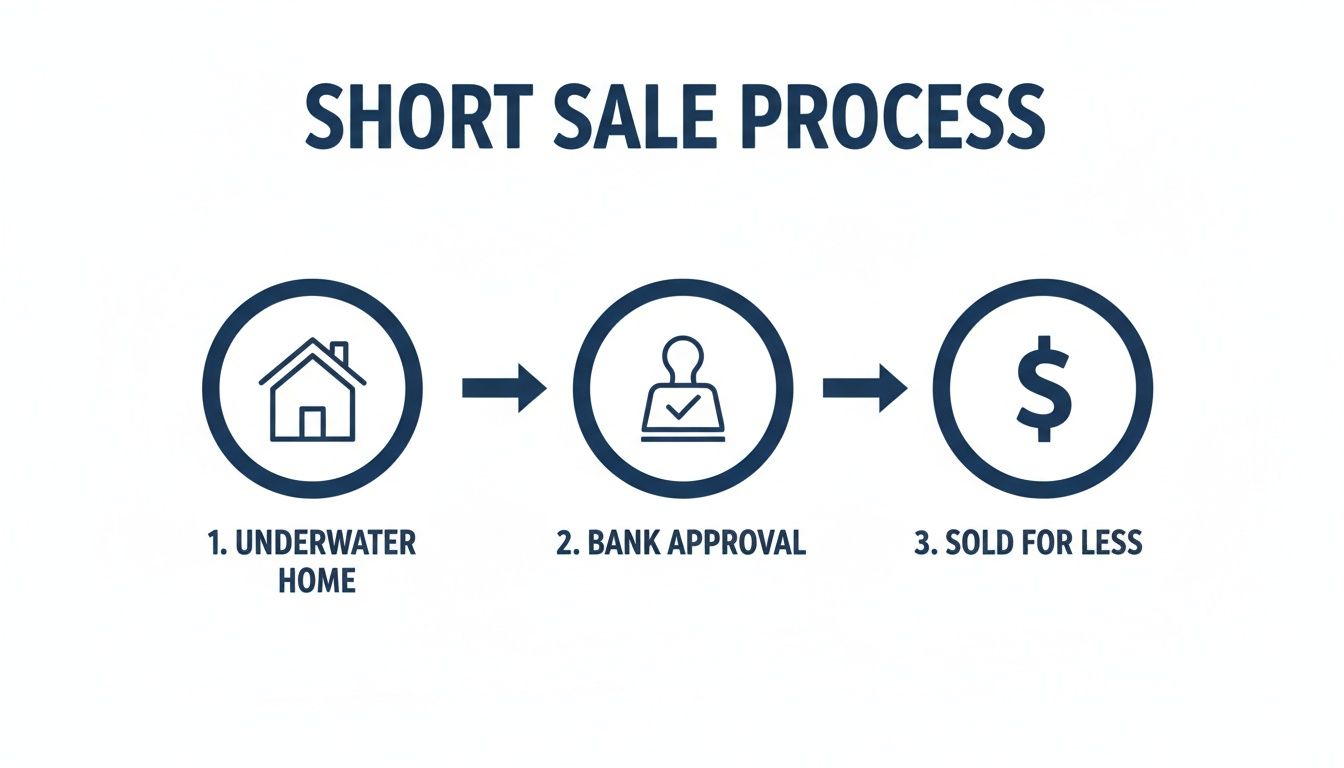
The diagram outlines three fundamental stages which start with problem identification before moving to lender approval and concluding with the final sale.
The First Move: Contact and Preparation
The process initiates when you find yourself unable to continue making mortgage payments. This is the crossroads where taking action gives you some control over what happens next. Waiting only makes things worse.
First up, call your lender. Be direct and honest about your financial situation and tell them you want to explore a short sale to avoid foreclosure. The thing is they will listen to you because foreclosures create major problems for them since they end up spending time and money on them.
The next step requires you to find a real estate agent who has experience with short sales. This isn’t a job for just any agent. A specialist knows how to navigate the lender’s maze of requirements, price the home correctly for a quick offer, and handle the tough negotiations that are sure to come.
Putting Together Your Short Sale Package
With an agent on your team, it’s time for the most labor-intensive step: building your short sale package. Think of this as your formal application to the lender, proving you have a genuine financial hardship and that accepting a loss now is their best move.
At the core of your short sale package you must include a properly written hardship letter. This is your personal story. It’s where you clearly and honestly explain what happened—a job loss, a medical crisis, a divorce—that put you in this position.
Your package will need to be packed with documentation, including:
- Financial Records: Your most recent bank statements and pay stubs, along with a detailed list of your monthly income and expenses.
- Tax Returns: Lenders will almost always ask for your last two years of filed federal tax returns.
- The Hardship Letter: That personal letter explaining the specific, unavoidable reasons you can no longer afford your mortgage.
- Third-Party Authorization: A simple form that gives your agent the green light to talk directly to your lender for you.
Getting this package right is everything. A complete and accurate submission is critical for getting the bank’s approval.
From a Buyer’s Offer to the Closing Table
Your agent will send the lender your complete short sale package and any offers from buyers after your home enters the market. And then, you wait. This is often the hardest part. The bank’s review process duration varies from several months up to more than twelve months because of their current workload and internal administrative procedures.
The lender will approve your offer which moves you closer to finalizing the deal. Your agent needs to return to the negotiation process after they receive either a rejection or a counteroffer from the other party. Things can get even trickier if you have a second mortgage or other liens, as each of those lienholders has to agree to the deal, too.
The pressure really mounts if the foreclosure clock is already ticking. If you find yourself in that spot, it’s critical to know all your options. It is possible to sell a house during foreclosure, but you’re working against a very tight deadline.
A successful short sale closing allows you to abandon your unaffordable mortgage which creates space for you to recover your financial stability.
Weighing the Pros and Cons of a Short Sale
Short sales function as an effective method to stop foreclosure from happening. But it’s definitely not a magic wand. This is a complex process with some real-world advantages and, frankly, some significant drawbacks. The only way to make the right call is to look at both sides of the coin with complete honesty.

The decision requires you to find an equilibrium between two opposing elements. So, let’s weigh the potential benefits against the very real challenges to see if this path makes sense for your situation.
The Advantages for Homeowners
When you’re staring down overwhelming mortgage debt, a short sale can feel like a lifeline. A short sale offers homeowners a better alternative to foreclosure because it provides a more respectful method of property sale. The benefits are substantial, especially when you think about the alternative of the bank simply seizing your home.
One of the biggest wins here is that you avoid foreclosure. A foreclosure is a harsh legal process that the bank brings against you. A short sale, on the other hand, is a transaction that you initiate. That simple shift puts you back in the driver’s seat, which can make a world of difference during such a stressful time.
Another huge benefit is the possibility of debt forgiveness. The lender will accept the sale proceeds as total loan repayment during a successful short sale. This means they forgive the rest of what you owe—the “deficiency.” Without this, the lender could legally come after you for that difference for years.
Finally, while your credit will take a hit, the damage is almost always less severe than a foreclosure.
A short sale usually shows up on your credit report as “settled for less than the full amount.” To future lenders, that looks a lot better than a foreclosure. It often means a shorter recovery time, too. You might be able to qualify for a new mortgage in as little as two years, a stark contrast to the seven or more it can take after a foreclosure.
The Disadvantages and Realities
While a short sale is often a better path than foreclosure, it’s crucial to go in with your eyes wide open. The method does not offer a solution which eliminates all pain. The process brings its own set of serious consequences and emotional burdens you need to be ready for.
The most immediate downside is the damage to your credit score. Short sales result in credit score drops between 50 and 150 points but they do not cause damage as severe as foreclosures. Your credit report will keep that mark for seven years. To get into the nitty-gritty, you can learn more about how a short sale impacts your credit in our detailed guide.
On top of that, there is no financial gain for you. When you sell your home through a traditional sale you get to keep the equity. In a short sale, every single penny goes straight to the lender. You won’t receive any money from selling your home.
The entire process stands as the most exhausting element of this situation.
- The timeline for short sales tends to be long and unpredictable. The process can extend from four months up to more than twelve months.
- The application process requires you to submit numerous financial documents. The lender needs you to provide bank statements and pay stubs as proof of your financial difficulties.
- Emotional Stress: The constant uncertainty of waiting for the bank’s approval, coupled with the stigma of the situation, can be incredibly taxing on you and your family.
The following comparison will show you the main differences between these two options.
Short Sale vs Foreclosure Key Homeowner Impacts
| Factor | Short Sale | Foreclosure |
|---|---|---|
| Control Over Process | Homeowner initiates the sale and has some control. | Bank initiates legal action; homeowner has very little control. |
| Credit Score Impact | Significant drop, but less severe. Reported as “settled for less.” | Most severe damage possible. Stays on record for 7+ years. |
| Future Homeownership | Possible to get a new mortgage in as little as 2 years. | Very difficult. May need to wait 7 or more years. |
| Deficiency Judgment | Often waived by the lender as part of the agreement. | Lender can pursue homeowner for the remaining debt balance. |
| Privacy | A private real estate transaction. | A public record that is easily searchable. |
The table shows that short sales lead to superior financial recovery results and better personal dignity outcomes than other options.
The long and uncertain process of foreclosure leads many homeowners to seek alternative solutions. A direct cash sale provides a definite closing date which removes the need to deal with lender approval delays. The process offers a quick and definite exit for critical time-sensitive situations. The service provides an additional choice for you to evaluate during your decision-making process.
The History Behind the Short Sale
To really get what a short sale is, you have to understand where it came from. This wasn’t always a standard real estate term. The phrase became popular because it emerged during one of the most severe economic crises of recent times.
The short sale entered mainstream recognition through the 2008 housing market collapse. The market crash caused property values to drop dramatically which created mortgage debt problems for millions of American homeowners. The borrowers owed the bank more money than their property held actual market value. It was a financial trap.
Why Short Sales Became a Thing
Lenders were forced to find an alternative solution because foreclosure rates were about to become overwhelming. The bank had to deal with expensive and lengthy legal procedures related to foreclosure which reached unprecedented levels. The short sale provided a practical and less painful solution for all parties involved.
Homeowners could sell their property through this program while the lender would cancel the remaining mortgage debt. The program enabled lenders to reduce their losses through a process which was less expensive and faster than full foreclosure. The growing demand for short sales led to government programs which standardized the process to make it accessible for homeowners facing financial distress.
Understanding the 2008 crisis is crucial. The short sale exists as an economic solution rather than a personal defeat because it was designed to address large-scale financial crises.
Short Sales in Today’s Market
The real estate market has thankfully recovered since then, but the short sale remains an important lifeline. These loans have become less common but they continue to provide vital assistance to homeowners who experience major financial difficulties.
Personal Reasons Now Drive Short Sales More Than Market Conditions Did in the Past.
- Sudden Job Loss: Losing a primary source of income can make it impossible to keep up with mortgage payments.
- Medical Emergencies: A health crisis can bring on overwhelming debt, forcing a family to make tough choices about their home.
- Divorce: Splitting up assets often requires selling the house, and a short sale might be the only viable way.
- Forced Relocation: A sudden job transfer might not allow enough time for a traditional sale to go through, especially if the local market is slow.
Short sales became very common during the peak of the housing crisis. The first quarter of 2012 saw a 25% increase in short sales compared to the previous year which reached the highest level since 2009. Short sales emerged as the leading home sale method in Las Vegas during April 2012 when they reached nearly 30% of all transactions. You can read more about the dramatic rise of short sales during that period.
Knowing this history helps you see that a short sale isn’t some shady workaround—it’s a proven strategy for navigating financial distress. The process provides a structured and respectful method to escape an underwater mortgage which proves to be a better alternative than foreclosure.
Exploring Your Foreclosure Alternatives
The situation of possible foreclosure creates an impression that your available options are diminishing with each passing day. The good news is you possess more power than you realize. A short sale is one route, but it’s crucial to understand it isn’t your only choice.
Before you commit to that long and often unpredictable journey, take a breath and look at the full menu of alternatives. Each one has its own set of pros and cons, and the right one for you depends entirely on your specific situation.
The very first step? Talk to your lender. It might seem counterintuitive, but banks genuinely want to avoid foreclosing on a home. It’s an expensive headache for them, and many have programs specifically designed to help homeowners get back on their feet.
When you open that line of communication, they’ll likely walk you through a few standard options. The ability to identify these elements will help you choose with clarity.
Traditional Lender-Based Solutions
The following methods describe how you can work with your bank to discover a resolution. These programs exist primarily for homeowners who face temporary financial difficulties yet maintain a strong chance of financial recovery.
- Loan Modification: This isn’t just a temporary fix; it’s a permanent change to your mortgage terms. Your lender might lower your interest rate or extend the life of the loan to make your monthly payments more manageable. If you want to stay in your home and can handle a smaller payment, this is often the best-case scenario.
- Forbearance Agreement: Think of this as hitting a temporary “pause” button. A forbearance lets you reduce or stop your mortgage payments for a set period, usually a few months. It’s perfect for short-term crises like a sudden job loss or medical bill, but remember—you’ll have to repay those missed payments down the road.
- Deed in Lieu of Foreclosure: With this option, you voluntarily hand the property deed back to the bank. In return, the lender agrees to cancel your mortgage debt. It’s a much faster way out than a short sale and avoids a public foreclosure auction, but you still lose the house, and it will take a serious toll on your credit.
As you weigh these options, it can be incredibly helpful to consult a mortgage professional who can offer expert guidance tailored to your financial picture.
The lender-focused solutions designed to prevent foreclosure require extensive paperwork and extended approval times which intensify the difficulties of an already challenging situation.
The 7 ways to avoid foreclosure are explained in our detailed guide which shows all available options.
An Alternative for Speed and Certainty: The Fast Cash Sale
What happens if the traditional routes don’t fit your situation? You might need to sell your home quickly because you lack the time to wait for bank approval and you cannot handle major repairs. This is where another option comes into play: selling your house directly for cash.
Companies that buy houses for cash offer a fundamentally different approach. The process of selling for cash removes the need for buyers to go through the difficult and prolonged process of short sales or loan modifications because they get a guaranteed upfront offer.
The program exists for homeowners who want to complete their sale process quickly while keeping things simple and guaranteed.
A short sale is a marathon of uncertainty that can last over a year. A cash sale, by contrast, is a sprint. The entire process can take anywhere from a few months to well over a year.
What’s the holdup? It’s almost always the lender’s internal review. Think layers of bureaucracy, misplaced paperwork, and extra hurdles if you have a second mortgage or other liens. The lengthy and uncertain process of foreclosure leads many homeowners to seek faster and more reliable alternatives.

You have multiple options to deal with financial difficulties. The key to solving this lies in choosing the best option between working with your lender or pursuing a short sale or other faster alternatives. At Eagle Cash Buyers, we provide fair, no-obligation offers and can close on your timeline, often in just a few weeks. Find out how we can help you skip the stress and move on with your life.