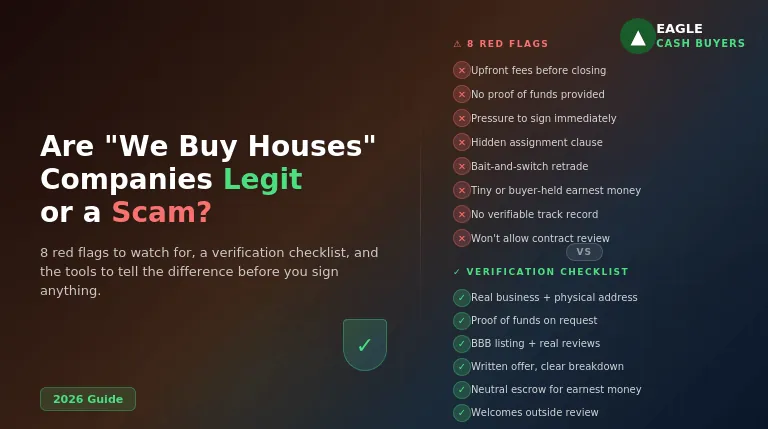
Are we buy houses companies legit? Many are real businesses that buy at a discount, then renovate, resell or rent. Scams exist too, often schemes to take control of your title or tie up your house. Judge the specific cash buyer: a written offer, a real business registration, a neutral title company and no upfront fees.
The question isn't whether the industry is legit. It's whether the specific buyer sitting across from you is, and that is something you can check. This guide gives you eight red flags, a verification checklist, official places to check a buyer, and the tools to tell the difference between a professional and a predator.
Full disclosure: Eagle Cash Buyers is a cash home buying company, so we have a clear interest in this topic. We're writing it anyway because the best way to build trust is to give you the tools to verify us the same way you'd verify anyone else.
How "We Buy Houses" Companies Actually Work
A "we buy houses" company is a real estate investor (or group of investors) that buys homes directly from homeowners, usually as-is, for cash, and below full market value. They profit by renovating and reselling, renting, or wholesaling the property.
The trade for the seller: you accept a lower gross price in exchange for speed (no months on market), certainty (cash, no financing contingency), convenience (no repairs, no showings, no agent commissions), and simplicity (minimal paperwork, close at a title company).
Eagle Cash Buyers works this way. Eagle is rated A+ by the BBB and has completed more than 1,000 transactions since 2019. There's no agent commission on a direct sale, and Eagle pays closing costs except the seller's mortgage payoff, back taxes and liens, and the seller's share of transfer tax. Closings can happen in as little as 21 to 42 days, or later if the seller needs more time. You can see how Eagle's process works step by step.
Not every company is the same kind of buyer, and our guide to the main types of companies that buy houses as is explains the models and how to choose one. This page is about the other question: how to tell a legitimate buyer from a bad one.
Why the Cash Home Buying Industry Attracts Scams
Two structural features make this industry vulnerable to bad actors: a low barrier to entry and a pool of motivated sellers. Together, they invite trouble.
A Low Barrier to Entry
Real estate agents hold a license and answer to a licensing board. A company that buys homes may be regulated differently, and the rules depend on the state. A sign and a website are cheap. Nothing about calling yourself a cash buyer proves you can close, so legitimate investors operate alongside people who have no intention of closing at all, and from the outside the two can look the same.
Some states have started to regulate wholesaling. Connecticut, for example, has required wholesalers to register with its Department of Consumer Protection since 1 July 2026, and it lets sellers cancel a wholesale contract within three business days (Connecticut DCP). Rules differ by state, so ask a local real estate attorney what applies where you live.
Sellers in Distress Are Targets
Many homeowners who contact "we buy houses" companies are facing foreclosure, divorce, probate, job loss, or other time-sensitive situations. Scam operators know these sellers are less likely to comparison-shop, read every line of a contract, or push back on terms. Time pressure is their friend.
The North Carolina Department of Justice describes one version of this: "we buy homes" signs and mailers aimed at owners who are behind on their mortgage, where the company wants you to sign over control of your home instead of buying it. Its advice is to be wary of anyone who asks you to transfer your title based only on their promises (NC Department of Justice).
The ProPublica Investigation
In 2023, ProPublica published a multi-part investigation into HomeVestors of America, the company behind the "We Buy Ugly Houses" franchise. The series reported that some franchisees used deception and bought homes well below market value from homeowners in vulnerable situations. The company's CEO stepped down in August 2023. In January 2024, ProPublica reported that HomeVestors would require its franchises to give sellers a disclosure with a three-day window to terminate the contract.
That reporting matters because it showed the problem isn't theoretical, and it also showed that public scrutiny can push a company to change how it treats sellers. None of this means you should avoid cash offers. Verify who you're dealing with. This guide shows you how. For more on that franchise model, see what "we buy ugly houses" really means for sellers.
The 8 Red Flags of a Scam Cash Buyer
If a buyer trips even one of these flags, slow down. If they trip two or more, walk away. Here is the short version, side by side, and the full explanation of each flag follows the table.
| Topic | A legitimate buyer | A red flag |
| Money | Pays its own costs; yours come out of the proceeds and show in the written offer | Asks you for a fee before closing |
| Funds | Shows proof of funds | Dodges the question |
| Timing | Gives you days to read and compare | "This offer expires today" |
| Contract role | Says whether it will buy directly or assign | Hides an "and/or assigns" clause |
| Price | Holds the price unless something real turns up | Offers high, then cuts it before closing |
| Earnest money | Held by a title company, escrow agent or closing attorney | Tiny, or held by the buyer |
| Track record | Registered business, address, reviews | A landing page and nothing else |
| Review | Welcomes an attorney's read | Discourages outside advice |
1. They Ask You to Pay Fees Upfront
In a real cash sale, money flows one direction: buyer to seller. A request for an "appraisal fee," "processing fee," "administrative fee" or "service charge" before closing is a serious red flag. A legitimate buyer pays its own costs.
Eagle doesn't ask sellers for money up front. The costs that stay with the seller in a typical sale, such as a mortgage payoff, back taxes and liens and the seller's share of transfer tax, come out of the proceeds at closing and appear in the written offer.
2. They Won't Show Proof of Funds
A real cash buyer can produce a recent bank statement or proof-of-funds letter showing the money to close. If they refuse, they either don't have the cash or they're a wholesaler planning to assign your contract to someone else, and either way you deserve to know before you sign anything that ties up your house. Ask.
3. They Pressure You to Sign Immediately
"This offer expires today." "We have another property to look at this afternoon." "You'll lose this price if you wait." These are classic high-pressure tactics designed to prevent you from getting competing offers or having an attorney review the contract. Don't bite.
A legitimate buyer understands this is a major decision. They give you time, and Eagle provides written offers that you are welcome to have your own attorney or agent review before you sign.
The test is simple. Say you want your attorney to read the contract and you need a few days. A buyer with nothing to hide says yes, while one who suddenly can't hold the price is telling you something important about how the rest of the deal is likely to go.
4. The Contract Has an "And/Or Assigns" Clause, and They Don't Explain It
"And/or assigns" means the person who signed the contract with you can sell that contract to someone else before closing. This is how wholesaling works: the "buyer" may not plan to purchase your home at all. They're selling the contract to another investor and keeping the spread.
Assigning a contract is not automatically a scam, and some states regulate it. But it's a red flag when it's hidden. If you see "and/or assigns" in the contract, ask directly: "Are you the end buyer, or are you assigning this contract?" A legitimate wholesaler will tell you. A scam operator won't.
Eagle may buy directly or assign the contract, and the agreement discloses which before you sign. That kind of upfront disclosure is exactly what to look for.
5. The Initial Offer Is Suspiciously High, Then Drops Before Closing
This is the bait-and-switch retrade. The buyer throws out a high number to get you to sign and stop talking to other buyers, then during the inspection or due-diligence period they "discover" issues and demand a steep price reduction, and by then you've lost weeks and feel stuck.
How to protect yourself: keep any inspection or due-diligence period short, ask how much earnest money is at stake and who holds it, and keep other offers in play until you've signed.
6. Earnest Money Is Tiny or Held by the Buyer
Earnest money is usually held by a neutral party such as a title company, escrow agent or closing attorney, not by the buyer. If the earnest money is, say, $100 on a $200,000 deal (a hypothetical example), or the buyer insists on holding it themselves, the deal has little financial commitment behind it. They can walk away at almost no cost.
Eagle closes through a title company, escrow provider or closing attorney. Learn more about how to negotiate with a cash home buyer to protect yourself on contract terms.
7. They Have No Verifiable Track Record
Check for: a real website (not just a landing page), a physical address (not a P.O. box), a BBB listing, Google reviews with named reviewers, a registered business name you can look up with your state's business registry, and a history of closed transactions. A company that can't produce any of this may not have bought a single house.
Eagle Cash Buyers, LLC is registered in Ohio and has a physical address (1985 Henderson Rd STE 1085, Columbus, OH 43220), an A+ rating from the BBB, Google reviews on its homepage and more than 1,000 completed transactions since 2019. You can read reviews from real Eagle sellers.
8. They Won't Let You Have the Contract Reviewed
Any buyer who discourages you from having an attorney or trusted advisor review the contract before signing is not acting in your interest. Walk away. A purchase agreement for a cash sale should be readable, and a legitimate buyer will answer questions about it.
Wholesalers vs. Direct Buyers: What Sellers Need to Understand
A direct buyer purchases your home with their own funds, renovates it, and resells or rents it. A wholesaler puts your home under contract, then sells that contract to a real buyer. They never use their own money. They never actually buy the house.
Neither is inherently a scam. The seller experience, though, is very different, and that difference is what to look for in the contract and in the first few phone calls with any buyer.
| Direct Buyer | Wholesaler | |
| Uses their own funds? | Usually (ask for proof of funds) | No, depends on finding an end buyer |
| Will they actually close? | Depends on the company, but they aren't waiting to find another buyer | Depends on finding an end buyer |
| Who buys your house? | The person you're talking to (or their disclosed partner) | An unknown third party |
| Contract language | Standard purchase agreement | Includes "and/or assigns" or assignment clause |
| Price risk | Depends on the contract | The price can change if the end buyer's terms differ |
| Disclosure | Transparent about their role | May or may not disclose they're wholesaling |
Wholesalers can serve a purpose, because they connect sellers to buyers who might not have found the property otherwise, but you should always know whether you're dealing with one. Ask directly, and look for the assignment clause in the contract.
The rules differ by state. Check yours. Connecticut requires wholesalers to register with its Department of Consumer Protection from 1 July 2026 (Connecticut DCP). Oklahoma's Predatory Real Estate Wholesaler Act took effect on 1 November 2021 and requires wholesalers to hold a real estate license (Oklahoma Real Estate Commission). Other states handle it differently, so ask a local attorney. If you want to understand how a direct buyer calculates the offer price, read how cash home buyers calculate their offers.
How to Tell a Legitimate Company That Buys Houses (Checklist)
A real cash buyer passes all of these checks. Go through them before you sign anything.
- Real business identity. Registered company name you can look up with your state's business registry, physical address (not just a P.O. box), professional website, named team members.
- Proof of funds. A recent bank statement or proof-of-funds letter showing liquid funds to cover the purchase, recent enough that it reflects what the buyer has today.
- BBB listing and online reviews. A BBB profile (check the complaints, not just the rating), reviews on several sites from named past sellers, and a track record of actual closed transactions.
- Written offer with a clear breakdown. Not a verbal promise (see what a cash offer on a house is). The offer should state the price, what's included (closing costs, commissions), what comes out of your proceeds, the proposed timeline and the transaction structure.
- Earnest money held by a neutral third party. Title company, escrow provider, or closing attorney. Never the buyer.
- No upfront payments from you. The money comes to you, and nothing goes the other way before closing.
- Transparent about the transaction structure. Will they buy directly, or is a partner or assignee involved? A legitimate company discloses this upfront.
- Willing to let you get competing offers and have the contract reviewed. No pressure, no "today only" deadlines, no discouraging outside advice.
If a buyer passes all eight, that's a good sign. Two or more failures? Keep looking. A checklist can't predict how every deal will go, which is why an attorney's review of the contract still matters.
Official Places to Check a Buyer
You don't have to take a company's word for any of this. These are places you can look yourself:
- Your state's business registry. Confirms the company exists under that name. Each state runs its own, so search the state where the company says it is registered, and compare the name on the registry with the name on your contract.
- County records. The NC Department of Justice points to county government records, usually online, as a way to confirm that the person you are dealing with really owns a home.
- The BBB profile. Read the complaints and how the company answered them, not only the letter grade.
- Your state attorney general. Most have a consumer protection division with a complaint line. North Carolina's, for example, is (877) 566-7226 (NC Department of Justice). Look up your own state's.
- The FTC. Report a company that makes false or misleading claims at ReportFraud.ftc.gov.
- A real estate attorney in your state. Ask them to read the contract before you sign.
Everyone Told Her It Was a Scam
Real Seller Story
One seller Eagle talked with was working two jobs and going to school. For about five years she had let people live in her house, and she was running out of both money and hours. "My bills are too high right now," she said. "I want to get myself out of debt."
She had a second problem. People close to her said it had to be a scam. Several warned her that "if anything's easy isn't real."
That is a fair warning. Cash buyer scams are real, and people who care about you should say so. The useful answer to a fair warning is to check, not to argue.
That is what she was told she could do. The company had a written contract, and she could look it up through the Better Business Bureau, where Eagle is rated A+ and the profile is public for anyone to read. She did not have to trust a phone call. She could verify the company herself.
This story covers what she asked and what she was told on the call. It says nothing about how her sale went.
What to Do If You Think You've Been Scammed
If you've already signed a contract and believe you were deceived, you may still have options. Act quickly.
Check Your Rescission Period
Some contracts include a window during which you can cancel without penalty, and the rules vary by state, so read your contract language or call a local real estate attorney right away. Connecticut, for example, gives sellers three business days to cancel a wholesale contract. Act fast. The HomeVestors change mentioned above covers that company's franchises only, and not all buyers include a window like it.
Report It
Here's where to file:
- FTC (Federal Trade Commission): File a report at ReportFraud.ftc.gov.
- Your state's attorney general: Contact the consumer protection division.
- FBI's IC3 (Internet Crime Complaint Center): If the scam involved wire fraud or other online deception, file at ic3.gov.
- BBB: File a complaint against the specific company.
Consult a Real Estate Attorney
If you believe the contract was signed under duress or based on misrepresentation, an attorney can advise on your options for voiding it. Do this soon, because deadlines can be short.
Frequently Asked Questions
Are "we buy houses" companies legit?
Many are legitimate businesses that buy homes at a discount, renovate or rent them, and earn their margin on the work and risk. But the industry has a low barrier to entry, so scams exist. Verify every cash buyer with the checklist above before signing anything.
Is "We Buy Houses" a legitimate business?
"We buy houses" is a phrase that many unrelated companies use, so there is no single answer. Some are established businesses and some are not. Judge each one on its own: its registration, its written offer, who holds the earnest money and whether it asks you for money first.
What is the best company to buy my house for cash?
No ranking can answer that for your house. The better question is which type of buyer fits your situation and which written offer leaves you with the most after payoff and any liens. Compare offers side by side, and read our guide to the main types of companies that buy houses as is first.
How do I know if a cash buyer is real?
Ask for proof of funds. A recent bank statement or letter will do. Check for a BBB listing and reviews on several sites from named sellers, then verify they have a physical address and a business name you can look up with your state's business registry. Make sure earnest money goes to a neutral title company or closing attorney, not to the buyer.
What is a wholesaler, and is that a scam?
A wholesaler puts your home under contract and then sells (assigns) that contract to another buyer. They may never purchase the property themselves. It's not inherently a scam, but it becomes one when the wholesaler hides their role, retrades the price after you've signed, or fails to close because they couldn't find an end buyer.
Should I pay any fees upfront to sell my house for cash?
No. In a legitimate cash sale, money flows from buyer to seller, not the other way around, so any request for money before closing, whatever the company calls it, is a red flag you should take seriously.
What does "and/or assigns" mean in a real estate contract?
It means the person who signed can transfer the contract to a different buyer before closing. It's the hallmark of a wholesale deal. If you see this assignment clause, ask directly whether they're the end buyer or an assignor, because transparency here is the difference between a legitimate operation and a hidden wholesale.
Does Eagle Cash Buyers charge any fees?
There's no agent commission on a direct sale with Eagle, and Eagle pays closing costs except the seller's mortgage payoff, back taxes and liens, and the seller's share of transfer tax. The written offer shows what you'd receive, so you can check it before you sign.
How can I report a cash buyer scam?
File a report with the FTC at ReportFraud.ftc.gov, your state attorney general's consumer protection division and the BBB. If wire fraud or online deception was involved, also report it to the FBI's Internet Crime Complaint Center at ic3.gov. Keep copies of everything.
Where Eagle Cash Buyers Fits
Now you know the red flags. You also have the verification checklist, the official places to check a buyer and where to report problems, and you have seen that the industry has real professionals and real scams, with transparency as the difference between them. Eagle Cash Buyers, LLC is registered in Ohio, and you're welcome to verify us the same way you'd verify anyone else.
We evaluate properties across 43 states, and whether we can make an offer depends on the property, the title and our buying criteria. We may buy directly or assign the contract, and the agreement says which before you sign. If you want to compare our offer against other buyers, good, because that's what a confident company tells you to do. Verify us.