



So, how long does probate actually take? The short answer is anywhere from 6 to 24 months, with the national average landing around 20 months. The duration of probate administration shocks families because they receive their inherited home much later than they expected.
The Probate Timeline: A Quick Answer and Realistic Averages
The last thing people want after their loved one dies is to have their affairs become stuck in an extended legal proceeding. Unfortunately, that’s often exactly what probate is: the court’s official method for confirming a will, paying off debts, and distributing what’s left.
Think of it as the estate’s final financial audit. The process duration varies widely because of financial complexity and court backlog and family member agreement on each step.
People face their initial struggle when they start to understand what happens in real life versus what they expected to happen. A lot of people figure settling an estate will take a few weeks, maybe a couple of months at most. The wrong interpretation creates financial problems which make people feel more emotional stress because they must deal with their property. The court system’s slow pace fails to stop the continuous payment of property taxes and insurance and utility bills and maintenance expenses for the vacant building.
A Major Gap in Understanding
The gap between human expectations and actual outcomes reaches an extreme level. Let’s look at the numbers.
People hold various beliefs about probate but actual statistical evidence shows different patterns than what most people expect.
Probate Duration Expectations vs Actual Results
| Common Belief (Surveyed Population) | Estimated Timeline | Actual Average Timeline |
|---|---|---|
| 15% of Americans | 1 to 3 months | |
| 37% of Americans | Unsure | |
| Only 2% of Americans | Aware of true length | ~20 months |
The table shows that most people lack sufficient preparation for their upcoming journey.
The average probate case in the United States drags on for about 20 months. People fail to understand that the process requires twenty months to complete. The other 15% believe the process will complete within one to three months whereas 37% of people remain uncertain about the actual duration of probate. You can dive deeper into these common probate misconceptions to see the full study.
This knowledge gap makes it essential for people to establish their expectations clearly from the beginning.
The reality is that probate is a marathon, not a sprint. The actual duration of estate management extends to about twenty-four months which helps heirs develop appropriate strategies for handling estate assets including real estate without unexpected financial burdens.
Knowing this average helps you prepare for what’s coming. The question transforms from a basic time estimate into a strategic inquiry which asks about the necessary steps to handle operations during this period. The new way of thinking helps me handle the process successfully while I make smart decisions about the inherited assets.
Navigating the Step-by-Step Probate Journey
So, you want to know how long probate really takes? The best way to understand the timeline is to stop thinking of it as a single event and start seeing it for what it is: a legal journey with several mandatory stops. People need to follow every stage before they can reach the final goal. The process requires multiple phases which each serve their unique purpose while following their scheduled timelines; these phases span several months to complete instead of weeks.
The process of time accumulation during this journey needs to be analyzed from each stage perspective.
Stage 1: Filing the Petition and Naming an Executor
The engine comes to life at this point. The executor named in the will files a petition with the local probate court to start the process but if no will exists then an heir must file for probate. The process requires route approval before the designated driver receives their assigned keys.
The court needs to confirm the will before it can officially assign the executor who also goes by the name personal representative. The person needs to receive this appointment because it provides them with the legal authority to handle the estate administration process. The court schedule plus official appointment document issuance known as “Letters Testamentary” will take between one and two months to complete the initial stage.
Stage 2: Notifying Heirs and Creditors
The executor must complete their first legal requirement which involves informing all estate stakeholders about the current status of the estate. The process requires all potential heirs and will beneficiaries and identified creditors to receive formal notification. The trip has officially started according to a group text which I sent out to everyone.
The executor needs to publish a notice in a local newspaper while they continue their work. The announcement serves as a formal notice to unknown creditors who must file their claims within the specified time frame. State law defines this notification period which lasts between two and three months. No shortcuts here.
People face challenges when their anticipated outcomes fail to match what actually happens in real life.
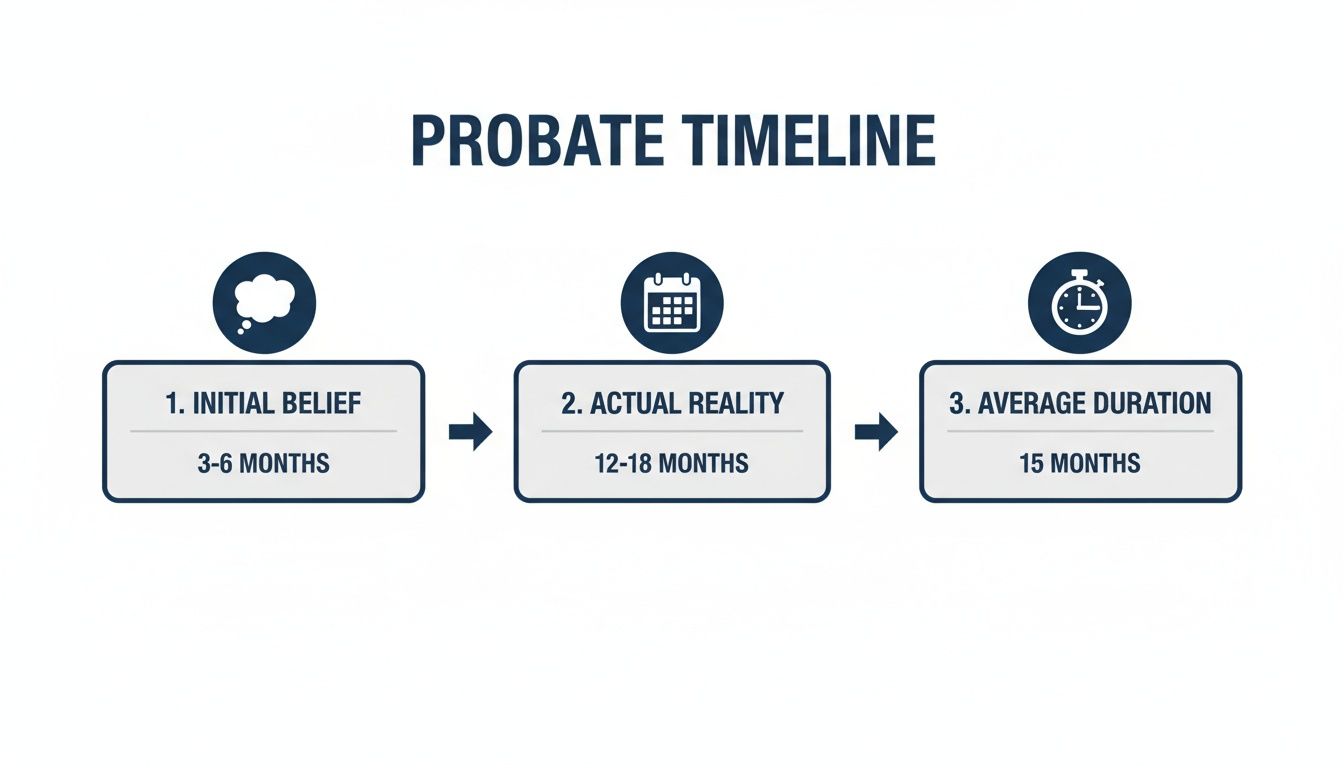
People have different expectations about how long probate will take compared to what the actual average duration of the process turns out to be.
Stage 3: Taking Inventory of All Estate Assets
The executor has to run a massive operation to identify every asset that belonged to the deceased person while they notify creditors. The process requires a complete listing of all assets during this extensive examination.
The process leads to an endless exploration which demands:
- Real Estate: The process requires ordering a formal appraisal to determine the value of all properties.
- Bank Accounts: The process involves locating all bank accounts to determine the exact amount of money present at the time of death.
- Investments: The process requires evaluation of stock portfolios and bonds and retirement funds to determine their worth.
- Personal Property: The evaluation process needs to determine the value of important possessions which include cars and jewelry and art collections.
The process will take two months to complete for an estate which contains only a house and a bank account. But if there are multiple properties, business interests, or hard-to-find assets, this stage can drag on for much longer.
Stage 4: Paying Off Debts, Taxes, and Final Expenses
The process of bill payment starts after the creditor claim period ends and the estate assets receive their assessed value. The estate cash funds get used to pay for every expense which includes both final medical costs and remaining credit card debts. The heirs will not receive any money until all legitimate debts have been paid in full.
The process usually reaches a point where everything comes to a standstill. The executor must sell estate assets including the family home if the estate lacks sufficient cash to pay its debts.
The executor will be busy paying:
- Funeral costs and final medical bills
- Credit card balances and loans
- The deceased’s final income taxes
- Estate taxes, if the estate is large enough to owe them
The process of completing these financial duties will extend the total time requirement by three to six months.
Stage 5: Distributing Assets and Closing the Estate
The end of our journey has arrived. The executor needs to create a final accounting document which they must submit to the court after all debts and taxes have been settled. The document provides a complete financial overview which displays all incoming assets and all paid bills and a strategy for distributing remaining funds to appropriate heirs. The process of transferring property ownership and other assets reaches its conclusion through this step.
The executor receives authorization to distribute inheritance after the judge approves the accounting. The final step requires you to file an additional petition which will officially close the estate through court approval. The final process of wrapping up these activities will take between one and three months to complete which will conclude the entire process.
Common Roadblocks That Can Delay Probate
The probate process encounters various unexpected obstacles which block its path despite all preparatory work. The average timelines give you a decent ballpark, certain issues can stretch the process out far longer than anyone expects. A project which should require only a few months of work can transform into a multi-year period of constant problems. You need to understand the typical obstacles which will help you identify them before they appear so you can avoid them.

The problems function as unexpected roadblocks which block the path of the highway stream. The disruptions emerge suddenly to block what should have been a simple workflow.
Will Contests and Family Disputes
The probate process experiences its longest delays because family members engage in conflicts with each other. The entire process comes to a complete standstill when an heir decides to challenge the validity of a will. The parties involved in the case claim that the deceased person signed the document under duress and lacked mental capacity and that there exists a more recent will document.
The probate case faces a complete legal battle because of this dispute which emerged at the center of the case. The court needs to schedule hearings and review evidence and listen to testimony before it can reach a decision. The legal disputes between parties extend the process by six months to two years while all parties involved must pay rising legal costs.
Issues Locating Assets or Heirs
The executor needs to conduct investigations which resemble detective work during their job duties. An estate can’t be closed until every last asset is found and every heir is formally notified.
The situation becomes unmanageable when:
- The deceased maintained complete financial privacy which resulted in either no records or an extremely complicated documentation system.
- The physical storage of assets exists at locations which people do not expect.
- The executor needs to do an extended investigation because an heir has disappeared after moving and changing their name.
The process of identifying missing puzzle pieces will lead to extended inventory and notification periods.
The executor has a fiduciary duty to be thorough. They can’t just throw up their hands and move on; they are legally required to make a good-faith effort to find every asset and every heir. That takes time.
Complex Debts and Creditor Claims
The process of paying off the deceased person’s debts creates opportunities for extended delays to occur. The situation becomes complicated when an estate needs to pay multiple creditors or when one particular claim stands out due to its large amount or suspicious nature. The executor must examine every claim and work out possible settlements before they need to take court action to resolve any disputed bills.
The executor needs to sell assets which typically include the house to pay off the estate debts when the estate lacks enough cash to cover its obligations. The process starts its own timeline which requires months to complete because of the appraisal process and real estate market activities and sales discussions.
Property-Specific Problems
The house serves as the primary estate asset which presents the most intricate value assessment for most families. The process of selling or transferring inherited property to heirs requires solving multiple complex problems which arise from inherited property ownership.
The property problems usually consist of the following elements:
- Title Defects: A mechanic’s lien from an old renovation, an unreleased mortgage, or a property line dispute can create a “cloud” on the title, making a sale impossible. You can learn more about how to navigate these issues by reading about title problems that arise at closing.
- Condition Issues: The executor must decide between using estate money for home repairs or selling the property in its current state which would affect both its market value and its time on the market.
- Tax Liens: Unpaid property or income taxes often lead to liens being placed on the home. These have to be paid in full before a clear title can be issued to a new owner.
How State Laws Shape Your Probate Timeline
Probate isn’t a single, national system. State laws determine the entire process which leads to different experiences for people based on their geographic location.
States have different driving rules which operate independently from each other. A right turn on red which appears normal in one location becomes a prohibited action at another location. The probate process follows an identical system. The probate process which takes six months to complete in one state can extend up to eighteen months or more in different jurisdictions.
The local court schedule and state-specific deadlines and mandatory waiting periods create obstacles which interfere with the process. The estate settlement timeline depends most heavily on its physical location.
A Look at Timelines Across Different States
States maintain multiple systems which differ from one another at multiple levels. Some states have intentionally simplified their processes, while others are known for being notoriously slow and complex.
The probate process duration varies between different states because every estate follows its own unique path.
Estimated Probate Timelines in Different US States
| State | Typical Timeline for Standard Estates | Factors Affecting Timeline |
|---|---|---|
| California | 9 to 18 months | The courts handle many cases and require multiple notifications which extend the duration of complex cases. |
| Texas | As little as 6 months | Offers more streamlined options like independent administration for simple estates. |
| Florida | 6 to 9 months | The standard probate process uses formal administration but summary administration exists as an option to speed up probate for small estates. |
| New York | 6 to 9 months | Surrogate’s Courts can be busy, especially in metro areas. Executor actions can extend timelines. |
The rules of your area will determine what you will experience. The process requires knowledge of particular deadlines which include Texas probate statutes that determine when anyone can begin will filing.
The estate location determines how long it will take to complete the probate process. An executor must follow the rules of the state where the deceased legally resided, not where the executor lives.
What This Means for an Inherited House
The rules which control your inherited home ownership depend on the state where you live. Property management from different states becomes more complex because you need to understand the legal system which exists outside your state. New Jersey presents its own set of challenges when it comes to handling probate properties. Our guide on how to sell an inherited house in New Jersey provides you with the initial information you need if this applies to you.
You can make better choices by understanding the local timeline. The house should not remain on the market during a probate process which will take more than one year to complete. The inheritance faces a quick depletion because all its funds must cover rising property taxes and insurance costs and maintenance expenses and utility bills.
You need to evaluate your choices at this point. You have three options to consider: prepare the house for future sale, rent it out with court approval, or search for a quicker and more reliable solution. One option to consider is a cash home buyer. The companies which deal with these situations will make an offer during probate to give you a fixed sale price and a specific closing date. The process enables you to finish the sale as soon as the court signs off by avoiding the traditional listing period which brings both uncertainty and waiting time.
Strategic Options for an Inherited House in Probate
The probate process for an inherited house stretches out so long that it seems like an unending wait. The property continues to generate expenses through taxes and insurance and utility bills and maintenance costs even though the court has taken control. The financial burden leads to heir paralysis yet you possess more command over the situation than most people assume.
The process requires you to understand your available choices so you can develop an active strategy which meets both your family objectives and your current situation. You have the ability to select your next steps instead of being passively affected by the process.

Path 1: Wait and Maintain the Property
The simplest solution requires waiting until the probate process completes its course. The estate needs to handle all expenses which occur during the period when the home remains in its possession. The estate needs to have enough money to pay for all holding expenses which will continue for at least one year.
The path provides you with multiple options after probate completion when the financial situation meets the required criteria:
- Move In: An heir might decide to make the house their own.
- Rent It Out: The property could be turned into an income-producing rental for the beneficiaries.
- Sell Later: You can wait until the title is officially in your name before listing it on the open market.
The method shows potential for future growth but requires detailed financial monitoring at present. The property needs to stay under protection while receiving maintenance and insurance coverage throughout the entire probate period to maintain its market value.
Path 2: Prepare for a Traditional Sale
The process of selling your home does not require waiting for probate to finish. You can complete all necessary tasks except for the official sale closing before the legal transfer of ownership takes place. The proactive method will shorten the time between probate end and money receipt by several months.
The process resembles a running start which enables you to make an initial move. The probate waiting period serves as an opportunity for productive work.
- Make Necessary Repairs: Tackle any known issues to make the home more appealing to buyers.
- Clean and Stage: Declutter the home to get it ready for showings. You should use an estate sale pricing guide to determine the value of your inherited belongings during the process of sorting through your personal items.
- Hire a Real Estate Agent: A good agent can start marketing the property and lining up potential buyers.
The system allows you to accept an offer which depends on probate completion. The method works best for heirs who want to sell their property at market value while managing the necessary preparation work.
The probate period requires you to prepare the house for sale because these two lengthy processes will become simultaneous. The process will save you several months of waiting time and property holding costs after you obtain your legal ownership title.
Path 3: Explore a Faster Cash Sale
The ongoing expenses together with the lack of certainty create an overwhelming financial burden for families who receive an inherited home. The process of probate becomes more stressful because bills start to accumulate. A faster sale which provides certainty becomes the best solution for these cases.
The process requires you to sell the house directly to a cash buyer. Cash buyers purchase homes using their own money instead of depending on bank loan approvals which traditional buyers must endure. The process eliminates all financing delays which results in faster closing times. The company specializes in purchasing properties which they acquire without requiring any property improvements.
The process enables you to avoid all the typical problems which occur during this stage:
- You sell the house in its current condition without making any repairs or renovations.
- You save both time and money because you don’t need to prepare the home for showing.
- A direct sale through this method eliminates the need to pay standard real estate agent commissions which typically range between 5% and 6%.
Companies like Eagle Cash Buyers have deep experience purchasing homes in probate. They can make a fair cash offer and sign a purchase agreement while the estate is still working its way through the courts. The closing process will take only a few days once the executor receives authorization to sell. The method produces immediate results which convert an unwanted property into cash through a rapid sales process. Our guide on how to sell a house fast during probate provides detailed information about this process.
Frequently Asked Questions About Probate Timelines
The probate process generates multiple questions which all lead to the main inquiry about its expected duration. The answers to the most common inheritance questions become clear when we eliminate all unneeded information.
Can I Sell a House Before Probate Is Granted?
This is the big one, and the answer is a firm “yes and no.” Let me explain.
The court must grant executive powers to the estate before you can complete the sale and transfer ownership of the property. You cannot sell the property until you have obtained the required document which proves your ownership.
You need to understand that you must stay active instead of waiting for things to happen. You can start the sales process during probate which will help you save time in the future.
Here’s what you can generally do:
- Market the Property: Go ahead and list the house, take professional photos, and start showing it to potential buyers.
- Accept an Offer: You can sign a purchase agreement, but it must have a critical contingency clause stating the sale is subject to court approval.
- Work with a Specialist Buyer: Some buyers, particularly cash home buyers, are used to the probate process. They get that there will be delays and are often willing to sign a contract and patiently wait for the legal side to catch up.
The process enables you to secure a buyer who will remain committed until you receive court approval. Our guide on navigating probate property sales provides detailed information which will help you understand your available options.
What Happens If the Deceased Left No Will?
The legal term for someone who dies without creating a will is known as dying “intestate.” The estate still goes through probate, but the journey is often much longer and more complicated. The court must use a standardized formula which state law sets instead of following the wishes of the deceased.
The legal system of intestate succession establishes a rigid order which determines how assets will pass to heirs starting with the spouse before moving on to children and then parents and so forth. The probate process experiences delays because of these situations.
Here’s why it’s a slower process:
- The court needs to start a formal investigation which will help them find and identify all legal heirs who exist.
- The court must appoint an estate administrator because the deceased did not create a will to name an executor which will delay the process by several weeks to months.
- The absence of a will which clearly defines asset distribution leads to increased chances of family members fighting over the estate.
The court develops the distribution plan from scratch using a legal template because there is no will present. The process requires multiple hearings and legal notifications which will extend the probate period by at least several months.
Are There Ways to Speed Up the Probate Process?
The process requires you to complete all legal requirements and wait for court decisions but you retain some control over the process. The process of probate becomes faster through the prevention of all preventable mistakes which cause unnecessary delays.
The process functions to ensure the road ahead remains free from both traffic congestion and road damage. The best ways to keep things moving are all about solid preparation and clear communication.
Best Practices for an Efficient Probate:
- Stay Highly Organized: Keep immaculate records of everything—assets, debts, emails, and deadlines. A simple binder or a dedicated digital folder can be a lifesaver.
- Maintain Open Communication: Keep all the heirs in the loop with regular updates. The process develops trust which prevents misunderstandings from blocking the workflow.
- Hire an Experienced Probate Attorney: A good probate lawyer who knows the local courts is worth their weight in gold. The team members understand both the procedures and paperwork requirements and they know how to identify typical mistakes which should be avoided.
- Respond Promptly to All Requests: When the court or your attorney asks for a document, get it to them immediately. Your failure to provide documents will create a chain reaction which will delay all future deadlines.
At the end of the day, a proactive and organized mindset is the best tool you have for getting through probate as quickly as the system will allow.
The task of managing a house during an extended probate period creates an overwhelming situation for property owners. The ongoing expenses and uncertainty create a heavy burden. Eagle Cash Buyers offers assistance to people who want to find a quick and guaranteed solution. We provide a fair, no-obligation cash offer on your timeline, allowing you to secure a buyer now and close quickly once the court gives its approval. Visit us at https://www.eaglecashbuyers.com to learn how we can simplify the sale of your inherited property.