To sell a house fast in a slow real estate market, you pull three levers: price the home to what buyers are paying now, offer an incentive that solves the buyer's real financial barrier, and pick a sale method that matches your timeline. If speed matters more than the top price, a cash sale can close in as little as 21 to 42 days and stop the carrying costs that eat into your net every month the house sits.
Every month on the market costs money. Mortgage, taxes, insurance, utilities and upkeep keep coming on a house that is not selling, and after a few months of that, the premium you hoped to gain by waiting for a better offer can be gone entirely.
This guide covers the cost of waiting, pricing, buyer incentives, how to prepare the house, and when a cash sale makes more financial sense than a listing. The dollar figures are worked examples with round numbers, not market data. Eagle Cash Buyers has completed more than 1,000 transactions since 2019, and we evaluate properties in 43 states. None of this is financial, legal or tax advice, so check your own numbers with a professional.
What a "Slow Market" Means for a Seller
A slow market, often called a buyer's market, has more homes for sale than active buyers. Buyers tend to take longer to decide. They may negotiate harder, ask for concessions, add contingencies, or walk away from a home that misses their expectations on price or condition.
Markets are local. National averages can mislead you. Ask your agent for the current numbers for your neighborhood, including how many days comparable homes sat before going under contract, how many months of inventory there are, how often sellers cut their price, and how far the final sale price landed from the original ask. If your area shows the patterns in the right-hand column below, such as long waits, frequent price cuts and buyers who ask for help with closing costs, then the strategies in this guide are built for your situation.
| Factor | Seller's market | Buyer's market (slow) |
|---|---|---|
| Time on market | Short | Long, and growing |
| Offers | Several, often quickly | One or none; price cuts are common |
| Inspections | Sometimes waived | Thorough, used to renegotiate |
| Concessions | Rare | Common (closing costs, repairs, rate help) |
| Overpricing | Corrects quickly | The listing goes stale |
| Value of certainty | Lower | Higher, because financed deals can fall through |
The Real Cost of Waiting
While the house sits, you cover the mortgage, property taxes, insurance, utilities and basic upkeep on a property that earns nothing, and every dollar of it comes off what you net when the sale finally closes. Here is a worked example with round, hypothetical numbers.
| Expense | Monthly (hypothetical) |
|---|---|
| Mortgage payment (principal and interest) | $1,600 |
| Property taxes | $350 |
| Homeowners insurance | $150 |
| Utilities to keep the home show-ready | $200 |
| Lawn care or snow removal | $100 |
| Total per month | $2,400 |
| 3 months on market | $7,200 |
| 5 months on market | $12,000 |
Illustrative only. Your carrying costs depend on your loan, taxes, insurance and property.
Sell Now vs. Wait: A Hypothetical Comparison
Now put that cost into a comparison on a hypothetical $300,000 home, using three paths a seller might take. These assumptions are made up for illustration. A cash offer is below market value, and we assume 85% here only to show the method. It is not a prediction. It is not an Eagle quote either, and no one can tell you what a buyer would offer on your house without looking at it.
| Line | A: Cash sale now | B: List, sell in 3 months | C: List, price cut, sell in 5 months |
|---|---|---|---|
| Sale price | $255,000 | $285,000 | $270,000 |
| Agent commission (assumed 5.8%) | $0 | minus $16,530 | minus $15,660 |
| Pre-sale repairs | $0 | minus $5,000 | minus $5,000 |
| Seller closing costs (assumed) | Eagle pays closing costs except payoff, back taxes and liens, and transfer tax share | minus $4,000 | minus $4,000 |
| Carrying costs | Little (closing can come in as little as 21 to 42 days) | minus $7,200 | minus $12,000 |
| Net before mortgage payoff | $255,000 | $252,270 | $233,340 |
Illustrative. Mortgage payoff, liens and delinquent taxes come out of proceeds on every path.
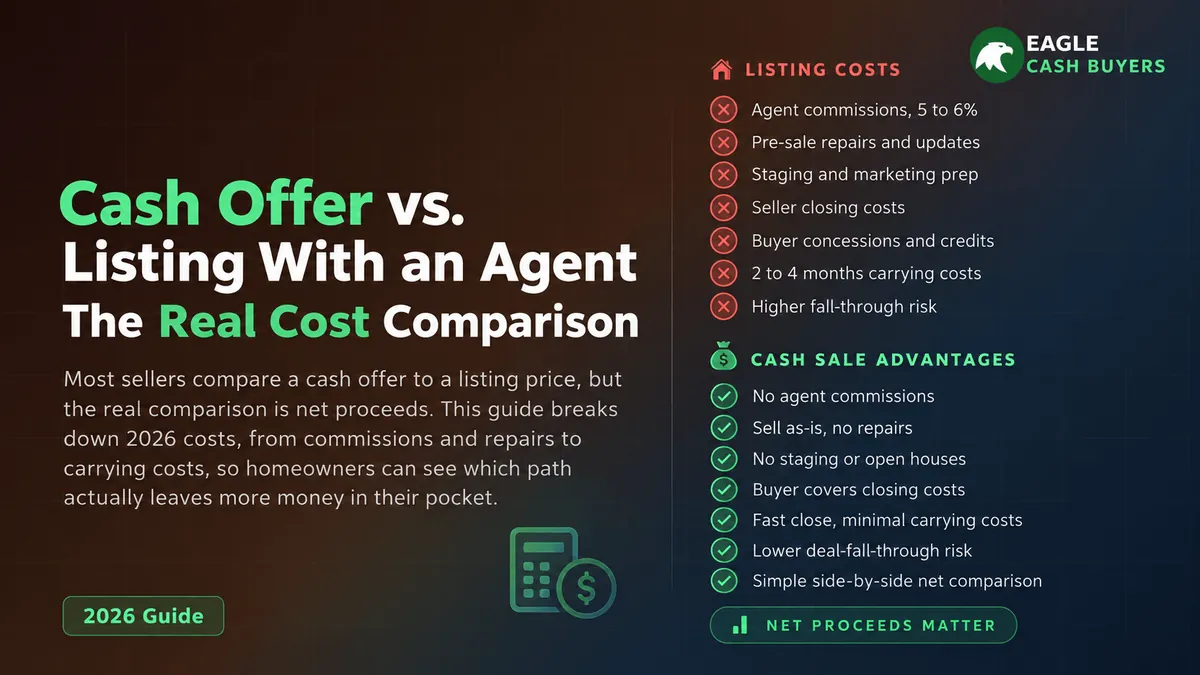
In this example, A and B land close together, and A is months faster. C nets about $21,700 less than A, because the carrying costs, the repairs, the commission and the price cut together ate the entire gap between a retail price and a cash price. That is the pattern to watch for.
Change the assumptions and the answer changes. A listing can net more when the house needs no repairs, is priced right from day one and you have both the time and the money to wait. The point is simple: run your own numbers before you decide. The question is not "which path has the highest price?" but "which path leaves the most money in my pocket, and how long does it take?"
Pricing Strategy: The Biggest Lever You Have
In a slow market, the right price on day one sells the house. A price that is too high can leave the listing sitting, and a listing that sits often ends up needing a price cut anyway. Price to current sold comparables. Not what you hope for. Not what a neighbor got last year, when the market was different, and not what an online estimate says.
Why Overpricing Costs More Than You Think
A new listing gets noticed by the buyers who are searching right now. As it sits, shoppers may start to wonder what is wrong with it, even when the only problem is the price. A later price cut can get less attention than a fresh listing at the right number would have had. Time on market also means more carrying costs, as shown above, and those do not come back.
When to Cut the Price and by How Much
Read the signals your listing is sending. They are blunt.
- Few showings: this can point to a pricing problem. Buyers see the listing, do the math in their heads, and skip it.
- Showings but no offers: the price may be close, but not competitive enough to trigger an offer.
- No activity at all: the price may be far off, and a small cut may not fix it.
- Agent feedback keeps mentioning price: the market is telling you. Listen.
One decisive reduction can work better than several small ones. Repeated small cuts may signal that more drops are coming, which gives buyers a reason to wait instead of making an offer today. Ask your agent what size of cut your local comparables support.
Also watch the search price bands. Buyers filter online searches by price, and a home listed at $305,000 will not appear in a search capped at $300,000. Dropping to $299,000 is a small cut that can put you in front of a different pool of buyers.
Use Current Comps
In a softening market, rely on the most recent sold comparables you can find. Older comps may describe a market that no longer exists. Adjust for condition as well. If the comp sold after a kitchen update and yours has not been touched, that difference belongs in your price.
Buyer Incentives That Can Help in a Slow Market
Solving a buyer's specific financial barrier can work better than a price cut. A seller credit lowers the cash the buyer needs at closing, and a rate buydown lowers the monthly payment during the first years of the loan, so each can help a buyer in a way a price reduction of the same size may not.
Closing-Cost Credit vs. Price Reduction
A hypothetical $350,000 home, using round numbers:
| Line | 1% closing-cost credit | $10,000 price reduction |
|---|---|---|
| Sale price | $350,000 | $340,000 |
| Credit to buyer at closing | $3,500 | $0 |
| Seller's gross before commission | $346,500 | $340,000 |
| What the buyer feels | $3,500 less cash needed at closing | About $63 a month less if the $10,000 is financed at 6.5% for 30 years |
Illustrative math. Whether a credit fits depends on the buyer's loan, and lenders limit how much a seller can contribute.
For a buyer who is stretching to cover the down payment and closing costs, the credit can matter more than a price cut they will hardly notice in their monthly payment. In this example it also leaves you with more.
The Rate Buydown
A seller-funded 2-1 temporary buydown lowers the buyer's rate by 2 percentage points in year one and 1 point in year two, then it returns to the full rate. The seller puts a lump sum into escrow at closing to cover the difference.
Here is the math on a hypothetical $300,000 loan at a 6.5% note rate. In year one the rate is 4.5%, which cuts the payment by about $375 a month. In year two it is 5.5%, which cuts it by about $193. Added up, the subsidy is roughly $6,800. That is a real cost. Compare it with what a price cut or a credit of the same size would do for the buyer, and for your net.
Not every loan allows it. Fannie Mae, for example, counts a seller-funded buydown toward its limit on seller contributions. For a principal residence that limit runs from 3% to 9% of the sales price or appraised value, whichever is lower, depending on the loan-to-value ratio, and for an investment property it is 2%. (Fannie Mae Selling Guide, Interested Party Contributions) Other loan programs have their own limits. Confirm with the buyer's lender before you offer one.
Other Incentives
- A home warranty: can ease a buyer's worry about older systems. Ask what it costs and what it covers.
- A flexible closing date: matching the buyer's timeline can remove a sticking point.
- Appliances included: small cost, visible value.
- Buyer's agent compensation: ask your agent how offering compensation to the buyer's agent would affect showings and your net.
Preparing the Property: Remove Objections, Do Not Renovate
In a slow market, buyers may use every visible defect as a bargaining chip. Your goal is not to remodel. It is to take away the reasons to say no, or to offer less, before they ever come up in a negotiation.
Start with curb appeal. The exterior is what buyers see first in the listing photos, and tidy landscaping, a clean driveway and a freshly painted front door can help the first impression. Those fixes are usually inexpensive.
Declutter and depersonalize. Buyers need to picture themselves in the rooms, and crowded rooms feel smaller.
Fix the small things an inspector will list. Leaky faucets, broken fixtures and cracked caulk are often cheaper to repair than to negotiate over.
Invest in good photos. Listing photos are often a buyer's first look at your house, so treat them as your first showing.
Skip big renovations. A major remodel before selling may not come back in the sale price, and in a buyer's market buyers may still ask for a discount. Check with your agent before you spend.
When a Cash Sale Makes More Financial Sense
A cash sale can make sense when the cost of waiting, the repairs needed to compete, and the commission and closing costs of a listing add up to more than the price gap between a cash offer and a retail price. It does not happen every time, so run the comparison for your own house.
A cash sale often fits when any of these is true:
- The house needs work before it could compete on the open market
- Your timeline cannot absorb a months-long listing, whether because of a move, foreclosure pressure, a divorce or an estate
- Carrying costs are straining your finances
- A previous listing expired or a buyer's financing fell through
On the other side, listing is usually the better route when the house is in good shape and you have both the time and the money to wait for a financed buyer. The cash price is below market. You accept that in exchange for speed and certainty. For a closer comparison, see cash offer vs. listing with an agent and we buy houses companies vs. a realtor. For how costs break down, see who pays closing costs in a cash sale.
How Eagle Cash Buyers Fits a Slow Market
Eagle may buy directly or assign the contract to another buyer, and that is disclosed in the written agreement before you sign. Whether we can make an offer depends on the property, the title and our buying criteria. Not every house qualifies.
The process in short:
- Tell us about the property. Condition, occupancy and your timeline.
- Get an offer. We review comparable sales, the property's condition and the anticipated costs.
- Agreement, property review and title. You get a written agreement, then a walkthrough (virtual or in person), and title or escrow is opened.
- Close. Closing can happen in as little as 21 to 42 days, or later if you need more time, and you pick the date. Eagle pays closing costs except the seller's mortgage payoff, back taxes and liens, and the seller's share of transfer tax. There is no agent commission on a direct sale.
You do not need to make repairs or stage the house for us to review it. There is no buyer mortgage approval to wait on, which is one place financed deals can fall apart. See what a cash offer is and how it works, and our guide to selling a house as-is.
Frequently Asked Questions
How do I sell my house fast in a slow market?
Price to current sold comparables, offer an incentive that solves the buyer's cash-to-close or monthly-payment problem, and choose a sale method that fits your timeline. If speed matters most, a cash offer can close in as little as 21 to 42 days, whatever the market is doing.
Should I lower my price in a slow market?
If you are getting showings but no offers, a single decisive reduction can be better than several small ones, ideally one that moves you into the next search price bracket. If you are getting almost no showings, the price is likely far off. Your agent can size the cut from local comps.
What buyer incentives work best?
Credits toward closing costs and seller-funded rate buydowns address two common buyer barriers, which are cash at closing and the monthly payment. Lenders and loan programs cap how much a seller can contribute. Confirm the limits with the buyer's lender before you offer anything in writing.
How much does it cost to hold a house that will not sell?
Add up your mortgage, property taxes, insurance, utilities and upkeep, then multiply by the months you expect to wait. Our worked example above used $2,400 a month, but your number depends on your own loan and costs.
Is it better to sell to a cash buyer in a slow market?
It depends on your numbers, even in a slow housing market. A cash offer is below market value. But after commissions, repairs, concessions and months of carrying costs have been subtracted from the listing path, the gap between the two can be smaller than it looks. A well-kept house with time on your side may net more as a listing.
Can I sell my house as-is in a slow market?
Often, yes. Many conditions are possible, and whether we can make an offer depends on the property, the title and our buying criteria. Selling as-is skips the repair costs and the prep time that a listing normally requires, which matters in a market where upgrades may not pay you back. See our guide to selling a house as-is.
The Bottom Line
A slow market punishes two things: the wrong price and doing nothing. Sellers who do best price to current data, solve the buyer's actual financial problem, and decide with clear eyes whether the cost of waiting is worth the possible premium of a listing. Run both paths on paper. Then choose.