
When you sell a house, you usually choose between two routes. You can hire a real estate agent and list the house, or you can sell directly to a company that buys houses for cash. Neither one is right for everybody. We buy houses vs realtor comes down to your timeline, the condition of the house and what you need from the sale.
We're a cash buyer, so we have an interest here. We'll say plainly where a listing can come out ahead, because a seller who picks the wrong route can lose time or money, and neither of us wants that. This guide compares the two on speed, certainty, costs and price, and helps you decide. For the full cost math, see our cash offer versus listing comparison.
Your Quick Guide to We Buy Houses vs Realtor
Many homeowners go with an agent. For good reason. The agent prices the house, markets it on the MLS, schedules showings and negotiates with buyers. The goal is to create competition and get the best price the market will pay.
The other route is a direct sale. A company that buys houses makes you an offer on the house as it stands. No listing. Some of these buyers are investors who renovate and resell. Others rent the house out. Our guide to the main types of companies that buy houses as is explains how they differ.
Cash Buyer vs Realtor: Key Differences
| Factor | Cash home buyer | Listing with a realtor |
|---|---|---|
| Timeline | With Eagle, as little as 21 to 42 days, or longer if you need more time. You pick the date. | Varies with the market, the price and the condition, and includes the buyer's financing, appraisal and inspection. |
| Certainty | No buyer mortgage or appraisal to wait on. A sale still depends on the title and the contract. | Depends on the buyer's financing, appraisal and inspection results. |
| Repairs and prep | Usually none. Sold as is. | Often some repairs, cleaning or staging, and buyers may ask for repairs or credits after an inspection. |
| Fees | No agent commission on a direct sale with Eagle. Eagle pays closing costs except your mortgage payoff, back taxes and liens, and your share of transfer tax. | An agent commission, which is negotiable and set in the listing agreement, plus the seller's closing costs. |
| Price | Below what a repaired, listed house might bring, reflecting the condition, the repairs and the buyer's margin. | You set a list price aiming for market value. The final price depends on the offers you get. |
These are general patterns. Individual companies and agents differ, so confirm every detail in writing.

Understanding the Two Home Selling Models
The Cash Buyer Model
A "we buy houses" company is an investor. It buys with its own money, so there's no lender to wait on. It also takes on the repairs, the resale and the risk, which is why the offer comes in lower than a market price, and why the trade only makes sense when speed and simplicity matter to you.
The Traditional Realtor Model
A listing agent represents you. The agent typically handles:
- Pricing the house against recent sales nearby, so the number is grounded in what similar houses actually sold for
- Listing it on the MLS and arranging photos
- Scheduling showings and open houses
- Negotiating offers
A good agent can be worth the commission when the house is in good shape and you have time. Agents know the local market. The idea is to invite as many buyers as possible, which creates competition and, with luck, pushes the price up. That's a real advantage.
If you want to handle the sale without an agent, our guide on how to sell your house without a realtor explains how.
A Detailed Look: We Buy Houses vs Realtor
Speed: The Race to the Closing Table
A cash buyer pays with its own money, so the sale doesn't wait on a lender. A listing has more steps. You prepare the house, market it and wait for the right offer, and then the buyer goes through mortgage approval, an appraisal and an inspection, each of which can add days or weeks before anyone gets to the closing table. Timing varies.
Certainty: Fewer Unknowns, Not Zero
With a cash buyer, the deal is less exposed to financing problems. Once you agree on a price and sign the contract, you have a closing date you can plan around, and that's worth something if you're moving on a deadline. It isn't risk-free. Title issues, liens and an unreliable buyer can still derail a sale. Check who you're dealing with. Our guide on whether we buy houses companies are legit shows how.
With a listing, the uncertainty sits mostly on the buyer's side. A buyer may need a mortgage, an appraisal that supports the price and an inspection that goes well, and any one of those can lead to a renegotiation or a cancelled contract. That's the risk.
Fees and Costs: What You Actually Pay
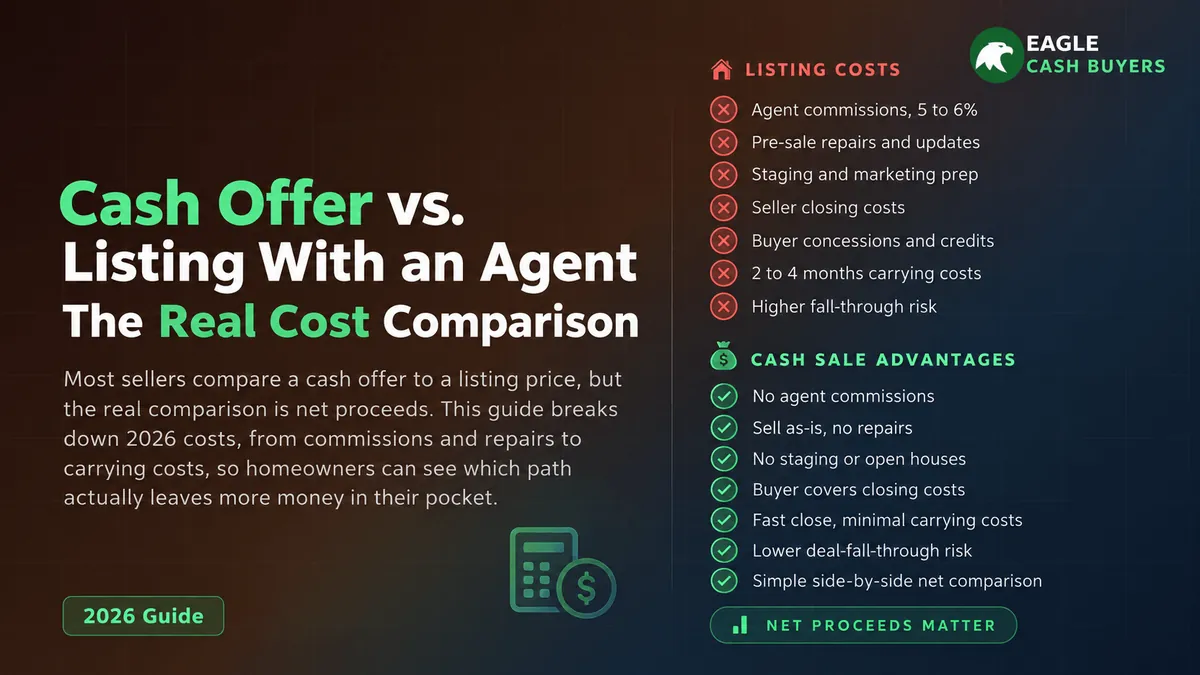
The costs look very different. A listing typically means an agent commission, which is negotiable and not set by law, and is fixed in your listing agreement, plus the seller's closing costs and any repairs, staging or carrying costs while the house sits on the market. A direct sale with Eagle has no agent commission, and Eagle pays closing costs except your mortgage payoff, back taxes and liens, and your share of transfer tax. Other buyers have their own terms, so ask for them in writing.
Price: Gross Sale vs. Net Proceeds
At first glance a listing looks better, because the list price is higher. What matters is the money you take away after everything is paid. Here are the points to weigh:
- A cash offer is lower, and it already reflects the condition of the house. You aren't paying for repairs or a commission on a direct sale.
- A listing may sell for more. Once you subtract the commission, repair costs, carrying costs and the time involved, the gap can narrow, though not always. It can also stay wide.
Which side of that gap you land on depends on your house and your market, and the only way to know is to run both sets of numbers for your own situation before you commit to either route. Don't guess. Our cash sale versus traditional sale article goes through the numbers.
How to Decide
Two questions do most of the work. Do you have the time to wait out a listing? Do you have the money to put the house right first? If both answers are yes, listing with a good local agent can net more, and we'd tell you to compare before you sell for cash.
If either answer is no, the comparison changes. A house that needs more repair than you can afford, a closing date you can't miss, a foreclosure clock or an inherited house you can't maintain are all cases where a cash sale can come out ahead. Sometimes it's the only sale that closes.
You don't have to choose blindly. Not here. Get an agent's opinion of the listing price and at least one written cash offer, then compare what you would net from each. For a wider look at the options, see our guide to cash buyers, iBuyers and agents.
Can I Negotiate With a We Buy Houses Company?
Yes. Many investors build an offer from a formula, and a reliable cash buyer should be able to explain it, including the repair estimate and the margin. Know something the buyer missed, such as a new roof or a recent repair? Raise it. Ask for any change in writing.
Frequently Asked Questions
Is it cheaper to sell to a cash buyer or use a realtor?
It depends on the house. A cash offer is lower, but a direct sale with Eagle has no agent commission and no repairs on your side, while a listing may bring a higher price along with a commission and the cost of preparing the house. Compare the net figure.
Which is faster, a cash sale or a listing?
A cash sale can be faster, because a cash offer doesn't wait on a buyer's financing. With Eagle, closings can happen in as little as 21 to 42 days, or later if you need more time. A realtor listing's timeline depends on your market and your buyer.
Do I need a realtor to sell to a company that buys houses?
No. A direct sale doesn't need a listing agent. You can still ask an agent or attorney to read the contract before you sign, and we encourage that, because a second pair of eyes on any purchase agreement is cheap protection.
Can I get offers from both before deciding?
Yes. It's the best way to decide. Ask an agent what the house might list for and what you'd net after costs, then compare that with a written cash offer from a buyer who will show you how it was calculated.