


Selling a distressed property isn’t like selling a normal home. You’re juggling repair costs, possible foreclosure pressure, lender deadlines, or a property you inherited that hasn’t been touched in years. The right move depends on one thing: what you need most right now. Speed, top dollar, or just a clean exit.
This guide walks you through your real options, what each one costs in time and money, and how to choose without second-guessing yourself later, helping you sell distressed property with confidence.
What Is a Distressed Property?
A distressed property is any home tied to financial trouble, physical damage, or both. That covers homes in pre-foreclosure, properties with code violations, abandoned houses, inherited homes with deferred maintenance, and houses with major structural issues like foundation cracks or fire damage.
Roughly 1 in 10 U.S. homes shows some level of distress at any given time, according to ATTOM Data Solutions. So if you’re in this spot, you’re far from alone. Knowing what is a distressed property helps you make the right decision when selling a distressed home.
Your Options for Selling a Distressed Property
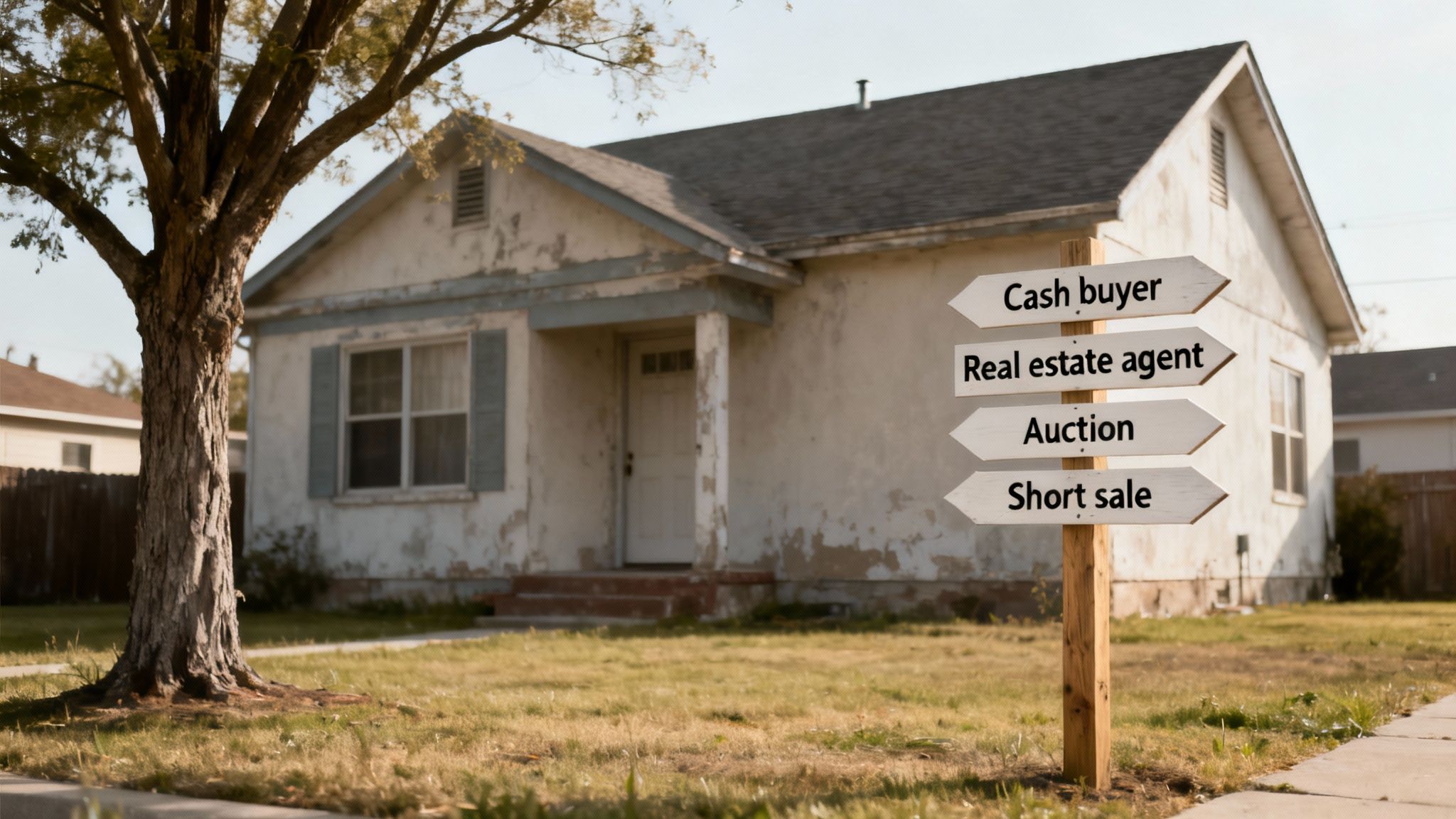
Most sellers land on one of four paths. Each one trades something off.
| Selling Method | Typical Timeline | Seller Costs | Sale Certainty |
| Cash Buyer | 7 to 21 days | Almost none | Very High |
| Real Estate Agent | 3 to 6 months | 8 to 10% plus repairs | Moderate |
| Auction | 30 to 60 days | Marketing fees | Low to Moderate |
| Short Sale | 4 to 12+ months | Low (lender pays most) | Very Low |
Below, we’ll break down when each option makes sense and when it doesn’t, helping you sell distressed property efficiently.
1. Sell to a Cash Buyer
This is the fastest route, and it’s why most distressed property buyers exist in the first place. Cash buyers purchase your property in its current condition. No repairs, no staging, no inspections that fall apart at the last minute.
A serious cash buyer will give you a written offer within 24 to 48 hours after seeing the property. Closing usually happens in two to three weeks. You pick the date.
This works best if:
- You need selling distressed property fast before a foreclosure auction
- The home needs more repairs than you can afford
- You inherited a property out of state
- You just want the headache gone
You can see exactly how the cash buyer process works here.
2. List With a Real Estate Agent
The traditional route can pull in a higher gross sale price, but the net often isn’t as good as it looks on paper. After commissions (around 6%), closing costs (around 2%), and the repairs buyers will demand after inspection, sellers commonly walk with 10 to 15% less than the listing price.
Listing makes sense when the property has cosmetic issues only and you have time and cash to fix it up properly. If the home has major problems, traditional buyers will either walk or hammer you on price after inspection.
3. Sell at Auction
Auctions create urgency and competition, but the catch is the reserve price. If bidding stalls below your minimum, the sale dies and you still owe marketing and auctioneer fees, sometimes $1,500 to $5,000.
Auctions work for unusual properties (large acreage, unique commercial-residential mixes) where pricing is genuinely hard to peg. For a typical single-family home, the risk-to-reward ratio usually doesn’t favor the seller.
4. Pursue a Short Sale
A short sale happens when you owe more than the home is worth and the lender agrees to accept less than the full mortgage balance. It can prevent foreclosure, but it’s slow, paperwork-heavy, and the bank holds all the cards.
According to the Consumer Financial Protection Bureau, lenders can take 60 to 90 days just to acknowledge a short sale package, and the full process often stretches past a year.
Worth pursuing only if foreclosure is the alternative and you don’t qualify for a loan modification.
How Cash Offers Are Calculated
A lot of sellers worry they’ll get lowballed. Here’s how a legitimate offer actually gets built:
After-Repair Value (ARV) minus Repair Costs minus Holding Costs minus Buyer’s Margin = Your Offer
So a home with a $300,000 ARV needing $60,000 in repairs and $15,000 in holding and closing costs, with a 10% margin for the buyer, lands around $195,000 cash, no fees, no commissions.
That number sits next to a traditional listing scenario where you’d net $300,000 minus $60,000 in repairs, minus $24,000 in commissions, minus $6,000 closing, minus four to six months of carrying costs. The gap shrinks fast.
For more on the tradeoffs, this breakdown of selling a distressed home as-is from Bankrate covers the financial logic well.
Avoid These Mistakes When Selling a Distressed Home
- Pouring money into repairs that won’t recoup. Most renovations return under 70% of cost.
- Pricing based on what you owe, not what the property is worth. Buyers don’t care about your mortgage balance.
- Trusting verbal offers. Get every offer in writing with a clear closing timeline.
- Skipping due diligence on the buyer. Ask for proof of funds. A real distressed property buyer will provide it without hesitation.
Selling a Distressed Home Without the Stress
If you’ve already decided that speed and certainty matter more than squeezing out the last dollar, a direct sale is the cleanest path. Eagle Cash Buyers handles distressed properties across every condition: vacant homes, fire-damaged structures, hoarder situations, inherited estates, pre-foreclosure cases.
Get a no-obligation cash offer and pick your own closing date.
Reach out for a free cash offer today
Frequently Asked Questions
What is a distressed property?
A distressed property is a home with serious physical damage, financial trouble like pre-foreclosure, or both.
Can I sell an abandoned property I inherited?
Yes. Distressed property buyers regularly purchase abandoned and inherited homes, often without requiring you to clean them out first.
How fast can I sell a distressed property?
Most cash sales close in 7 to 21 days. Traditional sales take 3 to 6 months on average. This is the fastest way of selling distressed property fast.
Will I get less money selling to distressed property buyers?
The gross price is lower, but after agent fees, repairs, and holding costs, the net often comes out close to a traditional sale, with far less hassle.
Do I need to make repairs before selling?
Not if you sell as-is to a cash buyer. They factor repair costs into the offer. This is the key advantage of selling a distressed home to a professional buyer.