
HomeVestors vs a direct cash buyer: the biggest difference is who you actually deal with. HomeVestors is the franchise network behind the "We Buy Ugly Houses" slogan, and its own site says each franchise is independently owned and operated. Eagle Cash Buyers is one company that evaluates houses in 43 states and may buy a house itself or assign the contract. Both buy as is for cash. So compare the written offer, what comes out of it and the closing date, because those three decide what a sale is really worth to you.
We wrote this. Keep that in mind. Every fact about HomeVestors comes from the HomeVestors FAQ page, quoted or closely paraphrased and checked in October 2026. Terms change, so confirm them with the office that contacts you. HomeVestors and We Buy Ugly Houses are trademarks of their owner. Eagle Cash Buyers has no business relationship with HomeVestors and is not part of its franchise network.
HomeVestors vs Eagle Cash Buyers: The Short Answer
- A HomeVestors office may be the closer fit if you want someone at your door from the first conversation, if you have a mobile home without its land, or if you are outside our 43 states.
- Eagle may be the closer fit if you would rather start with a phone call than a home visit, want one company's published terms, or want to hear about a second option that can pay more if you can wait.
- Listing with an agent may net more than either if you have the time to wait out a sale and the money to put the house right first.
Neither company usually pays full market price. A footnote on the HomeVestors FAQ page says its offers "are typically discounted below market value in exchange for speed and convenience." Our cash offers work the same way. A cash offer is usually lower than the price a fully repaired home could reach on the open market, because the buyer takes on the repairs, the holding costs and the risk of reselling. In return you skip the repairs, the showings and the wait.
How Does HomeVestors Work?
HomeVestors describes "a network of over 750 franchises," and adds: "Each franchise is independently owned and operated, ensuring personalized service tailored to your local market." Your local property specialist presents the contract for you to sign.
The process starts in person, with "a no-obligation consultation where we do a quick walkthrough of your house." After that visit, its representative weighs the condition of the house, the scope and cost of repairs for resale, the time those repairs take, comparable homes nearby, and holding costs during the work, which it lists as "taxes, payments, insurance, utilities, and homeowners association dues." Because the offices are independent, HomeVestors says its local specialists have "the flexibility and freedom" to negotiate.
On costs, its FAQ says: "We don't charge commissions, real estate fees, or service charges. We also pay typical closing costs." On timing, the page is careful: "Sometimes, we can close in as little as three weeks, although sometimes circumstances dictate a longer timeline." Elsewhere it says it can "sometimes close in as little as 3 weeks, or later if you need more time," and that the specialist will work with you "to set a closing date that works for your timing and situation." After you sign, it describes a three-day option period in which you can cancel by notifying your property specialist in writing.
One more line deserves attention. The site notes that "cash" does not mean the deal involves no financing or that the closing is certain. That is a fair warning about any cash sale, ours included.
How Does Eagle Cash Buyers Work?
Tell us the address and a little about the house. We review it, may ask to walk through it, and send a written cash offer with no obligation. If you accept, a closing agent handles the title work and you choose the closing date.
We present our offers on a call. Once we have the property information we need, we can usually give you an initial offer within minutes to a few hours during business hours. At Eagle, our policy is to have everyone on the deed and every decision maker on the call when we present the offer, so they can decide together whether to move forward. An offer is only an offer. Nothing is binding until you and Eagle sign a purchase agreement.
We buy houses in any condition. Whether Eagle makes an offer depends on the area, the value and whether the numbers work, not on condition. We buy mobile homes only when they are sold together with the land they sit on.
Eagle charges no fees, and you pay no repair costs and no closing costs. There is no agent commission on a direct sale to us. Your mortgage payoff, any liens and prorated property taxes are paid from the sale proceeds. On a standard cash offer the seller pays the transfer tax; on a Retail Max sale Eagle pays it. The purchase agreement states who pays.
Eagle may purchase the property itself or, if the purchase agreement permits, assign its contractual rights to another investor or purchasing entity. Any assignment right is stated in the agreement before you sign.
Most sales close in 21 to 42 days, or later if you need more time. You pick the date. If you want a higher price and can wait, Retail Max is our second option. We put the house under contract at an agreed price above our straight cash offer and market it to an end buyer. Showings are needed, and the timeline is longer because it depends on that buyer and their financing. You usually net more than with a cash offer, but less than a full retail listing of a fixed-up house.
HomeVestors vs Eagle Side by Side
The HomeVestors column follows its FAQ page, checked in October 2026.
| HomeVestors (its FAQ page) | Eagle Cash Buyers | |
|---|---|---|
| Business model | Franchise network. Each franchise is independently owned and operated | One company (Eagle Cash Buyers, LLC, registered in Ohio) |
| Who the buyer is | Not named on the FAQ page. Your local property specialist presents the contract, so ask who the legal buyer is | Eagle, which may buy itself or assign the contract, as the agreement states before you sign |
| How it starts | Consultation with a walkthrough of the house | A call or form. We may ask to walk through the house |
| Offer based on | Condition, repair scope and time, comparable homes nearby, holding costs | The area, the value and whether the numbers work |
| Fees and commissions | None charged, per its FAQ | No fees and no agent commission on a direct sale |
| Closing costs | "We also pay typical closing costs" | No closing costs. Payoff, liens and prorated property taxes come from the proceeds |
| Transfer tax | Not stated on the FAQ page. Ask the office | You pay it on a standard cash offer. We pay it on Retail Max |
| Closing timeline | "Sometimes" as little as three weeks, or later if you need more time. Date set to fit "your timing and situation" | Most sales 21 to 42 days, or later. You pick the date |
| Cancel after signing | Three-day option period, notice in writing | Varies. Ask for the agreement |
| Property types | Houses, townhomes, condos, multi-tenant, "some mobile/manufactured homes," commercial | Any condition. Mobile homes only with the land |
| Where | Over 750 franchises | 43 states |
Franchise vs Single Company: What Changes for You
With a franchise, the brand on the mailer and the office you deal with are not the same business. HomeVestors says its local property specialists have the freedom to negotiate, so check the record of the office you are talking to, not only the brand.
With Eagle, you deal with one company and one set of published terms. The buyer question still matters. Because we may assign the contract, read who the buyer is and what the assignment clause says before you sign. Then ask anyone, franchise or not, three questions. Who is the legal buyer on this agreement? Who is my contact after I sign, and how often will I hear from them? Can the closing date move if my plans change?
That last question deserves a straight answer. In the seller files Eagle documented in 2026, about one in three sellers were moving, and about one in seven needed flexible timing. Severe condition, the "ugly house" itself, came up in about one in ten. These are sellers who contacted a cash buyer, not a representative sample of home sellers.
Real Seller Story: When the Next House Wasn't Ready
A seller and his partner in the Southeastern US were selling one house while trying to buy another, and the second purchase depended on the first. The money from our sale was earmarked for a down payment. Then their financing hit a wall. A lender told them they likely couldn't close on a new home until November.
His fear was the obvious one, and he named it: what if he sold and had nowhere to go? Our transaction coordinator's answer was direct. "We're not gonna get you out on the streets and get you homeless or anything like that... we might simply just stay in the contract." Our position was that the timeline could stretch, pause or wait for his financing rather than force a closing.
Two smaller details mattered as well. The coordinator offered to send the signed agreement so the seller could show the professionals on his next purchase that money was coming. Many agents accept that, though not all do. And he had a fixed rhythm of contact: "Tuesdays and Fridays are the days that I regularly update my clients." Whoever you sell to, ask for both.
How to Compare a HomeVestors Offer With Ours
Compare what you keep. The offer price, your net proceeds and the market value of the house are three different numbers. Ask each buyer for a written offer and an estimated settlement statement, then fill in the same lines for both. This worksheet is an illustrative example of the lines, with no real figures.
| Line (illustrative example) | Offer A | Offer B |
|---|---|---|
| Offer price | ||
| Minus your mortgage payoff | ||
| Minus liens and back taxes | ||
| Minus your share of prorated property taxes | ||
| Minus any transfer tax you pay | ||
| Minus any other charge the agreement puts on you | ||
| Estimated money to you at closing | ||
| Closing date, and can it move? | ||
| Inspection or option period, and what can change after it | ||
| Who the buyer is, and is there an assignment clause? |
Whatever remains after the mortgage, any other liens and your share of the sale costs goes to you. If one number is higher but its agreement lets the price change after an inspection, the gap may not survive. Our guide to how cash buyers calculate an offer shows the math, and the cash offer purchase agreement guide walks through the clauses worth reading twice.
Eagle Cash Buyers is not a law firm, title company or tax advisor. This information is general and is not legal, title or tax advice. Laws, procedures and transaction costs vary by state and locality, and the purchase agreement and closing documents control each transaction.
When HomeVestors May Be the Better Fit
- A mobile home without its land. HomeVestors lists "some mobile/manufactured homes." We buy mobile homes only with the land.
- A house outside our 43 states. The HomeVestors site lists service areas that include Maine, Nebraska and Wyoming, where we do not buy. Our locations page lists the states we cover.
- You want someone in person from day one. HomeVestors builds its offer around a walkthrough at the first meeting.
Or neither of us. Two things decide this: whether you have the time to wait a sale out, and whether you have the money to put the house right first. Where you have both, list it with a good local agent, and we can usually tell you so. Weighing several kinds of buyer? Our guide to companies that buy houses as is sorts them by type, and our Eagle vs Opendoor comparison covers the iBuyer route.
How to Check Reviews and Complaints Yourself
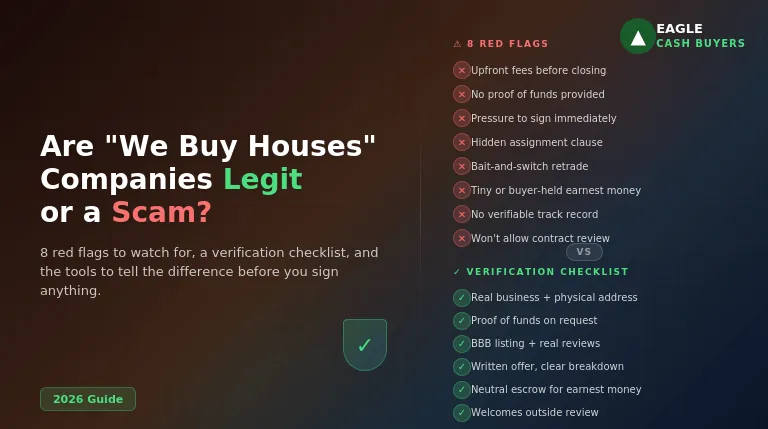
We do not summarize other companies' reviews, so check them yourself. Use the exact legal name on the agreement, not just the brand, because a franchise office's record and the national brand's record can differ. Look up that name's BBB profile and your state's business registry, and ask your state attorney general's office (USA.gov finder, checked October 2026) whether it has received complaints.
The North Carolina Department of Justice (checked October 2026) describes a specific scheme in which a "we buy homes" company gets the owner to sign over control of the home and leases it out, while the owner still owes the mortgage. Its advice: "Beware of anyone who asks you to sign over the title to your home based only on their promises to sell your property."
Check us the same way. Eagle Cash Buyers, LLC is registered in Ohio and rated A+ by the BBB. Our post on red flags in cash home buyers has a longer checklist.
HomeVestors FAQ
Is HomeVestors legit?
Yes, it is a real franchise company, with over 750 franchises according to its FAQ. How a given buyer treats you depends on the office, since each franchise is independently owned. Check that office's legal name with the BBB and your state attorney general before you sign.
How does HomeVestors work?
A local property specialist walks through the house, makes a cash offer based on condition, repairs, comparable homes and holding costs, and then presents a contract. You get three days after signing to cancel in writing, HomeVestors says. Ask the office for its terms.
Is "We Buy Ugly Houses" the same as HomeVestors?
"We Buy Ugly Houses" is the HomeVestors slogan. Its FAQ warns that not every company using "ugly house" or "we buy houses" signs belongs to HomeVestors, and it suggests contacting HomeVestors directly to check. Our post on what "We Buy Ugly Houses" really means explains the slogan.
How much does HomeVestors pay for a house?
Its FAQ page does not publish a percentage. HomeVestors says it purchases houses "at a discount in exchange for convenience," so expect less than a repaired house would sell for. Get a second written cash offer, ask an agent what the house would list for as is and after repairs, and compare the money you would keep from each.