You open the payoff statement and the number is higher than anything a buyer would pay. It happens after a dip in local prices, a cash-out refinance, a small down payment or a loan that spent its first years paying mostly interest. The question is always the same. Can you sell your house when you owe more than it is worth?
Yes, but it will not look like a normal sale. Not even close. The proceeds will not clear the mortgage on their own, so someone has to cover the gap. That someone is you, the lender or a mix of both, and the answer to that one question decides almost every other step that follows. So start there.
This guide is the starting point. It shows how to find your real numbers, lays out the main ways forward and explains where a cash sale fits, without pretending any of them is easy. It is general information, not legal, tax or financial advice, so confirm details with your servicer, a HUD-approved housing counselor and, where it matters, an attorney or tax professional in your state.
What Owing More Than Your House Is Worth Means
People call it being underwater, or having negative equity. Your mortgage balance is higher than what the home would sell for today. Say it would sell for $220,000 and you owe $250,000. You are $30,000 underwater, and that is only an illustration, because real gaps can be far smaller or far larger depending on the market, the loan and how long you have owned the home.
Common causes include:
- Local home values that fell after you bought or last refinanced
- A low down payment, so there was little equity to begin with
- A cash-out refinance that raised the balance faster than the value
- Early loan years, when a larger share of each payment goes to interest rather than principal
None of this means you did something wrong. It does change the sale. A normal closing pays the mortgage from the proceeds and sends you whatever remains, and when nothing remains, the whole order of operations flips and the lender gets a vote.
Step One: Get Your Real Numbers
Guessing makes every later decision worse. Gather three figures before you talk to anyone who wants to buy your house, whether that is an agent or a cash buyer.
- Your payoff amount. Request it in writing from your servicer. Federal rules generally require the servicer to send a payoff statement within 7 business days of a written request. It includes interest and fees, so it is higher than the balance on your last statement.
- Your home's likely sale price. An online estimate is a starting point only. An agent's comparative market analysis or a written cash offer is closer to reality.
- Every other claim on the title. A home equity loan, a HELOC, a tax lien or a judgment all have to be dealt with at closing. Claims can add up fast. Our guide on selling a home with liens or back taxes explains how.
Subtract the payoff and other claims from the likely price, then subtract the costs of selling. If the result is negative, that figure is the gap you have to solve. Simple, and sobering.
Your Options When You Sell Your House When You Owe More Than It Is Worth
Wait and keep paying
If you do not have to move, time can help. Payments reduce principal, and values may recover. It only works if you can keep paying comfortably, and nobody can promise that prices will rise, so treat waiting as a bet rather than a plan, and decide how long you can afford to hold it.
Bring cash to closing
If you have savings, you can sell the usual way and pay the shortfall at the table. No lender negotiation. You do need cash for the gap and for the costs of selling on top of it, which is why this route is open to fewer people than it first appears.
Ask your servicer for help first
Servicers may offer options such as a refinance, a loan modification, a repayment plan, forbearance, a short sale or a deed in lieu of foreclosure. Refinancing is hard without equity, so ask your servicer whether any program applies to your loan, and keep a written record of who you spoke with, on what date and what they told you, because answers can change from one call to the next.
Request a short sale
A short sale means selling for less than you owe, with the lender's consent. Simple idea, slow process. The CFPB defines it as a sale of your home for less than what you owe on your mortgage. The lender or servicer must approve, so you cannot force it. In some states a lender can still pursue the leftover balance (a deficiency) unless you get a written waiver, so ask about that before you agree to anything.
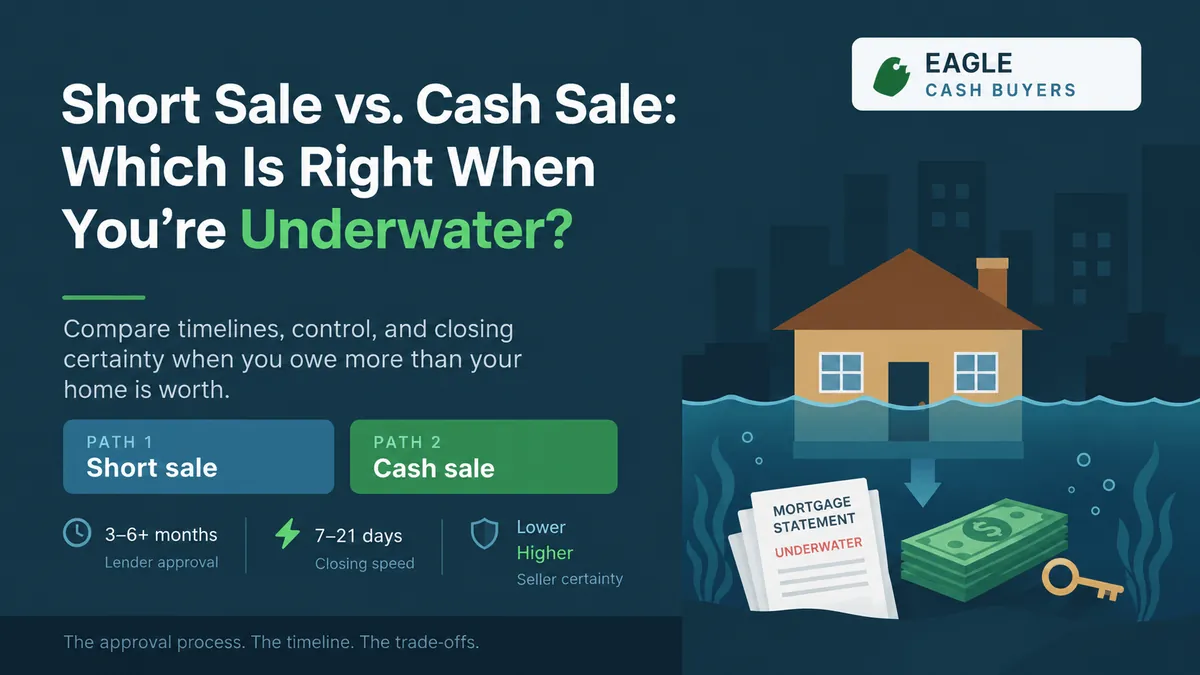
We compare the two paths in detail, with worked numbers, credit effects and the deficiency risk, in short sale vs. cash sale when you are underwater. Start there if a short sale is on your list.
Consider a deed in lieu
With a deed in lieu, you hand the property to the lender to settle the loan, which can avoid a foreclosure but also needs lender approval and carries its own credit and tax effects that you should understand before you agree to anything in writing. Not automatic. See deed in lieu of foreclosure vs. selling for cash for the comparison.
Where a Cash Sale Fits
Let us be direct. A cash buyer does not erase the gap between what you owe and what the house is worth. The mortgage still has to be paid or settled at closing, one way or another.
What a direct cash sale can change is everything around that gap. There is no agent commission on a direct sale with Eagle Cash Buyers. There are no repairs to fund before listing and no wait for a buyer's loan approval. When there is equity, closing can happen in as little as 21 to 42 days, or later if you need it, and you pick the date.
Underwater is different. If the price will not cover the payoff, the lender has to agree to accept less, and that approval sets the timeline for the whole sale, which can run far longer than the buyer's own closing period. Nothing is certain, and whether we can make an offer on a home like that depends on the property, the title and our buying criteria. The price is also below market, which is the trade for speed and a sale without repairs.
| Path | Lender approval needed? | Cash needed from you? | Main catch |
|---|---|---|---|
| Traditional sale, pay the gap | No, with a payoff statement | Yes, for the gap and selling costs | Needs savings; agent commission and repairs may apply |
| Short sale | Yes | Usually not | Approval is not certain; ask about a deficiency waiver |
| Direct cash sale | Only if the price is below the payoff | Depends on the gap | Cash price is below market; a short payoff still needs the lender |
| Deed in lieu | Yes | Usually not | Credit and tax effects; lender can say no |
Behind on payments too? Time matters even more. Read selling your house during foreclosure and what happens to your mortgage when you sell for cash. Our how it works page shows the steps.
Credit and Tax Watch-Outs
Credit first. Most negative marks stay on a credit report for about seven years, according to the CFPB. Ask your lender how it would report a short sale or a deed in lieu, and get the answer in writing.
Taxes second. Careful here. The IRS says canceled debt is generally taxable unless an exclusion applies, such as bankruptcy or insolvency. The exclusion for qualified principal residence debt covered only debt discharged before January 1, 2026, or discharged under a written arrangement made before that date. The details are in IRS Topic 431. Whether any exclusion applies to your sale depends on your facts and the timing, so ask a tax professional before you sign.
Get Free Help Before You Decide
HUD-approved housing counselors can go through your numbers and your options with you. According to the CFPB, their help often comes at little or no cost to you, and its tool lets you find one near you.
One warning, and it matters. Be wary of anyone who asks for money up front, promises a result, asks you to sign over your title or tells you to stop talking to your lender.
Frequently Asked Questions
Can you sell a house when you owe more than it is worth?
Yes. Negative equity does not rule out a sale. You can pay the gap yourself, ask the lender to approve a short sale, or look at other lender-approved options. Which one fits depends on your cash, your timeline and your lender, so get the numbers first.
Do I need my lender's permission?
If the sale price will not cover the payoff and you want the lender to accept less, yes. If you pay the gap yourself, you generally just need a payoff statement. Rules and practices vary by lender and state.
Will I owe money after a short sale?
It depends on your state and on what the lender agrees to in writing. In some states a lender can pursue the difference unless it waives that right. Get any waiver in writing. Then have a local attorney read it before you close.
Can I sell if I am underwater and behind on payments?
Often, yes. It is harder, and time matters more. Servicers generally cannot make the first foreclosure filing until a loan is more than 120 days delinquent, so acting early keeps more options open, while waiting until a sale date is scheduled can close most of them. See our guide to selling before foreclosure.
The Bottom Line
Owing more than your home is worth narrows your options. It does not end them. Not even close. Waiting, paying the gap, a lender-approved short sale and a direct sale each solve a different piece, and the right choice follows your savings, your timeline and your lender.
Start with your payoff statement and a counselor. Bring the real numbers to any buyer you speak with. Eagle Cash Buyers evaluates properties in 43 states, and we are happy to look at yours, though whether we can make an offer depends on the property, the title and our buying criteria.
Not sure which option fits your situation? See all of our services.