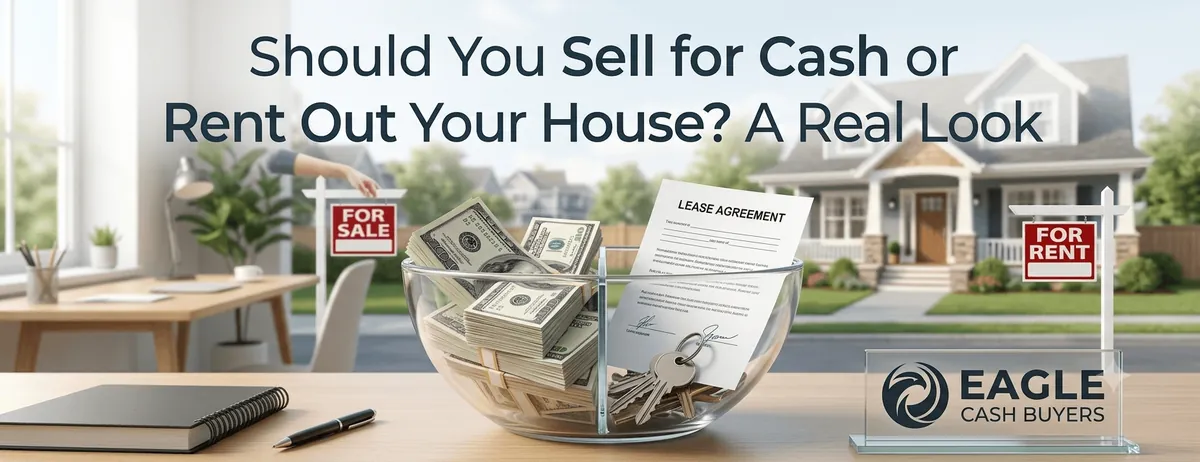
You're looking at a house you don't need to live in anymore, and two paths are pulling at you. Rent it out and collect monthly income, or sell it and move on. Most articles on whether to sell for cash or rent out your house tell you to "weigh the pros and cons." This one shows you how to weigh them.
We'll walk through what being a landlord really costs, how to work out what a sale would net you, and the tax questions that can quietly change the answer. A quick note before we go further: this is general information, not financial or tax advice. Rules depend on your situation and your state, so talk to a licensed professional, such as a CPA, a tax attorney or a real estate attorney, before you decide.
The short version? Renting makes sense when you can cover every carrying cost, not just the mortgage, absorb a bad month without stress, and stay a landlord for years, and if that does not describe you, selling may be the cleaner choice. Simple enough. The hard part is knowing which one you are.
Should You Sell for Cash or Rent Out Your House?
It depends on four things: how much money you can keep tied up, how much risk you can carry, how long you would stay a landlord, and what your tax situation looks like. There is no single right answer.
A rental turns a house you live in into a small business that earns rental income. A cash sale turns it into a lump sum. Each one fits some people and punishes others, and the sections below are meant to help you see which side you are on before you sign a lease or a purchase agreement.
What Renting Out Your House Really Costs
Most people start with simple math. Say the mortgage is $1,800 and the house would rent for $2,200. That looks like $400 a month in profit. (These are hypothetical numbers.)
No. That $400 has to cover a long list of costs that the mortgage payment never included, and several of them arrive in lumps rather than as neat monthly bills.
- Landlord insurance, since a standard homeowner policy may not cover rental use.
- Repairs and maintenance, plus a reserve for big items like a roof, a furnace or a water heater.
- Vacancy: the weeks or months between tenants when rent is zero but the bills keep coming.
- Turnover costs, such as cleaning, repainting and re-listing.
- Property management fees, if you hire help, or your own time if you don't.
- Legal costs if a tenant stops paying, and the time an eviction can take, which varies by state.
- Extra bookkeeping and tax preparation.
Your actual costs depend on the age of the house, its condition and your location, so get real quotes instead of leaning on a rule of thumb.
Averages hide the bad cases. One difficult tenancy can wipe out a long run of good months, and you rarely get a warning.
What a Cash Sale Actually Nets You
Fair question. A common worry is that a cash buyer will give your house away at a steep discount. Let's be clear about what a cash offer is. It is generally below what the house might bring on the open market, because the buyer takes on repairs, holding time and resale risk. Expect that.
The better comparison is what you keep. Start with the sale price. Subtract the mortgage payoff. For a traditional listing, also subtract agent commission, the seller's closing costs, repairs you make to get the house ready and the cost of carrying the house while it sits on the market. For a direct sale to Eagle Cash Buyers there is no agent commission, and Eagle pays closing costs except the seller's mortgage payoff, back taxes and liens, and the seller's share of transfer tax.
A listing can net more when you have both the time and the money to put the house right and wait for the right buyer. For houses that need work, or for sellers who cannot carry two payments while waiting, the gap can be smaller than the headline prices suggest. Our guide to cash offer vs. listing with an agent lays out the comparison, and how cash buyers calculate an offer explains where the number comes from.
A Simple Way to Compare Both Paths
You don't need a fancy spreadsheet. Two lists will do. Honest answers matter more.
For the sale path, write down the likely net: expected price, minus your mortgage payoff, minus selling costs. For the rental path, write down your monthly rent, minus every cost in the list above, and your plan for the day you eventually sell. Add the tax items in the next section. Then compare the two, and give the rental side a haircut for vacancy and repairs, because both will happen at some point.
Also ask what else the money could do. Equity in a rental is locked up, so it can't pay off a debt, fund a down payment on your next home or cover an emergency until you sell.
The Tax Questions to Check Before You Rent
This is where the "I'll just rent it for a while" plan changes. The rules below are federal. Your state may add its own. Confirm everything with a tax professional.
The home sale exclusion has a clock
If you sell your main home, you may be able to exclude up to $250,000 of gain from federal income tax, or $500,000 if you file jointly. To qualify, you generally must have owned and lived in the home for at least two of the five years before the sale, as IRS Publication 523 explains. Those two years don't have to be in a row.
Move out and rent the house, and that five-year window keeps moving. It never stops. Wait long enough and you may no longer meet the two-year test. Publication 523 also says the exclusion doesn't cover gain equal to depreciation you claimed after May 6, 1997 on a home used as a rental.
Depreciation comes back at sale time
Rental houses are generally depreciated over 27.5 years, and land can't be depreciated at all, per IRS Publication 527. The depreciation lowers your taxable income each year. When you sell, the part of your gain tied to that depreciation (called unrecaptured section 1250 gain) is taxed at a maximum 25% federal rate, according to IRS Topic 409. That is separate from any other capital gains tax.
This can come as a surprise at closing. Ask a CPA before you convert the house. Not after.
A 1031 exchange can defer tax, but it keeps you in the game
A like-kind (1031) exchange lets an investor defer tax by rolling a sale into replacement real estate. The timing rules are strict. The IRS instructions for Form 8824 say you must identify the replacement property in writing within 45 days of the transfer and receive it by the earlier of 180 days or your tax return due date.
Notice what that means for you. If your goal is to stop being a landlord, an exchange doesn't help, because it moves you from one rental into another and defers the tax without ending the work. A delay, not an exit.
State taxes vary
States treat sale gains differently. Check with a tax professional in your state before you decide.
Signs That Selling May Fit Better
Not everyone is built for landlording. Here are some of the clearest signals that selling, including selling for cash, is the better call for you, even if the rental math looks fine on paper.
- You don't want to be a landlord. Not "you're unsure." You actively dislike repair calls, tenant screening and lease disputes, and the thought of an eviction makes your stomach drop. That answer is enough on its own.
- You're moving away. Managing a rental from a distance adds travel, delays and management fees.
- You need the equity. Rent doesn't free the money. A sale does. That is the difference.
- The house needs significant repairs. A buyer who plans to repair may take that on. A tenant expects a home that works, and repair duties can fall on you as the landlord.
- The tax clock is running. If you've been out of the home for a while, ask your CPA how much of the home sale exclusion you may have left.
- You've been burned before. A bad tenancy is data.
Real Seller Story: A Contractor Who Chose the Cash Exit
One landlord who sold to Eagle is a good example of a seller who knew his numbers. He is a licensed contractor who flips houses, and he owned a rental that had gone vacant. He and his wife decided to move out of state.
He had planned to fix the house up. He had two contractor quotes in hand, $10,000 and $12,000, for cosmetic work such as paint, drywall and flooring. Nothing structural at all.
Then he changed course. In his words: "I don't want to spend $12,000 right now because I'm moving out of state." For him, time mattered more than margin.
(From an Eagle seller file. The record doesn't tell us how the sale ended. Details are removed to protect the seller's privacy.)
Signs That Renting Might Work
To be fair, there are cases where keeping the house makes sense. They need specific conditions, not optimism.
- The rent covers every cost, with room to spare. Run your own numbers, including vacancy and repairs. Rent that barely covers the mortgage leaves you exposed.
- You have real reserves. Not "some savings." You need enough cash to pay several months of carrying costs and still absorb one large repair or one eviction without borrowing.
- You live nearby or will hire professional management. Fees exist for a reason.
- You can commit for years. A longer hold gives appreciation and loan paydown a chance to outrun the costs of owning and eventually selling, though neither is certain.
- You are willing to learn. Screening tenants, writing a lease that complies with your state's rules and tracking depreciation are skills you build over time, not instincts you are born with.
The Accidental Landlord Trap
Most people don't decide to become landlords. They drift.
It starts like this. You can't sell for the price you hoped for, so you think, "I'll rent it for a year or two and see." A year becomes three, and in the meantime the tax picture shifts, the depreciation keeps adding up and the house gets older, so exiting gets harder instead of easier.
Renting feels like keeping your options open. It can narrow them. If you don't have a budget, a written plan and an exit date before the first tenant moves in, you aren't investing. You're hoping.
A Decision Framework: Six Questions
- Would the rent cover every cost in this article, not just the mortgage? If you can't answer yes with real numbers in front of you, including vacancy, repairs and the tax items above, renting probably does not work.
- How long would you hold it? Be realistic. A short hold may not cover the costs of owning, converting and later selling a rental.
- Do you have cash reserves beyond your normal emergency fund? One eviction plus one major repair can hit in the same year.
- Will you manage it yourself or hire a manager? Be honest about your free time, your patience for late-night calls and how far away you plan to live.
- What does your CPA say about your home sale exclusion and depreciation? This one question can move the whole answer.
- What would you do with the proceeds? If the answer is paying off debt, buying your next home or investing, you have a plan that doesn't need a tenant.
If You Decide to Sell for Cash: What to Expect
Here is how it typically works.
- The first call. You share the basics, meaning the location, the condition of the house, what is going on in your life and when you would like to be done, and nobody pressures you to decide on the spot.
- A written offer. It is based on the details of the property and arrives in writing, so you can read it, compare it and talk it over with someone you trust.
- A property visit. A field agent or notary may visit, by appointment, to photograph the property and notarize documents.
- Closing. Closing can happen in as little as 21 to 42 days, or later if you need more time. You pick the date.
There is no agent commission on a direct sale. Eagle pays closing costs except the seller's mortgage payoff, back taxes and liens, and the seller's share of transfer tax. Eagle may buy the house directly or assign the contract, and that is disclosed in the agreement before you sign.
Every deal depends on a written purchase agreement, a review of the property and clear title. Eagle evaluates properties in 43 states, and whether we can make an offer depends on the property, the title and our buying criteria. Eagle Cash Buyers has completed more than 1,000 transactions since 2019.
If you have a tenant, read selling a rental property with tenants first. For the tax side of a landlord sale, see our guides on selling an investment property for cash and capital gains tax on a cash sale. And if the money is meant to clear debt, this guide to selling your house to pay off debt covers when it makes sense.
If You Decide to Rent: A Short Landlord Checklist
If the numbers favor renting and you are committed, handle these before the first tenant moves in. Rules vary by state, so confirm the details with a local attorney.
- Get landlord insurance. A standard homeowner policy may not cover rental use, so ask your insurer before the first tenant moves in, not after the first claim.
- Read your mortgage. Some loans have occupancy terms or require you to notify the lender before you rent the house.
- Check HOA rules. Some associations limit rentals, require approval of tenants or prohibit renting altogether, and fines can follow if you ignore them.
- Keep a separate bank account for the rental. It makes record-keeping and tax filing simpler.
- Build a maintenance reserve before you count any rent as profit.
- Learn your state's landlord-tenant law. Notice rules, deposit rules and eviction timelines differ a lot from state to state, and a mistake in the process can cost you months.
- Screen tenants carefully and use a lease that fits your state. A generic internet template may not hold up.
- Plan for taxes. Rental income and depreciation are reported on your return, so set up record-keeping from day one.
Frequently Asked Questions
Is it better to sell my house or rent it out?
It depends on your cash, your risk tolerance, your time horizon and your taxes, including capital gains. Renting suits owners with strong reserves who plan to hold for years and are ready to run a small business, while selling suits owners who want a lump sum, or who simply don't want to be landlords, so compare real numbers for both and ask a licensed professional.
Do I lose my capital gains exclusion if I rent out my house?
You can. Generally you must have lived in the house for at least two of the five years before you sell. If you rent it out long enough, you may no longer meet that test. Talk to a tax professional about your dates.
What is depreciation recapture?
Owners of a rental property claim depreciation deductions each year. When the house is sold, the gain tied to that depreciation can be taxed at a federal rate of up to 25%, as IRS Topic 409 explains. A CPA can estimate the effect for your house.
Can I sell to a cash buyer if I still have tenants?
Often, yes. A tenant occupied house can still sell, but it depends on your lease and on your state's landlord-tenant rules, since the buyer may take over the existing lease or you may have to give the tenant notice, and the timing can change what is practical, so ask a local attorney about your obligations first.
How fast can a cash sale close?
With Eagle, closing on a cash offer can happen in as little as 21 to 42 days, or later if you need more time. Title work and your state's closing process both affect the timeline, so ask early.
What if I'm already renting and want to stop?
You can sell a house that is currently a rental. You will need to follow your lease agreement and state law on notice to the tenant, and you should ask a CPA about the tax effect before you sign anything.