
Can I sell my house if I'm behind on payments? Yes. Being behind does not stop a sale. At closing, the sale pays off the loan, including the missed payments, interest and any fees the servicer is allowed to add. If the price covers that payoff, you keep what is left. If it does not, the lender has to approve a short sale. Act early, because the costs grow the longer you wait.
This guide is for homeowners who have missed one to four payments and have not had a foreclosure filing yet. It covers how the payoff works, the federal 120-day line, your options by equity position, what to say when the servicer calls and where to get free help. It is general information, not legal or financial advice. Foreclosure rules vary by state, so confirm your situation with a local attorney and a HUD-approved housing counselor.
If you already have a notice of default or a sale date, our guide to selling your house fast before foreclosure is the better fit. This one is about the window before that.
Can I Sell My House If I'm Behind on Payments? How the Payoff Works
Your lender does not need you to be current before you sell. It needs to be paid. So the number that matters is not "how far behind am I" but "what is my payoff."
A payoff statement is the servicer's written figure for everything it takes to close the loan out as of a certain date. That figure folds in the unpaid principal, the interest that has built up and any late charges or other costs your loan documents allow. Missed payments are not a separate bill. They are already inside the payoff.
Federal rules help here. Under 12 CFR 1026.36(c)(3), a servicer generally has to send an accurate payoff statement within a reasonable time, and no more than seven business days, after it gets a written request from you or someone acting for you. There are exceptions, for example when the loan is already in foreclosure or bankruptcy, and then the rule is simply "a reasonable time." You can read the rule on the CFPB's Regulation Z page.
In practice, the title company or closing attorney usually orders the payoff once you are under contract, and on closing day that amount is sent to the servicer out of the sale proceeds so the lender can release its lien on the house. Then it is done. For the step-by-step mechanics, see what happens to your mortgage when you sell your house for cash.
How Far Behind Can You Be Before Foreclosure Starts?
There is a federal line. A mortgage servicer generally cannot make the first notice or filing required for a foreclosure until the loan is more than 120 days delinquent. That is the rule in 12 CFR 1024.41(f). It has narrow exceptions, such as a foreclosure based on a due-on-sale clause.
Four months. That is roughly the room most borrowers have before the legal process can begin.
The servicer is not silent during that time. Federal servicing rules generally require it to try to reach you by phone or in person by the 36th day of delinquency and to send a written notice about your options by the 45th day (12 CFR 1024.39). Some smaller servicers and certain loans are exempt.
After the 120-day line, the timeline depends on your state and on whether foreclosure there goes through the courts. Our guide on how long the foreclosure process takes walks through the stages. The short version: selling before that first filing is the calmest time to do it, because the payoff is smaller and every option is still on the table. Earlier is better.
Your Options by Equity Position
The CFPB lists the main paths for a homeowner who cannot keep up: refinancing, a loan modification, a repayment plan, forbearance, a short sale and a deed in lieu of foreclosure (CFPB: if I can't pay my mortgage, what are my options). Selling at full payoff, by listing or to a cash buyer, sits alongside them. Which one fits depends mostly on one question. Does the house sell for more than you owe?
| Option | Needs equity? | Who has to approve | What to know |
|---|---|---|---|
| List with an agent | Yes, enough to cover the payoff plus selling costs | You and the buyer | Can net the most when you have both the time to wait for a buyer and the money for repairs and carrying costs |
| Sell to a cash buyer | Yes, the price has to cover the payoff | You and the buyer | The price is below full market value; in exchange you skip repairs and pick the closing date |
| Short sale | No, it is for owners who owe more than the house is worth | Your lender, plus any other lienholders | Approval takes paperwork and time; ask in writing whether any remaining balance is waived |
| Repayment plan, forbearance or loan modification | No, you keep the house | Your servicer | Best when the hardship is temporary and you can afford the new terms |
| Deed in lieu of foreclosure | No | Your lender | You hand the house back; ask in writing what happens to any shortfall |
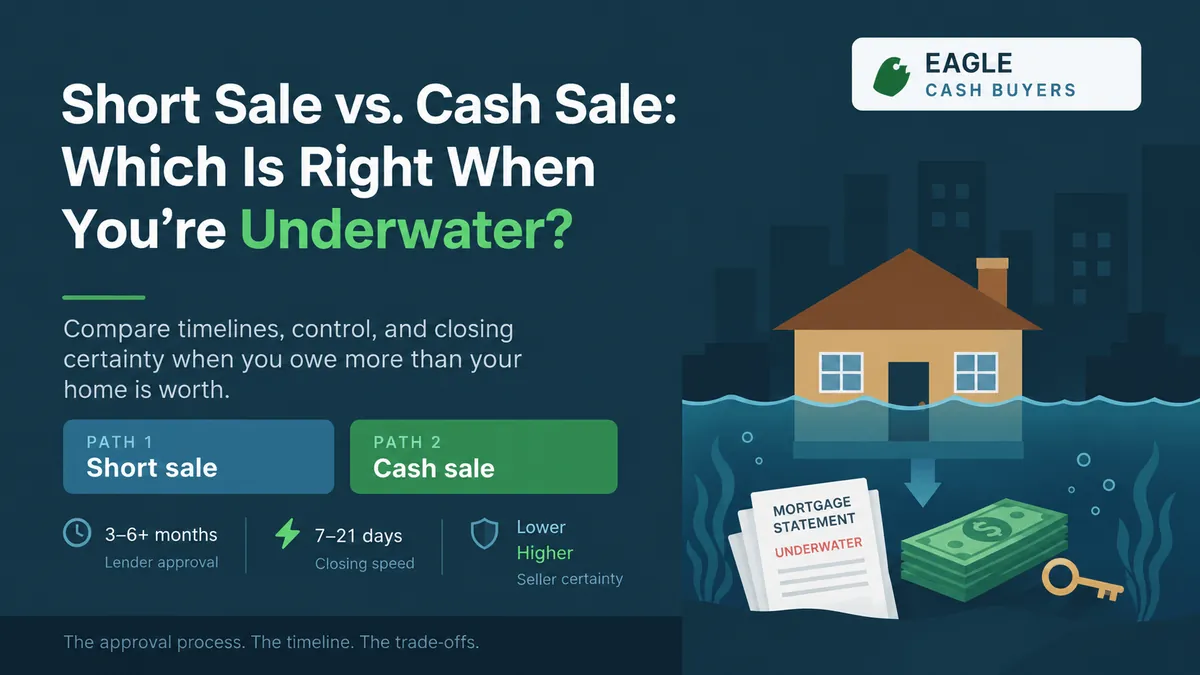
If you have equity, a sale that pays the loan in full is usually the cleanest exit. The missed payments get paid. Then they stop. If you are underwater, the lender's approval is the gate, and our short sale vs cash sale guide compares the two paths when the numbers are tight.

What to Say When Your Servicer Calls
The calls feel like pressure. Pick up anyway. They are also your best source of information, and ignoring them closes doors. The CFPB's advice is plain: call your servicer right away if you can't pay, and be ready to explain why, whether the problem is temporary or permanent, and what your income and expenses look like.
If you have decided to sell, a short script helps:
- Answer, or call back the same day. Note the date and the name of the person you spoke with.
- Tell them you are selling the house and, if you are under contract, when closing is set.
- Ask for a written payoff statement, and put that request in writing so the seven-business-day rule applies.
- Send the payoff statement to your title company or closing attorney.
- Ask, in writing, what options they offer while the sale is pending, such as a short pause or a repayment plan, and how any payment you make now would be applied.
Keep copies of everything. If you plan a short sale, ask the servicer how to apply and what documents it needs. A HUD-approved housing counselor can make that call with you.
Can I Stop Paying My Mortgage While I Sell?
Not safely, no. A contract to sell does not pause your loan. Each missed month can add a late fee, though only in the amount your mortgage documents allow, and state law may cap it. Interest keeps adding up every day. And every month you fall further behind moves you closer to the 120-day line, after which the servicer may start the foreclosure process even if a sale is in the works.
Sales fall through. Buyers back out, title problems surface, appraisals come in low. If that happens after you stopped paying, you are deeper behind with less time.
So keep paying what you can. If you truly cannot pay, say so to the servicer and ask about forbearance or a repayment plan in writing. Then talk to a HUD-approved housing counselor before you decide anything else.
What Happens to the Missed Payments, Fees and Other Liens at Closing
Everything secured by the house is paid from the sale price, in order of priority, before you receive anything: the first mortgage payoff with its missed payments and allowed fees, then a second mortgage or HELOC, back property taxes and any judgment or other recorded liens. Nothing is skipped. The title company finds them in the title search and pays each one directly.
Here is a hypothetical, rounded example. Say a house sells for $250,000. The payoff statement, with four missed payments and fees folded in, says $185,000. There are $4,000 in back taxes. Before any other seller costs, about $61,000 is left for the seller. Change any one number and the result changes, which is why the written payoff matters so much.
Our side is simple. When Eagle Cash Buyers buys a house, there are no fees, no repairs and no closing costs for the seller. You still pay, from the proceeds, your mortgage payoff, any liens (including back taxes) and your prorated property taxes. On a standard cash offer the seller also pays the transfer tax, while on a Retail Max sale Eagle pays it (Retail Max is our option for sellers who can wait: we market the house to an end buyer for a higher price), and the purchase agreement states who pays what, so read that part carefully before you sign anything. There is no agent commission on a direct sale.
When a Cash Sale Makes Sense (and When Listing Nets More)
Be honest with yourself about time and money. A listing can net more when you have both: the months to wait for a buyer and the cash to fix the house up and carry it while it sits on the market. Many owners who are already behind have neither, and every extra month adds interest and fees to the payoff.
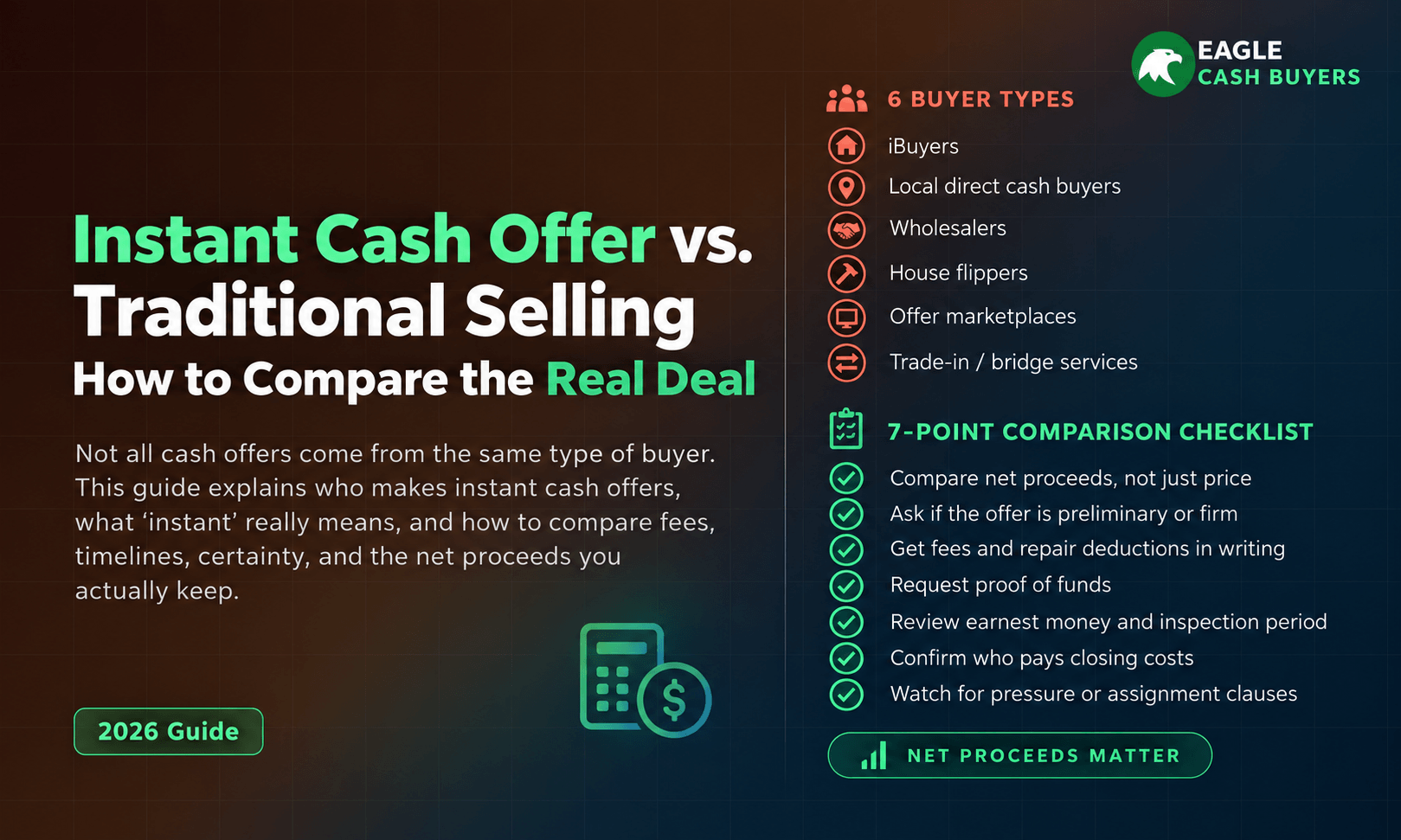
A cash sale trades price for speed and certainty. The offer will be below full market value. That is the trade. In return, the sale does not depend on a buyer's mortgage approval, and you can sell as is.
Here is how it works with us. We buy houses in any condition. Whether we make an offer depends on the area, the value and whether the numbers work. During business hours, we can often provide an initial offer within minutes to a few hours after receiving the necessary property information. Closing can take as little as 21 to 42 days, or longer if you need more time, and you pick the date, while we open title and the title company or closing attorney handles the payoff to your servicer from the proceeds. Eagle may buy the house directly or assign the contract to another buyer, and that is disclosed in the agreement before you sign. Homeowners in 43 states can request a written cash offer from Eagle; see our locations.
We are not a lender and do not lend money to homeowners. We are not attorneys either. For questions about your loan, talk to your servicer or a loan officer, and for legal questions, talk to a real estate attorney in your state.
Free Help Before You Decide
You are not alone in this. HUD-approved housing counseling agencies offer independent advice, often at little or no cost, on defaults, forbearance and foreclosure, and you can find one with the CFPB's housing counselor search or by calling the CFPB at (855) 411-2372. The HOPE Hotline, (888) 995-HOPE (4673), is open around the clock.
Watch for rescue offers. The CFPB is clear that you don't have to pay anyone to help you avoid foreclosure. Walk away from anyone who wants an upfront fee, promises a result, asks you to sign over your title or tells you to send your mortgage payments to them instead of your servicer.
FAQ: Selling a House When You're Behind on the Mortgage
How many months can you be behind on your house payment?
Under federal rules, a servicer generally cannot make the first foreclosure notice or filing until the loan is more than 120 days delinquent, so about four months. That is not a safe zone. Each late payment can bring a late fee, and the foreclosure timeline after that point depends on your state.
What happens if I sell my house but still owe money?
If the price covers what you owe, the loan is paid off at closing and you keep the rest. If not, it gets harder. You need the lender's approval for a short sale, or the cash to cover the gap at closing. Forgiven debt can be taxable unless an exception applies, so ask a tax professional; see IRS Topic 431.
Can I stop paying my mortgage if I'm selling my house?
It is risky. The loan keeps running until closing, late fees and interest keep adding to the payoff, and a sale can fall through. If you cannot pay, tell your servicer and ask about options in writing.
What happens if you sell your house but haven't paid off your mortgage?
That is how most sales work. The title company or closing attorney gets a payoff statement and pays the lender from the sale proceeds at closing. The lender then releases its lien.
Will selling my house stop a foreclosure?
A sale may help you avoid a foreclosure sale if it closes in time. If there is enough time, we work to close before the sale date or explain your options. We can't promise to stop or postpone a foreclosure.
Does a short sale hurt credit less than foreclosure?
Both are negative. Neither is small. The missed payments before either one are reported too. Most negative information can stay on a credit report for seven years. For loans sold to Fannie Mae, the wait before a new mortgage is generally four years after a short sale and seven after a foreclosure, with shorter periods for documented extenuating circumstances. Other loan programs set their own rules. Our guide on whether a short sale ruins your credit goes deeper.