

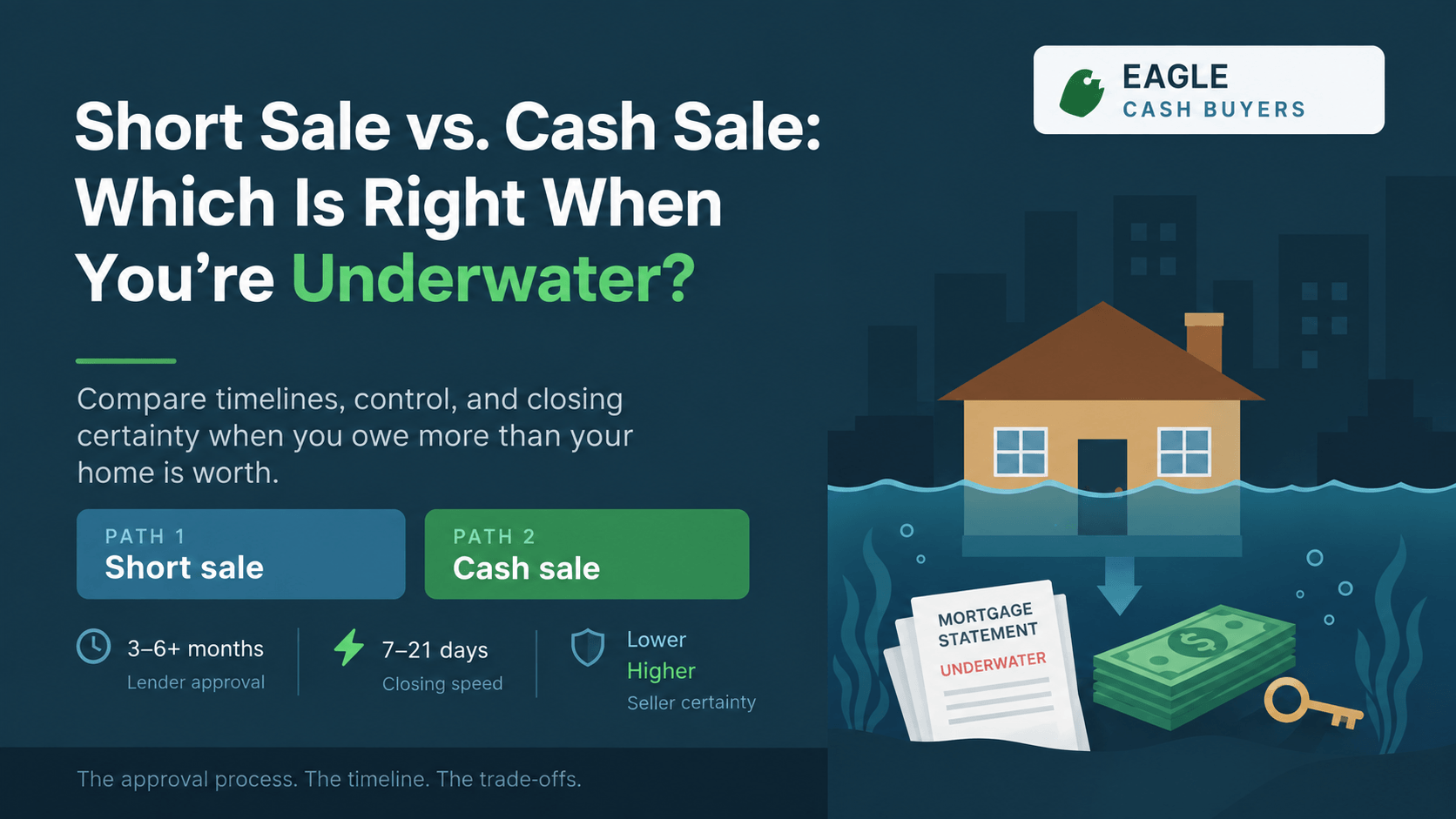
You owe $280,000 on your mortgage. Your house is worth $250,000. You need to sell. That $30,000 gap between what you owe and what the home is worth changes everything about how the sale works, who has to approve it, and what happens to your credit afterward.
If you’ve been researching your options, you’ve probably seen two terms used almost interchangeably: short sale and cash sale. They’re not the same thing. They solve different problems. And confusing them can cost you months of wasted effort or thousands of dollars you didn’t expect to owe.
This guide breaks down the real differences, with worked examples, credit impact data, deficiency judgment risks, and a step-by-step decision framework so you know which path fits your situation. If you’re looking for a broader overview of your options, start with our guide on how to sell your house when you owe more than it is worth.
What “Underwater” Actually Means (and Why It Changes Your Options)
An underwater mortgage means you owe more on your home loan than the property is currently worth. If your payoff amount is $280,000 and your home’s market value is $250,000, you are $30,000 underwater. That gap changes your selling options because a standard sale won’t generate enough proceeds to pay off the lender, which means the lender gets a say in what happens next.
Here’s how to figure out where you stand:
Get your payoff statement. Call your mortgage servicer and ask for the total payoff amount, including any arrears, late fees, and accrued interest. This is the number that matters, not the original loan balance.
Get your home’s current market value. You can use an online estimate as a starting point, but a comparative market analysis (CMA) from a local agent or an offer from a cash buyer will be more accurate.
Subtract. Value minus payoff equals your equity position. If the number is negative, you’re underwater by that amount.
Common causes of being underwater include purchasing at a market peak, cash-out refinancing that increased the loan balance, declining neighborhood values, and accumulated fees or interest from delinquency. Being underwater does not mean you can’t sell. It means your options require a different process than a standard sale.
One important point: a lender cannot foreclose simply because your home is worth less than you owe. Foreclosure requires missed payments. If you’re current on your mortgage but underwater, you have time to plan.
Short Sale vs. Cash Sale: The Core Distinction
A short sale and a cash sale are not the same thing, and understanding the difference is the first step to choosing the right path.
A cash sale describes how the buyer pays. The buyer uses their own funds. No bank financing, no appraisal contingency, no mortgage approval delay. This speeds up the transaction and reduces the risk of the deal falling apart.
A short sale describes a lender concession. The lender agrees to accept less than the full mortgage payoff. This solves the underwater problem, but it requires lender approval, hardship documentation, and significant time.
These two things can overlap. A cash buyer can be the purchaser in a short sale. But when you have equity (your home is worth more than you owe), a straight cash sale works without any lender involvement beyond the standard payoff. When you’re underwater, a cash sale alone doesn’t solve the problem unless you bring cash to cover the gap or the lender approves a short payoff.
Here’s how they compare across every major dimension:
| Dimension | Short Sale | Cash Sale (Seller Has Equity) | Cash Sale (Underwater, Short Payoff) |
|---|---|---|---|
| What it solves | Underwater mortgage | Need for speed, as-is sale | Underwater mortgage + speed |
| Lender approval required? | Yes (loss mitigation dept.) | No | Yes (lender must approve short payoff) |
| Typical timeline to close | 60-120+ days (lender review is the bottleneck) | 14-42 days | 45-90+ days (cash speed + lender review) |
| Who finds the buyer? | Seller/agent lists on MLS | Seller contacts buyer directly | Seller contacts buyer; offer goes to lender |
| Agent commissions | Negotiated (often 5-6%) | Varies; $0 in Eagle’s model | Varies; $0 or negotiated |
| Seller closing costs | Negotiated with lender | Varies; Eagle covers all customary closing costs | Negotiated |
| Credit impact | Short sale on record; typically 100-150 pt. drop; 7 years on report | Late payments only (if current on mortgage) | Depends on reporting; often similar to short sale |
| Deficiency judgment risk | Possible in many states unless waived in writing | None (loan paid in full or gap covered by seller) | Possible unless lender waives in writing |
| Tax on forgiven debt | Possible (IRC Section 61); exclusions may apply | None (no debt forgiven) | Possible; same rules as short sale |
| Seller nets cash? | Usually $0; seller walks away clean if approved | Yes (equity minus payoff) | Usually $0; lender may offer relocation assistance |
| Wait for new mortgage | 3 years FHA / 4 years conventional | No mandatory wait | 3 years FHA / 4 years conventional |
| Best for | Underwater seller with time and lender cooperation | Seller with equity who needs speed or certainty | Underwater seller with a cash buyer willing to negotiate with lender |
The Three Paths When You’re Underwater (With Real Numbers)
If your home is worth less than your mortgage balance, you have three realistic options to sell. Each one works differently, costs differently, and carries different risks. Here’s what each path actually looks like on the same $250,000 home with a $280,000 mortgage.
Path 1: Bring Cash to Close the Gap
You sell the home for $250,000. The proceeds go to the lender. You bring a check for the $30,000 gap at closing. The mortgage is satisfied in full, and you walk away with a clean record.
This path works for sellers who have savings, a second asset, or family help and want to avoid a short sale on their credit. It’s the cleanest exit, but it requires cash you may not have.
| Path 1: Seller Brings Cash to Close the Gap | |
| Home sale price | $250,000 |
| Mortgage payoff | $280,000 |
| Shortfall (seller brings to closing) | $30,000 |
| Agent commissions (MLS listing at ~5%) | $12,500 |
| Seller closing costs (est. 1-3%) | $2,500-$7,500 |
| Total out of pocket (MLS) | $45,000-$50,000 |
| Agent commissions (cash buyer, Eagle model) | $0 |
| Closing costs (cash buyer, Eagle model) | $0 |
| Total out of pocket (cash buyer) | $30,000 |
| Credit impact | Late payments only (if any) |
| Wait for new mortgage | None |
Notice the difference. If you sell on the MLS with an agent, the commissions and closing costs add $15,000-$20,000 to the gap you already have to cover. With a cash buyer that covers closing costs and charges no commissions, the gap stays at $30,000. When you’re underwater, those fees matter more than usual because they come directly out of your pocket.
Path 2: Lender-Approved Short Sale
You list the home, find a buyer at $240,000, and submit the offer to your lender with a hardship letter and financial documentation. The lender reviews the package and either accepts, rejects, or counters. If approved, the lender accepts $240,000 as satisfaction (or partial satisfaction) of the $280,000 debt.
The word “partial” matters. In many states, the lender can still pursue you for the remaining $40,000 (a deficiency judgment) unless the short sale agreement explicitly waives it. We’ll cover that in detail below.
| Path 2: Lender-Approved Short Sale | |
| Home sale price (buyer’s offer) | $240,000 |
| Mortgage payoff | $280,000 |
| Deficiency (lender absorbs or pursues) | $40,000 |
| Agent commissions | Negotiated with lender (often paid from proceeds) |
| Seller closing costs | Typically $0 (negotiated into lender approval) |
| Seller brings to closing | Usually $0 |
| Seller nets | $0 (walks away clean if lender approves) |
| Credit impact | 100-150 point drop; 7 years on report |
| Wait for new mortgage | 3 years (FHA) / 4 years (conventional) |
| Timeline | 60-120+ days (lender review + listing period) |
| Key risk | Deficiency judgment if not waived in writing |
The short sale process typically follows these steps:
1. Contact your servicer and tell them you want to pursue a short sale. Ask about their loss mitigation department.
2. Submit a hardship letter explaining the financial event (job loss, medical expenses, divorce, income reduction) and financial documentation (bank statements, tax returns, pay stubs, monthly expenses).
3. List the property, typically through a real estate agent. Your lender may require the home to be listed on the MLS for a minimum period (often 90 days) before approving a below-payoff offer.
4. Submit the buyer’s offer to the lender’s loss mitigation department for approval. This review takes 30 to 120+ days.
5. If approved, close the sale. If rejected, the lender may counter or the process starts over.
Important: MLS listings for short sales must typically disclose that the sale is subject to lender approval. Buyers know this going in, and some will walk away rather than wait.
Path 3: Cash Buyer Submits an Offer in a Short Sale
A cash buyer (like Eagle Cash Buyers or a local investor) makes an offer on the underwater home. The seller submits that offer to the lender for short sale approval. The cash buyer’s offer eliminates financing risk, which can matter to lenders reviewing the deal.
The advantage is speed after approval. Once the lender says yes, a cash buyer can typically close within days or weeks rather than waiting for mortgage underwriting. There’s also no risk of the buyer’s financing falling through at the last minute, which kills short sales more often than most sellers realize.
The limitation is real, though: this path still requires lender approval. The lender controls whether to accept the offer. No cash buyer can guarantee that approval.
| Path 3: Cash Buyer in a Short Sale (Hybrid) | |
| Cash buyer’s offer | $245,000 |
| Mortgage payoff | $280,000 |
| Deficiency (lender absorbs or pursues) | $35,000 |
| Agent commissions (Eagle model) | $0 |
| Seller closing costs (Eagle model) | $0 (Eagle covers customary closing costs) |
| Seller brings to closing | $0 |
| Seller nets | $0 (walks away clean if lender approves) |
| Credit impact | Similar to standard short sale |
| Timeline | 45-90+ days (lender review + cash closing) |
| Key advantage | No financing fall-through; faster post-approval close |
| Key risk | Lender may reject; deficiency judgment if not waived |
From Our Transactions: In one of Eagle’s documented transactions, a seller in the Southeast owned a small house in another state. He had agreed to sell for $157,000, believing his payoff was around $146,000. Then title work came back with a number nobody expected: roughly $194,000 in total liens, including four separate claims tied to the same mortgage company, leftover from multiple loan modifications during the COVID years. The debt against the house exceeded the sale price by nearly $40,000.
This is the moment most sales fall apart. The seller’s fear was that he’d have to bring money to closing just to get rid of a property he couldn’t afford. Eagle’s coordinator laid out the situation plainly: if the deal collapsed, the lender would likely foreclose, and his credit would take the hit for years. The coordinator proposed negotiating directly with the lienholders to try to bring the total down to the contract price. No guarantee. He said so outright.
The seller’s response: “There’s no harm in trying… if it works out, then that’s great.”
That negotiation was still in progress at the time of documentation, and we can’t report a final outcome. But the case illustrates the hybrid path: a cash buyer identifying the problem during title work, proposing a lien negotiation plan, and offering the seller an alternative to walking away or waiting for foreclosure. (These are sellers who contacted a cash buyer, not a representative sample of all home sellers.)
If you’re trying to understand how to negotiate with a cash home buyer in a situation like this, the key is transparency about your payoff and lien situation from the start.
Credit Impact Comparison: Short Sale vs. Cash Sale vs. Foreclosure
The credit impact of selling an underwater home depends entirely on which path you take. A cash sale where the loan is paid in full has the least credit damage. A short sale sits in the middle. A completed foreclosure is the worst outcome for your credit and your ability to buy again.
| Exit Type | Credit Score Impact | Time on Report | New FHA Mortgage Wait | New Conventional Wait |
|---|---|---|---|---|
| Cash sale (loan paid in full) | Late payments only (30-90 pts if any) | 7 years (late pmts only) | No mandatory wait | No mandatory wait |
| Short sale | Typically 100-150 point drop | 7 years | 3 years | 4 years |
| Deed in lieu of foreclosure | Typically 100-150 point drop | 7 years | 3 years | 4 years (2 with extenuating circumstances) |
| Completed foreclosure | 100-160+ point drop | 7 years | 3 years | 7 years |
The practical difference is significant. After a cash sale where the mortgage is fully satisfied, there’s no mandatory waiting period for a new mortgage. After a short sale, you’re looking at three to four years before most lenders will approve a new home loan. After foreclosure, it can be seven years for a conventional loan.
Some housing experts note that the credit impact of a short sale, deed in lieu, and foreclosure are “all pretty similar” in terms of raw score damage. The real difference shows up in mortgage waiting periods and how future lenders view the event. A short sale signals that you worked with the lender to resolve the situation. A foreclosure signals that you didn’t, or couldn’t.
If timeline matters to you, understanding can you sell a house in 7 days gives context on how fast a cash closing can happen when lender approval isn’t part of the equation.
The Deficiency Judgment Risk (and How to Protect Yourself)
A deficiency judgment is when your lender sues you for the difference between what you owed and what the home sold for. In a short sale, this risk is real: the lender accepts less than the full balance, and in many states, the lender can still come after you for the gap unless the short sale agreement explicitly waives it.
This is the single most important thing to negotiate in any short sale.
Only a handful of states broadly restrict deficiency judgments after a short sale. Alaska, California, Minnesota, Montana, Oregon, and Washington have laws that may limit a lender’s ability to pursue the deficiency in certain situations. But in most states, the lender has the legal right to pursue the balance unless the short sale agreement says otherwise.
The protection is straightforward but often overlooked: the short sale agreement must state in writing that the transaction satisfies the debt in full and that the lender waives its right to a deficiency judgment. If those words aren’t in the document, you may still owe the money after the sale closes.
How deficiency risk changes by exit type:
| Exit Type | Deficiency Risk | How to Protect Yourself |
|---|---|---|
| Cash sale (loan fully paid) | None. Loan satisfied. | N/A |
| Short sale | High in most states unless waived | Negotiate written waiver in short sale agreement |
| Cash buyer short payoff | Same as short sale | Same: written waiver required |
| Deed in lieu | Possible unless waived | Negotiate waiver in deed-in-lieu agreement |
| Foreclosure | Possible in most states | Check state anti-deficiency laws; consult attorney |
Check your state’s deficiency judgment laws or consult a real estate attorney before proceeding with any short sale. This is not an area where assumptions are safe.
Tax Implications: When Forgiven Debt Becomes Taxable Income
If your lender forgives part of your mortgage through a short sale, the IRS may treat the forgiven amount as taxable income. On a $280,000 mortgage settled for $240,000, the $40,000 difference could appear on a 1099-C and be taxed as ordinary income. That’s real money owed to the IRS on top of the financial stress you’re already managing.
There are two exclusions that may protect you.
Exclusion 1: Insolvency (IRC Section 108). If your total debts exceed your total assets at the time of forgiveness, you may be able to exclude the forgiven amount from taxable income. This exclusion is permanent, does not expire, and applies regardless of what type of debt was forgiven. You report it on IRS Form 982.
Exclusion 2: Qualified Principal Residence Indebtedness (QPRI). The Mortgage Forgiveness Debt Relief Act historically excluded up to $750,000 of forgiven primary residence mortgage debt from taxation. This provision was extended multiple times but expired on January 1, 2026. Agreements entered into in writing before that date may still qualify for the exclusion even if the discharge happens after. As of this writing, no further extension has been enacted, though legislation (H.R. 917) has been introduced to make it permanent.
If you sell for cash and the mortgage is fully paid (including seller bringing cash to cover the gap), there is no forgiven debt and no tax issue.
Consult a tax professional. This section is general information, not tax advice. The interaction between federal and state tax rules, the insolvency calculation, and the QPRI timeline make this an area where professional guidance is worth the cost.
What to Do Right Now: A Decision Framework
The right path depends on three things: your equity position, your timeline, and your lender’s willingness to negotiate. Here’s how to figure out which option fits.
Step 1: Get your payoff statement. Call your servicer. Ask for the total payoff amount including all arrears, fees, and accrued interest.
Step 2: Get your home’s current value. An online estimate, a CMA from an agent, or a cash buyer offer all work. Get more than one data point.
Step 3: Calculate your equity position. Value minus payoff. Positive means you have equity. Negative means you’re underwater.
Step 4: Follow the right branch:
Positive equity or break-even: Sell via listing or cash buyer. Standard process. No lender involvement beyond the payoff.
Underwater + have cash to cover the gap: Sell and bring cash to closing. Cleanest credit outcome.
Underwater + no cash + have time (3+ months): Pursue a short sale through your lender’s loss mitigation department.
Underwater + no cash + limited time: Contact a cash buyer who handles distressed properties. Ask if they can work with your lender on a short payoff. Also contact a HUD-approved housing counselor immediately at hud.gov/counseling or (800) 569-4287.
Step 5: Contact your lender early. Tell them your situation and intent to sell. Ask about loss mitigation options. Many lenders will delay foreclosure proceedings if a sale is actively in progress.
Step 6: Get professional guidance. A real estate attorney for legal implications. A tax professional for forgiven-debt questions. A HUD-approved counselor for free, impartial advice. If you’re considering selling your house to pay off debt, getting all three perspectives before making a decision is worth the time.
What Eagle Cash Buyers Can (and Can’t) Do for Underwater Sellers
Eagle Cash Buyers buys homes in any condition, including homes facing foreclosure, with liens, or in other financial distress. If you have equity, Eagle can close fast with no fees and no repairs. If you’re underwater, Eagle may still be able to help, but the process is different and the outcome depends on your lender.
What Eagle can do:
Buy your home as-is for cash with no agent commissions, no fees, and no repairs required. Close most transactions within 21 to 42 days. Cover all customary closing costs. Work with sellers in foreclosure, with liens, or behind on taxes. Submit a cash offer that the seller can present to their lender as part of a short sale process. Provide post-occupancy options if you need extra time after closing.
What Eagle cannot do:
Guarantee that a lender will approve a short sale or short payoff. Eliminate a seller’s deficiency risk (that’s a lender decision). Provide legal or tax advice. Promise a specific outcome in any distressed situation.
Across 42 seller transactions Eagle documented in 2026, roughly 10% involved foreclosure or pre-foreclosure pressure, and about 19% had delinquent property taxes. About 19% had title or deed problems that needed to be resolved before closing. (These are sellers who contacted a cash buyer, not a representative sample of all home sellers.)
Eagle encourages every seller to compare offers, have their own attorney review the contract, and contact a HUD-approved housing counselor for free guidance. To learn more about how the title process works in a cash sale, read how cash home buyers handle title insurance.
Alternatives to Selling: Other Options for Underwater Homeowners
Selling isn’t the only option if you’re underwater. If you want to keep the home and can manage some form of payment, several programs may help you restructure or catch up.
Loan Modification
Your lender may agree to change the loan terms: a lower interest rate, an extended repayment period, or principal forbearance (deferring part of the balance). Contact your servicer’s loss mitigation department to start the process.
Forbearance
A temporary pause or reduction in your payments. This works best for short-term hardship (a few months of reduced income, a medical event). The missed payments are typically added back later through a repayment plan, a lump sum, or a modification.
Deed in Lieu of Foreclosure
You voluntarily transfer the title to the lender. This avoids the foreclosure auction but carries a similar credit impact to a short sale (100-150 point drop, 7 years on report, 3-4 year wait for a new mortgage). The lender may or may not waive the deficiency.
Wait for Appreciation
If you can afford the monthly payments, holding the property until market values recover may eventually eliminate the underwater position. This isn’t viable if you can’t make payments or need to relocate, but it’s the lowest-impact option if time is on your side.
HUD-Approved Housing Counseling
Free, government-backed counseling from trained professionals who can help you evaluate all your options. This is one of the most underused resources available. Visit hud.gov/counseling or call (800) 569-4287. If you’re facing foreclosure and need to sell fast, a HUD counselor can also help you understand your timeline and rights.
Frequently Asked Questions
What is the difference between a short sale and a cash sale?
A cash sale describes how the buyer pays: they use their own funds instead of mortgage financing. A short sale describes a lender-approved transaction where the sale price is less than the mortgage balance. A cash buyer can be the purchaser in a short sale, but the two terms solve different problems. Cash speeds up the payment. A short sale solves the underwater gap.
Can you sell a house for cash if you’re underwater?
Yes, but with conditions. If the sale price is less than the mortgage balance, the seller must either bring cash to cover the gap or get the lender’s approval for a short sale or short payoff. A cash buyer can speed up the process and reduce financing risk, but can’t eliminate the need for lender approval when the mortgage exceeds the sale price.
How long does a short sale take compared to a cash sale?
A standard cash sale with equity typically closes in 14 to 42 days. A short sale requires lender review and typically takes 60 to 120+ days, sometimes longer if multiple lienholders are involved. A cash buyer submitting an offer in a short sale can reduce the post-approval closing time, but the lender review period still applies.
Does a short sale hurt your credit more than a cash sale?
Yes. A short sale typically drops your credit score by 100 to 150 points and stays on your report for seven years. A cash sale where the mortgage is fully paid off reports only the existing late payments (if any). The practical difference can mean years of waiting before qualifying for a new mortgage.
Can a cash buyer help me avoid a short sale?
Only if you have enough equity or cash to cover the mortgage balance at closing. If you’re underwater and can’t bridge the gap, the lender must approve the sale for less than the balance, which is by definition a short sale or short payoff. A cash buyer can be the purchaser in that process, offering speed and certainty, but the lender approval requirement doesn’t go away.
Do I owe taxes on forgiven mortgage debt after a short sale?
Possibly. The IRS generally treats forgiven debt as taxable income. The insolvency exception (IRC Section 108) may protect sellers whose total debts exceed total assets. The QPRI exclusion historically covered primary residence debt but expired January 1, 2026 (agreements entered before that date may still qualify). Consult a tax professional for your specific situation.
Can my lender come after me for the difference after a short sale?
In many states, yes. A deficiency judgment allows the lender to pursue the gap between the sale price and the loan balance. Only a few states (Alaska, California, Minnesota, Montana, Oregon, Washington) broadly restrict this. The critical protection is to negotiate a deficiency waiver in writing as part of the short sale agreement.
What if I’m underwater and facing foreclosure with limited time?
Contact a HUD-approved housing counselor immediately at hud.gov/counseling or (800) 569-4287. At the same time, contact a cash buyer who handles distressed properties. A cash buyer may be able to submit an offer to your lender quickly. Also tell your lender you intend to sell. Many servicers will delay foreclosure proceedings if a sale is actively in progress.
Your Next Step
If you’re underwater and trying to figure out which path forward makes sense, start by getting the numbers. Call your servicer for your payoff. Then contact Eagle Cash Buyers at (833) 330-1625 for a no-obligation cash offer. Eagle is available 24/7 and can give you a starting point to compare against other options, whether that’s a traditional listing, a short sale, or a direct cash sale.
You don’t have to decide today. You do have to know your numbers. That’s where this starts.