Can a house stay in a deceased person's name? Yes, sometimes for years, but nobody can sell it until someone has legal authority to sign the deed and can prove it to the closing provider. Depending on the state and the estate, getting there takes a probate court order, a small-estate affidavit, an heirship affidavit or similar paperwork recorded with the county.
The sources below were checked November 2026. Eagle Cash Buyers is not a law firm, title company or tax advisor. This information is general and is not legal, title or tax advice. Laws, procedures and transaction costs vary by state and locality, and the purchase agreement and closing documents control each transaction. Before you pick a route, ask a probate attorney licensed where the house is, and the title company, escrow holder or closing attorney handling the sale, what they need.
Can a House Stay in a Deceased Person's Name?
Yes, for a while. The county's records usually keep showing the owner who died until someone records a document that shows who owns the house now, and plenty of families leave it that way for years, sometimes because a surviving spouse still lives there and sometimes because nobody knew any paperwork was needed.
The trouble starts when someone wants to do something with the house.
- Selling or refinancing. A closing provider generally won't let a sale close until the person signing the deed can show legal authority to sell for the owner who died.
- Bills. The property tax bill keeps coming. So does any mortgage payment.
- Insurance. A policy in the name of someone who has died may not protect the relatives looking after the house. Ask the insurer.
- People. Heirs move away or fall out, and some die before the house is sorted out. The longer the deed waits, the more signatures a sale can need.
Why You Can't Sell Until Someone Has Authority to Sign
Before a sale closes, the closing provider searches the public records and traces ownership from one owner to the next. That trail is the chain of title. Buyers and lenders usually want it unbroken.

A death leaves a gap. The records say the house belongs to your mother. You say it belongs to you and your brother now, and you are probably right, but the county doesn't know what the family knows and a title insurer won't take your word for it, so something official has to connect her name to whoever signs the deed now: letters from a probate court, a recorded affidavit or a court order. Which document fills that gap? State law and the shape of the estate decide.
We see this a lot. Of the seller files Eagle documented in 2026, more than one in four involved a death in the family, and about one in five involved a title or paperwork problem. Those are sellers who contacted a cash buyer, not a representative sample of home sellers.
Ways to Get a House Out of a Deceased Person's Name
The California courts' self-help guide (checked November 2026) calls probate the legal process to transfer property after the owner dies, and it adds that, depending on the amount and type of property, you may or may not need to go to court at all. Each state sets its own routes. Read the table as examples from three states, not as rules that apply where your house is.
| Route | How it works | State example (checked November 2026) |
|---|---|---|
| Probate | A judge appoints a personal representative, who collects the property, pays the bills and passes what is left to the heirs or beneficiaries. | California courts' guide. An estate may need probate even if there was a will. |
| Small-estate affidavit | A sworn statement used when the estate is small enough. | Missouri, section 473.097: the estate, less liens, debts and encumbrances, is $40,000 or less, at least 30 days have passed since the death, and no application for letters is pending or granted. The affidavit and the clerk's certificate are filed with the recorder of deeds in each county where the real estate is. In Texas, the small-estate affidavit is for someone who died without a will, and for real estate it can transfer only the homestead, and only to a surviving spouse or minor child. |
| Affidavit of heirship | A sworn statement of who the heirs are, recorded where the deeds are kept. | Texas, per Texas Law Help: used when the owner died without a will. It does not transfer title itself, but a title company usually accepts it to show the chain of title for a sale. Check with yours first. |
| Court heirship decision | A judge decides who inherits. | Texas: an application to determine heirship needs a court proceeding and an attorney. |
| Planning already in place | Some houses pass outside probate because of what the owner did while alive. | Texas: a transfer on death deed, done correctly, passes the house at death, and the house doesn't become part of the estate. Property held in a trust or with survivorship rights may also pass outside probate. |
Our pages on selling a house fast in Missouri and Texas cover the local side, and how long a court case runs there is its own question, which how long probate takes answers.
What the Closing Provider Will Ask an Heir For
Lists vary. Treat these as questions to expect, not a legal standard.
- A certified copy of the owner's death certificate.
- The document your state's route produces: letters from the probate court, a recorded small-estate affidavit, a recorded heirship affidavit or a court order.
- The will, if there is one.
- Signatures from everyone whose signature or authorization is required. That may be a court-appointed representative or, when the heirs inherited directly, often each heir.
- Payoff figures for any mortgage or lien still recorded against the house.
Sometimes the paper trail is a physical thing. In Iowa, before Iowa Title Guaranty issues a title guaranty, it requires an abstract of title brought up to date and certified by a participating abstractor, plus an attorney's title opinion (Iowa Code section 16.91, checked November 2026). Abstracts aren't used everywhere. Ask your local title company what it relies on.
Real Seller Story: When the Title Company Asked for Grandpa's Paperwork
An older woman in small-town Iowa decided to sell the family home and move near her daughter and grandson. Her house came with an abstract of title that went back to the 1800s and named her grandfather.
The title company asked for it, and she was baffled. "How can they not have the abstract?" she asked.
The answer was that the abstract stays with the owner and gets handed down, so the title company needed hers. She didn't want to scan a century-old document and risk losing pages, so she mailed the original to the title company herself.
Her record ends before closing day, so we can't tell you how the sale finished. Her story isn't about a missing deed, but it shows what a title search does: it walks the ownership back, owner by owner, including owners who died long ago, and when the papers that prove a link sit with the family, the family is the one asked to produce them.
What If the Owner Died Years Ago?
A death from ten or twenty years back doesn't rule out a sale. It just adds work.
Heirs who have since died. If one of the heirs has died too, that person's share may pass through their own estate, which can mean a second set of paperwork for the same house.
Routes that still work. In some states, time alone doesn't shut the simpler routes, though other states set deadlines for some court steps, so ask a probate attorney where the house is. Missouri's statute lets a qualifying heir make the small-estate affidavit any time after 30 days from the death, as long as the other conditions are met, and Texas Law Help notes that a Texas affidavit of heirship becomes evidence about the property once it has been on file for five years.
Bills that piled up. Back taxes, a mortgage and many other recorded liens can be paid from the sale proceeds at closing, provided there is enough equity and the payoff or release can be obtained. A disputed lien, or debts bigger than the sale price, can delay or stop the closing. Whatever remains after the mortgage, any other liens and your share of the sale costs goes to the estate or the heirs. Our guide to title issues when selling a house covers liens and other defects.
A power of attorney that ended. If you held a power of attorney for your parent, it generally ended when your parent died. The Wex legal dictionary at Cornell Law School (checked November 2026) says a power of attorney typically stays effective only while the principal is alive and competent, and our guide to selling a house with power of attorney explains what happens next.
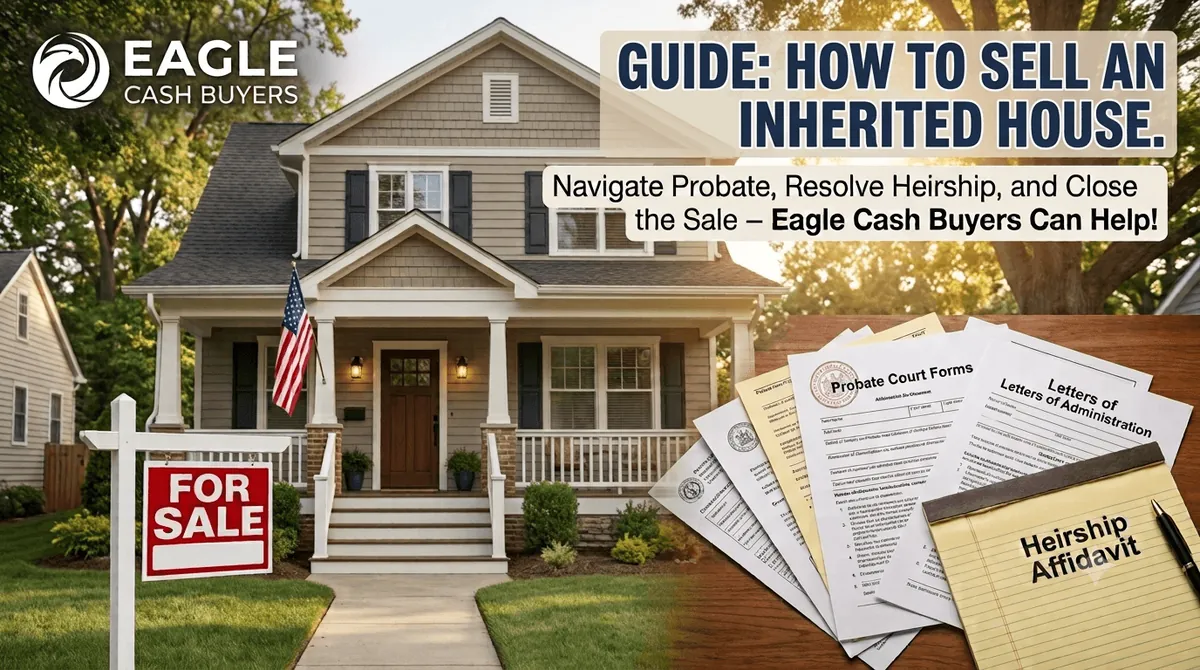
For the full path, read how to sell an inherited house.
Selling to a Cash Buyer While the Title Is Being Fixed
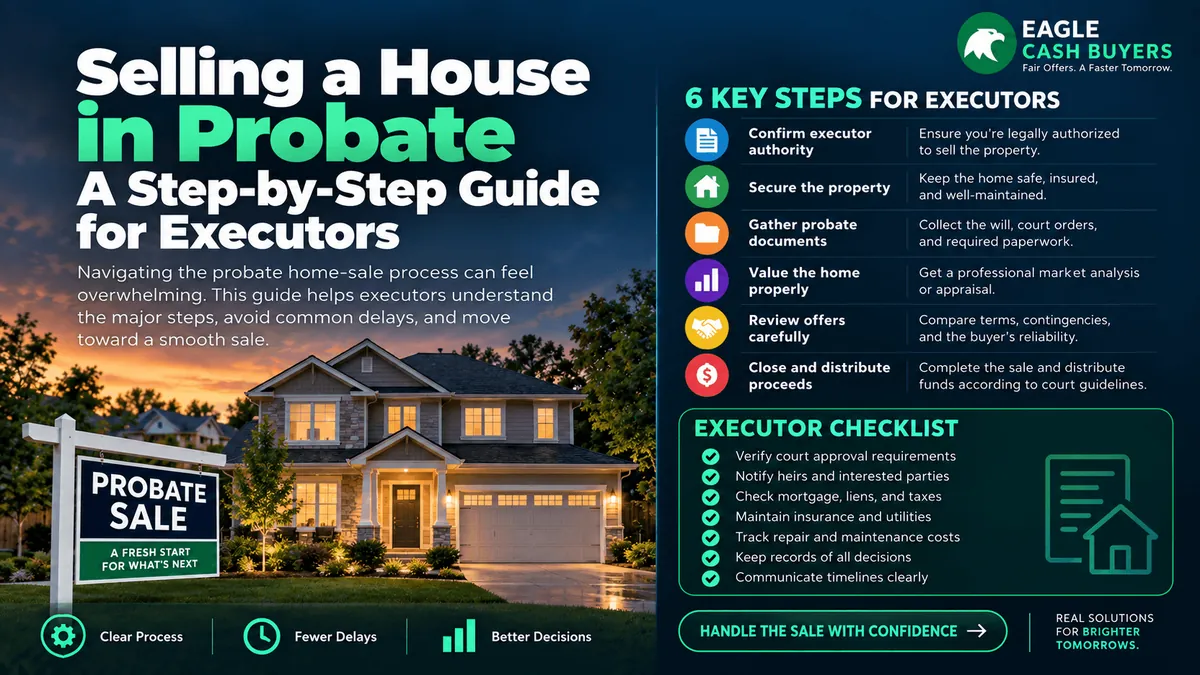
You don't have to finish the paperwork before you ask for an offer. When several heirs share the decision, this matters. At Eagle, our policy is to have everyone on the deed and every decision maker on the call when we present the offer, so they can decide together whether to move forward. If an executor is handling it, our guide to selling a house in probate walks through their side.
Know the trade-off. A cash offer is usually lower than the price a fully repaired home could reach on the open market, because the buyer takes on the repairs, the holding costs and the risk of reselling. In return you skip the repairs, the showings and the wait. If the heirs have both the time and the money to prepare the house and wait for a buyer, listing it with an agent may bring a higher price. Compare more than one written offer, or a listing agent's estimate, before the family decides.
Homeowners in 43 states can request a written cash offer from Eagle. Whether we can make an offer depends on the property, its location and its condition. See the states we buy in. An offer is only an offer. Nothing is binding until you and Eagle sign a purchase agreement. We can close in as little as 21 to 42 days once the title work has cleared, or later if you need more time. You pick the date.
Frequently Asked Questions
How long can a house be in a dead person's name?
Years. In many families it does stay that way, and the limits come from your state's estate rules and from practical problems, like a sale or refinance that can't close, more than from the deed itself. Ask a probate attorney about deadlines for the estate in your state.
Is it illegal to keep property in a deceased person's name?
The deed itself is rarely the problem. The duties around it are. California's courts, for example, say that anyone who finds an original will must deliver it to the court. The tax bill still comes due. Whether your state sets a deadline to open an estate is a question for a probate attorney there.
How do I get my deceased parent's house in my name?
Use your state's route. Depending on the estate, that may be probate, a small-estate affidavit, an heirship affidavit or a court order, but check first whether your parent recorded a transfer on death deed or held the house with survivorship rights, because then the house may have passed outside probate. If several people inherited, the recorded document usually names each of them, not just the child who handles it.
Can I sell my deceased parent's house without probate?
It depends on how title was held and your state's law. Property held in the deceased owner's name alone may require probate or another estate procedure before anyone has authority to sign a deed. Property held in a trust or with survivorship rights may pass outside probate. A probate or estate attorney licensed in your state should confirm who has authority and which procedure applies. We can evaluate the property and make an offer while that is being established, but we cannot close until someone has legal authority to sign.
For timing, see can you sell a house before probate.
Do all heirs have to sign to sell a house?
Often, yes. Everyone whose signature or authorization is required has to sign or approve the sale, and who that is depends on the route. When the heirs inherited directly, for instance through an heirship affidavit, each heir who now owns a share of the inherited property usually signs the deed. When a court has appointed a personal representative and given that person authority to sell, the representative may sign for the estate. A probate attorney can tell you which applies.
Can I live in my mom's house after she dies?
Often, for a while. It depends on her will, the other heirs and any mortgage, and living there doesn't make the home yours alone, because other heirs or beneficiaries may own a share of the estate. Tell the insurer who lives there, and talk to a probate attorney before you move in or ask anyone to move out.