
What happens when you call a cash home buyer? The first call is a short fact-finding conversation. You will be asked about the property, its condition, who owns it and your timeline. You won't sign anything and you won't commit to anything, and a careful buyer won't push you. An offer usually comes after the call, not during it.
Plenty of people hesitate before they dial, afraid of what happens once a real person is on the line. This guide walks through the first few minutes of the call, the questions you'll hear, what does not happen on it and what comes next. It is general information, not legal or financial advice.
The Five Things a First Call Covers
A first call usually covers five things, though the order varies by company. A good buyer lets you steer, answers your questions as they come up and doesn't rush you through the list.
- Hello and who you are. The buyer confirms your name and the address, and asks how you found them.
- The property. Size, age, condition, anything that needs work.
- The ownership and money side. Who is on the deed, whether there is a mortgage or any lien, and whether anyone lives there.
- Your situation. Why you are thinking of selling and when you would like to be done.
- Next steps. What the buyer needs from you, and when you will hear back.
The call takes a few minutes. Its job is to find out whether a cash sale could work for this house and these owners, so the buyer can work out a fair offer afterward.
Here is how one acquisition manager at Eagle described it to a caller: "This is really the first call... it's pretty basic. It's really more for us to find out a little bit more about the property, kind of the condition it's in and so on and so forth."
What Questions Will a Cash Buyer Ask You?
None of these is a trick. Each one feeds the offer or the closing later.
- The address. Everything starts here.
- Who owns it. Every owner on the deed matters, because every owner generally has to agree to a sale.
- Condition. Roof, heating and cooling, plumbing, foundation and anything unusual. Be honest, because surprises found later slow a sale down or change the price.
- Utilities. Whether the house uses a well or septic, which can affect what a buyer needs to check.
- Occupancy. Whether you live there, it is vacant or someone is renting it.
- The mortgage and liens. Roughly what is owed, because the payoff is paid from the sale proceeds at closing.
- Your timeline. Whether you want to move fast or need more time. You pick the closing date.
You don't need exact figures on the call. A rough balance is fine, and the title company confirms the real numbers later. For the paperwork that comes after, see our checklist of documents to sell your house for cash.
We buy houses in any condition. Whether we make an offer depends on the area, the value and whether the numbers work, not on condition.
Why Eagle Wants the Owners on the Offer Call
Real Seller Story
One call Eagle took shows why. A homeowner's husband phoned about her house. She had filled in the inquiry the day before, and he was in town running errands, so he thought he would get things started. He said she wanted him to reach out and "find out what opportunities there are out there."
The acquisition manager noticed that the inquiry was in the wife's name and the person on the phone was not her, so before discussing the property at all he asked a careful question: was she unable to take part for some reason? He explained that it was simply her house and she had asked him to make the first contact.
So the call paused. The acquisition manager wanted the owner on the line before going further, and the two agreed on a three-way call around noon, once he was home with her. It fits how Eagle works: we talk with the owner, and the owners make the decision.
This story covers only that first call. It says nothing about what happened afterward.
At Eagle, our policy is to have everyone on the deed and every decision maker on the call when we present the offer, so they can decide together whether to move forward. Other companies may handle first calls differently, and there is nothing wrong with a spouse, a relative or an attorney making the first contact. What matters is that the person with legal authority to sell is involved before anything is signed.
Can Someone Else Call on My Behalf?
Yes, anyone can start a conversation, as the husband did. But a sale needs the owner. If you hold the house with a spouse, an ex-spouse or siblings, everyone whose signature or authorization is required will generally need to take part in the sale. A person with legal authority, such as an agent under a power of attorney or an executor of an estate, may be able to act for an owner. The rules on that authority vary by state, so confirm with a local attorney before relying on it.
How Do Cash Buyers Verify Who Owns the House?
Usually the buyer asks on the call who owns the house. Later a title company or closing attorney searches the public records and confirms the owners of record before closing. If the names do not match, expect questions. That check protects you as much as the buyer.
What Does Not Happen on the First Call
This is the part that worries people most.
- You don't have to sign anything. No paperwork.
- You don't have to accept anything. No obligation.
- You are not asked for money. Eagle does not charge an upfront fee to make an offer or to buy your house. If someone offers mortgage or foreclosure help, the CFPB lists "You're asked to pay upfront for help" as a warning sign of a mortgage-related scam, and says plainly: "You don't have to pay anyone to help you avoid foreclosure." (CFPB, checked October 2026)
- You don't hand over your house. The North Carolina Department of Justice has warned about scams that use "We Buy Homes" advertising, in which homeowners are asked to "sign over control of your home" instead of completing a normal sale (checked October 2026). Anyone who asks you to sign over title on promises alone is a red flag.
Don't expect a firm offer before the buyer has enough information about the property. A fair price depends on the property, the area and the numbers. Some straightforward properties can be priced quickly. Others need photos, research or a walkthrough. A buyer who quotes a price in the first minute without knowing the house is guessing. Our guide to how cash home buyers calculate their offer shows what goes into one.
What Happens After the First Call?
A cash sale moves in a short line of steps. Here is the whole path at Eagle at a glance. Other buyers' steps are similar, but their timing varies.
| Step | What happens | What it means for you |
|---|---|---|
| 1. First call | Questions about the property and the owners | No paperwork and no obligation. The offer comes once the buyer has what it needs |
| 2. Photos or a walkthrough | Some properties need more research, photos or a visit before an offer can be finalized | You show the buyer what the house is really like |
| 3. Written offer | A written cash offer within one business day | You decide. There is no obligation to accept |
| 4. Purchase agreement | A written agreement you can read before signing. It states any right to assign the contract | Read every line. Ask an attorney if you want one |
| 5. Title work | A title company confirms ownership and clears the payoff and any liens | Title work, liens or payoffs can affect the timing |
| 6. Closing | Most sales close in 21 to 42 days, or later if you need more time. You pick the date. | The date is written in the agreement |
During business hours (Monday to Friday, 9 am to 5 pm Eastern), we can usually provide an initial offer within minutes to a few hours after receiving the necessary property information. After hours and on weekends, we can schedule a call during business hours. If you call Eagle outside those hours, a 24/7 receptionist answers the phone. Offers are made during business hours.
Eagle may buy the house itself or, if the purchase agreement permits, assign its contractual rights to another investor or purchasing entity. Any assignment right is stated in the agreement before you sign. Our how it works page covers the process in more detail, and what a cash offer on a house is explains the offer itself.
Eagle charges no fees, and the seller pays no repair costs and no closing costs. Your mortgage payoff, any liens and prorated property taxes are paid from the sale proceeds. On a standard cash offer the seller pays the transfer tax where one applies. The purchase agreement states who pays.
What Should You Ask the Buyer on the First Call?
The call goes both ways. These questions work with any company, including ours, so write them down before you dial.
| Question to ask | What a good answer sounds like |
|---|---|
| Will you buy the house yourself, or might you assign the contract? | A direct answer, and a promise that any assignment right is written in the agreement before you sign |
| Which costs will I pay, and which will you pay? | A clear list. Mortgage payoff, liens and prorated taxes come from your proceeds, and the agreement says who pays the transfer tax |
| Who will handle the closing, and when will I get their contact details? | A licensed title or escrow company, or a closing attorney depending on the state, whose details you can check yourself |
| Can I choose the closing date, and will it be in writing? | Yes. You choose the date and it is written in the agreement. Title work, liens or payoffs can affect the timing |
| Do I owe anything if I don't accept your offer? | No. There is no obligation to accept |
For a closer look at red flags, read our guide to whether "we buy houses" companies are legit. A buyer who dodges these questions has told you something.
How Do You Protect Yourself After the Call?
Scammers don't only work on the first call. They also pose as title or closing contacts later, and they send fake wiring instructions by email. The CFPB's advice is short: "Never follow instructions contained in an email." (CFPB, checked October 2026) Confirm any wiring or payment instructions with a person you already trust, using a phone number you looked up yourself, not one from the email.
Questions People Ask About the First Call
Am I committing to anything by calling a cash home buyer?
No. A first call is a conversation. You don't sign, you don't pay and you aren't bound to accept an offer. If a company asks for a signature or a payment before you have seen a written offer and a written agreement, walk away.
Will I get an offer on the first call?
Usually not a firm one. A buyer needs the property details first. At Eagle, you can usually expect an initial offer within minutes to a few hours during business hours, and a written cash offer within one business day. Some properties need more research, photos or a walkthrough before the offer can be finalized.
Is selling a house for cash a good idea?
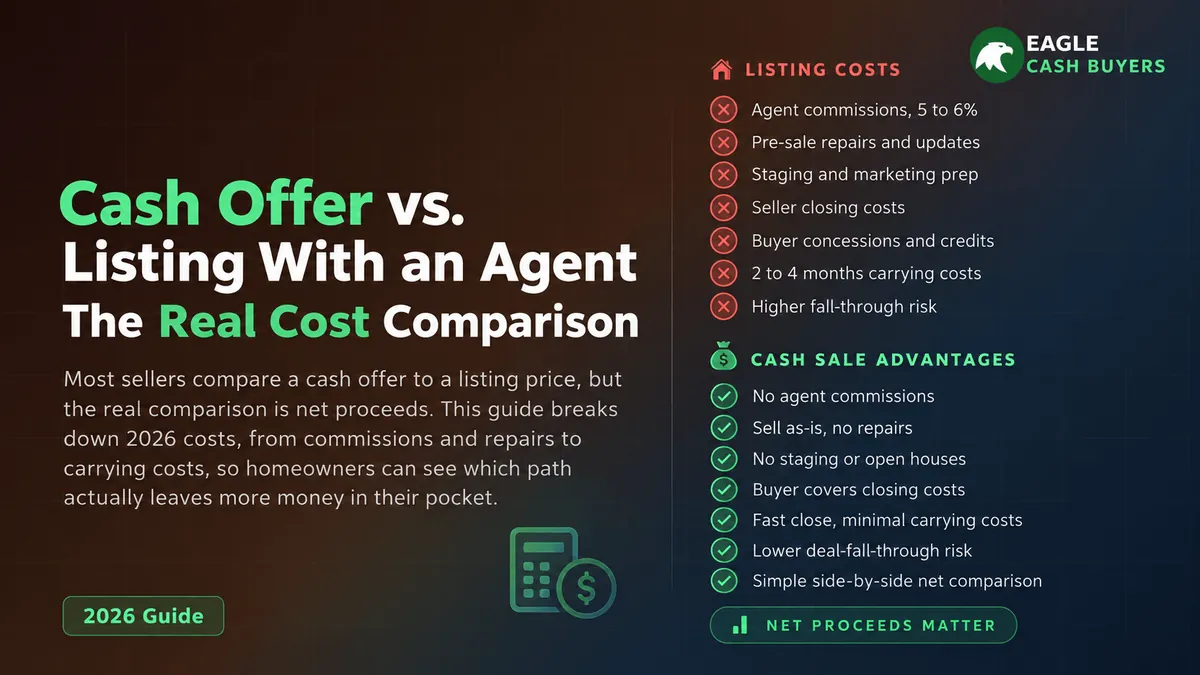
It depends on what you need. A cash sale is built for speed, fewer financing hurdles and selling without repairs. A cash offer is usually lower than the price a fully repaired home could reach on the open market, because the buyer takes on the repairs, the holding costs and the risk of reselling. Listing with an agent can net more. An agent's commission is usually between 5% and 6% of the sale price; it is negotiable and depends on the agent. If the house is in good shape and you can wait for a buyer, listing is often the better choice. If you are short on time or money, or the house needs work, a cash offer may fit better. Our guide to how to sell your house fast for cash lays out the choices.
What are the risks of a cash offer on a house?
The main ones are a price below market, a buyer who is not who they say they are and fine print you did not read. To reduce them, get more than one offer, read the full agreement from the first line to the last, and check the buyer's reviews and BBB profile before you sign anything or share financial details. Eagle is rated A+ by the BBB. Eagle is not a lender and does not lend money to home sellers. We are also not attorneys, so ask a loan officer or an attorney about loan and legal questions.